
|
Getting your Trinity Audio player ready...
|
Even by the standards of an institution that has set records for dysfunction in recent years, the Republican-led Congress in 2025 hit new lows for productivity.
Plagued by a razor-thin majority, intraparty divisions and a fear of doing anything that might draw President Donald Trump’s ire, Speaker Mike Johnson toiled to keep the House running.
He left the chamber out of session for a nearly eight-week period that coincided with the longest government shutdown in history. He maneuvered to avoid politically difficult votes on canceling Trump’s tariffs, releasing the Epstein files and extending health care subsidies, ultimately prompting his own rank-and-file to team with Democrats to go around him and force action. And he presided over a free-for-all of censures and reprimands on the House floor as lawmakers’ frustrations boiled over.

Fed up with the toxicity and inertia, some Republicans — including once-loyal Trump allies like Rep. Marjorie Taylor Greene of Georgia — headed for the exits, diminishing the majority’s already thin voting margin.
A look at some key metrics illustrates the cost and scale of the dysfunction.
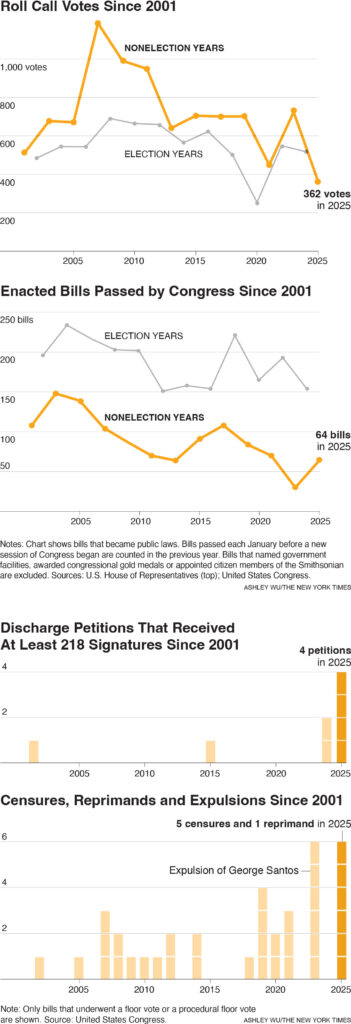
The most basic: House members cast 362 votes in 2025, the second-lowest count in the last quarter century. The only other year in that time frame when the House cast fewer votes was 2020, when the COVID-19 pandemic hit the United States.
That was also the fewest votes cast in a nonelection year since 1990. Congressional leaders typically schedule less time in session in Washington during election years to allow lawmakers to return to their districts more frequently to campaign.
The record-low levels of activity in the House in 2025 contributed to the fact that very few bills were enacted into law.
The only other year since 2001 that Congress enacted fewer bills was 2023, a time of so much turbulence that far-right Republicans ousted their own speaker, Kevin McCarthy, for working with Democrats to pass spending legislation.
Lack of Productivity
The lack of productivity that year could also be attributed to divided government: Republicans controlled the House, Democrats controlled the Senate and President Joe Biden was running for reelection. But in 2025, Republicans had a governing trifecta in Washington, controlling both chambers of Congress and the White House.
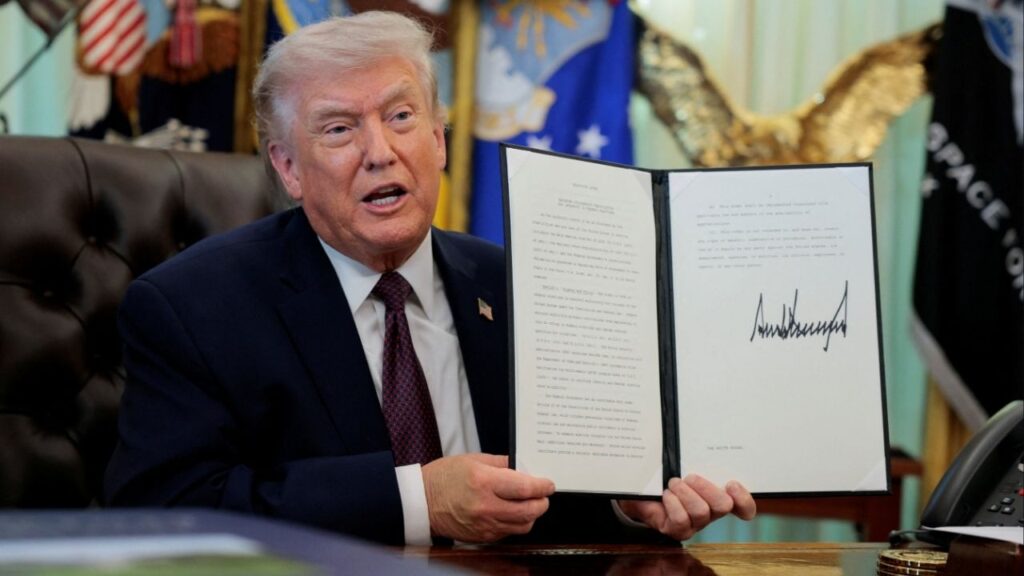
While Congress moved uncharacteristically quickly to meet Trump’s demand that it deliver his tax cut and domestic policy law, Johnson labored to quash measures the president opposed. He even resorted repeatedly to an arcane maneuver to ensure the House would not be forced to vote on a measure to cancel his tariffs.
It was one example of how, under Johnson, the House marginalized itself last year, as Congress more broadly ceded its power to Trump.
The speaker also attempted to avoid votes on other measures the president opposed, including legislation to compel the Justice Department to disclose materials regarding Jeffrey Epstein, the convicted sex offender who died in prison in 2019; and a bipartisan bill to extend health care subsidies that expired at the end of 2025.
That generated so much resistance in his own ranks that it fueled a record number of successful efforts to go around Johnson and force legislation to the floor. That can be done by way of what is known as a discharge petition, which circumvents the normal process for bringing up a bill, which is controlled by the speaker, if a majority of House members sign a petition demanding it.
Historically, members of the majority were reluctant to embarrass their party’s leaders by using a discharge petition, and lawmakers feared retaliation for publicly supporting efforts to subvert the speaker. The efforts were viewed more as public statements of discontent than viable legislative vehicles. But in 2025, several succeeded and led to concrete action.
The Epstein measure was enacted last fall, and the House this month passed a bill to restore the health subsidies, though it has an uphill road to enactment in an election year.
As it has spun its wheels on legislation, the House has increasingly been consumed by partisan measures aimed at scolding and punishing each other. Official rebukes, once exceedingly rare and mostly reserved for egregious conduct or illegal acts, have become commonplace. Six of them came to the floor in 2025 for six different members.
That number was on par with 2023, when members targeted four lawmakers, including George Santos, whom they expelled from Congress as he faced 23 federal criminal charges and was discovered to have lied to voters about much of his biography.
—
This article originally appeared in The New York Times.
By Minho Kim and Ashley Wu
c. 2026 The New York Times Company