
|
Getting your Trinity Audio player ready...
|
WASHINGTON — House Republicans on Wednesday advanced a watered-down bill that would impose some restrictions on lawmakers who trade stock, a move that Democrats said only blunted momentum for a more stringent ban with bipartisan support that they were seeking to bring to the floor.
The Stop Insider Trading Act, which is backed by Speaker Mike Johnson, would require new restrictions on stocks for lawmakers and their family members.
It would bar lawmakers from buying individual stocks. But it would allow members of Congress to keep their existing stock and continue to sell it if they provide seven to 14 days of notice. It would also allow them to reinvest dividends in new stocks, and let spouses and other family members trade freely on behalf of a lawmaker.

Democrats Believe loopholes Undermine the Ban
Taken together, Democrats said, the loopholes undermined the premise of a ban on congressional stock trading, which has overwhelming bipartisan support among voters who view the practice with great suspicion.
“This bill is a political scam,” Rep. Norma Torres, D-Calif., said during a Wednesday morning hearing where the bill cleared committee, a step toward receiving a full vote on the House floor. “It is Republicans pretending to care about corruption while creating wealth for themselves.”
Torres said the legislation was “a gift to insider traders, disguised as ethics reform.”
And Rep. Joseph D. Morelle, D-N.Y., said the bill included “a loophole so big, you could fly a Qatari jet right through it.”
Rep. Bryan Steil, R-Wis., the chair of the House Administration Committee, framed the legislation as an important step.
“No member of Congress should be profiting off of insider information,” said Steil, who sponsored the legislation. “If you want to trade stocks, go to Wall Street.”
But he said it was important to make Congress inviting to people who had successful careers before choosing one in public service. He added that waiting to pass something more restrictive would be asking “perfection to be the enemy of the good.”
Democrats, however, said the proposal was not even a half-measure: It was worse than doing nothing at all.
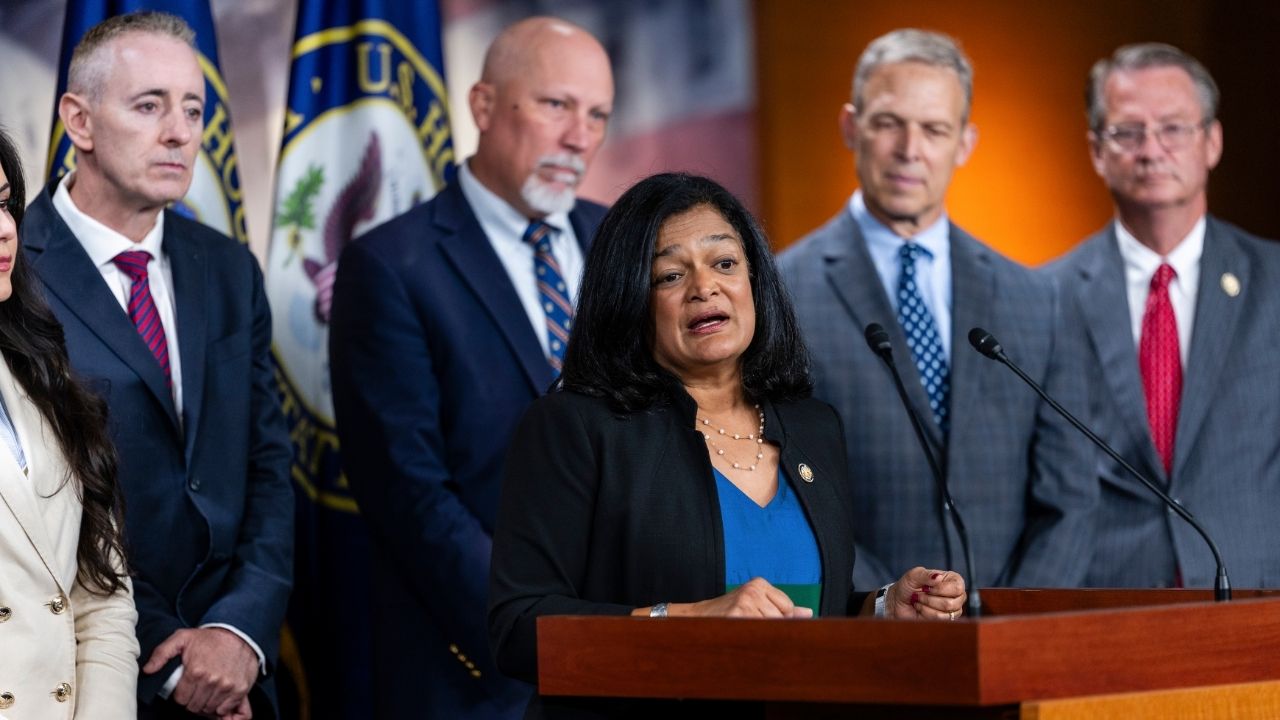
Before the hearing, two House Democrats held a news conference outside the hearing room and declared that the legislation that was being pushed by Republican leadership was actually intended to protect wealthy lawmakers.
“They’ve taken the concept of a stock trading ban but completely eradicated it with this bill,” said Rep. Pramila Jayapal, a Washington state Democrat who has been involved in negotiating bipartisan legislation on the issue. “Mike Johnson is trying to co-opt the language of a stock-trading ban and substitute something that is completely not a stock-trading ban.”
Jayapal noted that some of the most eyebrow-raising trades by lawmakers would be allowed to continue under the new bill.
She singled out Rep. Rob Bresnahan, R-Pa., who had dumped millions of dollars in the stock of companies that managed Medicaid enrollees before voting to cut Medicaid. The Johnson-backed legislation would allow members to continue to own stock in companies while members voted on bills that affected the share values of those companies.
“Speaker Johnson doesn’t have the courage to ban members of Congress from owning and trading stocks,” said Rep. Seth Magaziner, D-R.I., one of the lead sponsors of the bipartisan stock ban bill.
Barring lawmakers from trading stock has over the years attracted an unusual coalition that includes hard-right members such as Rep. Chip Roy, R-Texas, and progressive members such as Rep. Alexandria Ocasio-Cortez, D-N.Y. The practice has helped sour voters on their representatives in Washington and erode their trust in government, and pushing for a ban has helped lawmakers in both parties tap into a populist current.
Democrats Also Struggled to Reach Consensus
When Democrats held a majority in the past, they also struggled to reach any consensus on legislation to ban congressional stock trading. Former House Speaker Nancy Pelosi, whose husband is a prolific stock trader, was resistant to a ban before realizing she was on the wrong side of the issue, politically.
Rep. Hakeem Jeffries, D-N.Y., the minority leader, has promised to bring the bipartisan bill to the floor if Democrats regain control of the House.
Magaziner said that even among Republicans he had been working with, there was disappointment about the legislation that advanced Wednesday. “We were all hoping for and expecting an actual ban on members of Congress owning and trading stocks,” he said. “There’s disappointment on both sides of the aisle that Republican leadership is putting forward something that is not that.”
For months, a bipartisan group of lawmakers has been working to reconcile several congressional proposals to ban stock trading into one bill that has a chance of passage.
They have settled on the Restore Trust in Congress Act, which would prohibit members of Congress from owning individual stocks, with some exceptions, and from trading individual stocks. The ban would also apply to immediate family members, unless spouses are trading in connection with their primary employment. Lawmakers are also seeking to expand the legislation to include a prohibition on trading by the president and vice president.
Now, the group is racing against Johnson to see who can rush a bill to the floor first.
The bipartisan group of lawmakers plans to introduce a discharge petition Monday, a move that would force a floor vote on its bill if 218 members sign on. Magaziner said that there was enough bipartisan support for the issue and that he expected to be able to circumvent Johnson and force a vote on the floor.
Democrats are planning to start their own petition next week that would also allow them to include a provision applying to the president and the vice president.
On Wednesday, Democrats tried to attach an amendment to the Republican-backed bill that would include the president and the vice president in any legislation that restricted trades.
But Rep. Mary Miller, R-Ill., immediately dismissed the effort as an attempt to insert a “poison pill” into the legislation.
And Steil said that such an amendment would ultimately “derail the underlying bill.”
The amendment failed.
—
This article originally appeared in The New York Times.
By Annie Karni/Eric LEE
c. 2026 The New York Times Company