

|
Getting your Trinity Audio player ready...
|
This story was originally published by CalMatters. Sign up for their newsletters.

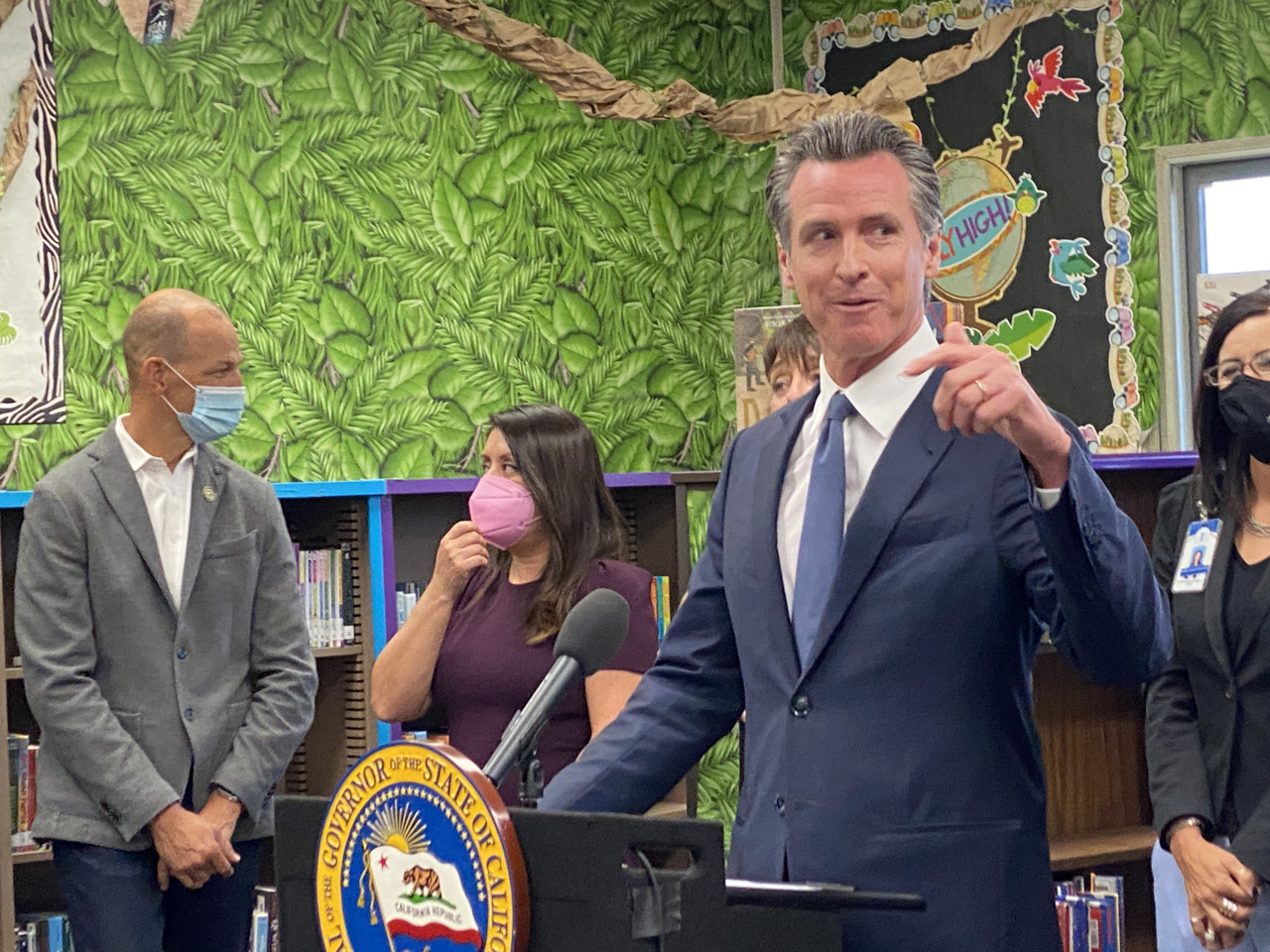
Gov. Gavin Newsom on Thursday proposed paring down the responsibilities of California’s elected State Superintendent of Public Instruction and shifting more power to the State Board of Education.
“California can no longer postpone reforms that have been recommended regularly for a century,” Newsom said, referring to numerous reports over the years that have suggested streamlining the state’s system of K-12 school governance.
“These critical reforms will bring greater accountability, clarity and coherence to how we serve our students and schools,” Newsom said.
The move is intended to simplify California’s convoluted education governance, which policy analysts have said can be inefficient, redundant and sometimes at cross purposes.
The Proposal
Under his proposal, the State Board of Education, an 11-member body appointed by the governor, would take over the California Department of Education. The State Superintendent of Public Instruction would have broader responsibility to “foster coordination and alignment of state education policies from early childhood through post secondary education.” The proposal didn’t offer further details.
For more than a century, the state’s public K-12 schools have been governed by a web of authorities, both locally and at the state level. In Sacramento, the governor, state superintendent, State Board of Education and the Legislature all share policy-making duties, which may shift every few years depending on the political winds. The Department of Education, under the direction of the state superintendent, is supposed to carry out those policies.
Locally, school boards and county offices of education also hold power over schools, especially since the state switched to a funding system about a decade ago that gives more flexibility to school districts. County offices, among other duties, are charged with overseeing school district budgets.
California One of Nine States With Elected Schools Chief
California has a somewhat unique system of school governance. It’s one of only nine states that elects a schools chief. In other states, the top schools officer is appointed by the governor or the board of education, according to research by Education Commission of the States.
Newsom’s proposal echoes a December report by Policy Analysis for California Education which called for an overhaul of the state’s school governance structure.
“The need for stronger, more coherent governance has never been greater. Schools are grappling with fiscal challenges alongside deepening inequities, persistent opportunity gaps, and the lasting impacts of the COVID-19 pandemic on student learning and well-being,” the report’s authors wrote.
The issue is especially urgent, they said, as the federal government reels back its involvement in K-12 schools. President Donald Trump is in the process of shuttering the federal Department of Education, spinning off its duties to the states and other federal agencies. Federal education funding is also increasingly precarious, giving states more direct responsibility for educating children.
The PACE authors suggested several solutions, including the proposal that Newsom put forth. Under the PACE recommendation, the Department of Education would be run by an administrator appointed by the State Board of Education, and the superintendent would act as an independent advocate, with an eye on accountability. Most of the power and responsibility for schools would lie with the governor.
Previous Proposals
This is not the first time the issue has arisen. Several ballot measures over the years — none successful — have sought to change the role of the state superintendent. In 2023, ACA 9, by former Assemblyman Kevin McCarty, a Democrat from Sacramento, would have made the position appointed by the governor. McCarty withdrew it amid opposition from the California Teachers Association, the California School Boards Association and other groups.
In his proposal, Newsom cited other previous reports recommending changes to state schools governance, including one from 2002 and another from 1920.
The state’s current superintendent, Tony Thurmond, is winding down his second term. During his tenure, the department has expanded literacy efforts, community schools, student wellness programs and other initiatives. He’s also faced criticism for working side jobs and creating a “toxic workplace.”
Thurmond, who terms out in 2026, is running for governor.
Education Advocates Back Newsom’s Plan
Newsom’s proposal has backing from a wide array of education players, including the Association of California School Administrators, California Association of School Business Officials, Californians Together, which advocates for English learners, and EdTrust-West, a research and advocacy organization focused on equity.
”For far too long, California’s fractured education governance system has contributed to persistent inequities disproportionately impacting low-income students, students of color and multilingual learners,” said Christopher Nellum, executive director of EdTrust-West. “EdTrust-West commends Governor Newsom for championing these essential reforms.”
This article was originally published on CalMatters and was republished under the Creative Commons Attribution-NonCommercial-NoDerivatives license.