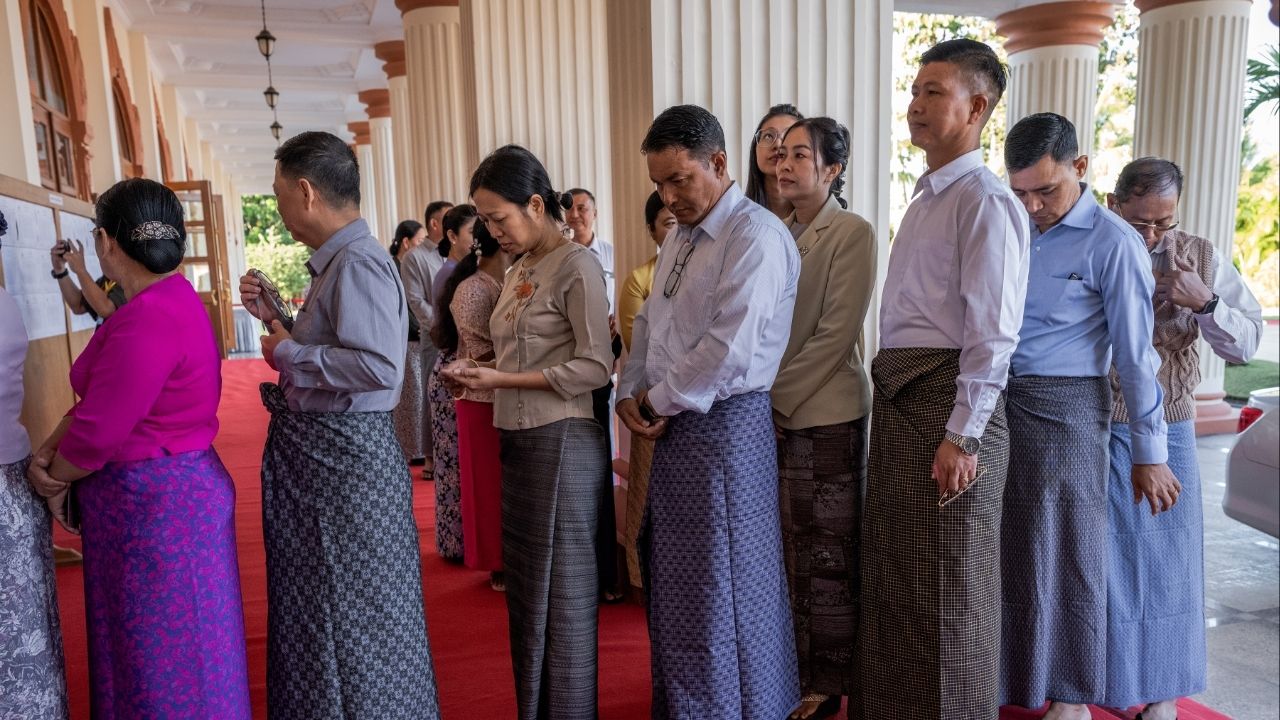
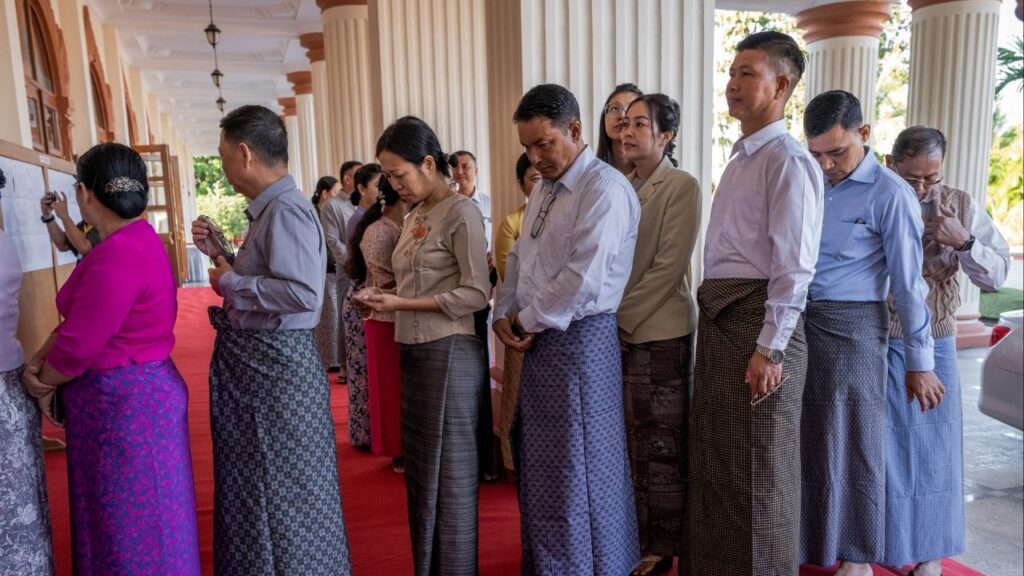
Military officers and family members lining up to vote in a military zone in Naypyidaw, Myanmar, on Sunday, Dec. 28, 2025. The voting for Parliament is almost sure to favor the ruling military junta, which is stage-managing the polls. Still, some see them as the most pragmatic way to try to improve conditions. (Daniel Berehulak/The New York Times)

Share
|
Getting your Trinity Audio player ready...
|
YANGON, Myanmar — As voters went to the polls Sunday for the first round of a heavily stage-managed election in Myanmar, the outcome was all but assured. The military junta that has ruled the country since seizing power in 2021 was almost certain to maintain its iron grip on power.
Some still hoped there was room for change.
“We have to do something,” said Nant Khin Aye Oo, chair of the Kayin People’s Party, one of the few parties that was not barred from fielding candidates. “We can’t live under this anymore.”
But turnout even in the country’s biggest cities, Yangon and Mandalay, appeared far lighter than it had been in the 2020 and 2015 elections, reflecting a more pessimistic mood.
“I don’t believe this election will really change things, but I came anyway to avoid trouble,” said Sandy Chit, 34, a cosmetics seller in Mandalay. “Many people here are voting out of fear, not hope.”
The military has governed Myanmar for most of its history since gaining independence from Britain in 1948. For about a decade starting in 2010, the country was seen as an exemplar for democracy after the military handed some power to a civilian government led by Aung San Suu Kyi, who had long been the beloved opposition leader.
That ended in 2021 when the army announced that it would not recognize the 2020 election victory by Suu Kyi’s party.
For the junta, the elections are in part to placate neighboring China, which has pressured it to hold the polls as a way out of a four-year civil war. The military — now estimated to control less than half of the country — also hopes that the elections to determine the next parliament will create an air of legitimacy that may give other countries an opening to embrace what is now largely a pariah state.
With the vote taking place on three separate days over the next few weeks, it will be hard to draw quick conclusions. Ballots will be cast only in the areas under military control. Results are not expected until after the final day of voting on Jan. 25.
In Naypyidaw, the capital, Senior Gen. Min Aung Hlaing, who led the 2021 coup, emerged grinning from the polling station, showing off his left pinkie dyed purple as a sign of having voted.
—
This article originally appeared in The New York Times.
By Sui-Lee Wee/Daniel Berehulak
c. 2025 The New York Times Company
RELATED TOPICS:
Categories


Police Activity Shuts Section of Highway 59 in Merced County

Surge of Economic Pain Pushes Iranians to the Streets