
|
Getting your Trinity Audio player ready...
|
BRUSSELS — In an era of chaos coming from the White House, European Union lawmakers decided Thursday to find stability where they could — or at least where they hoped they could.
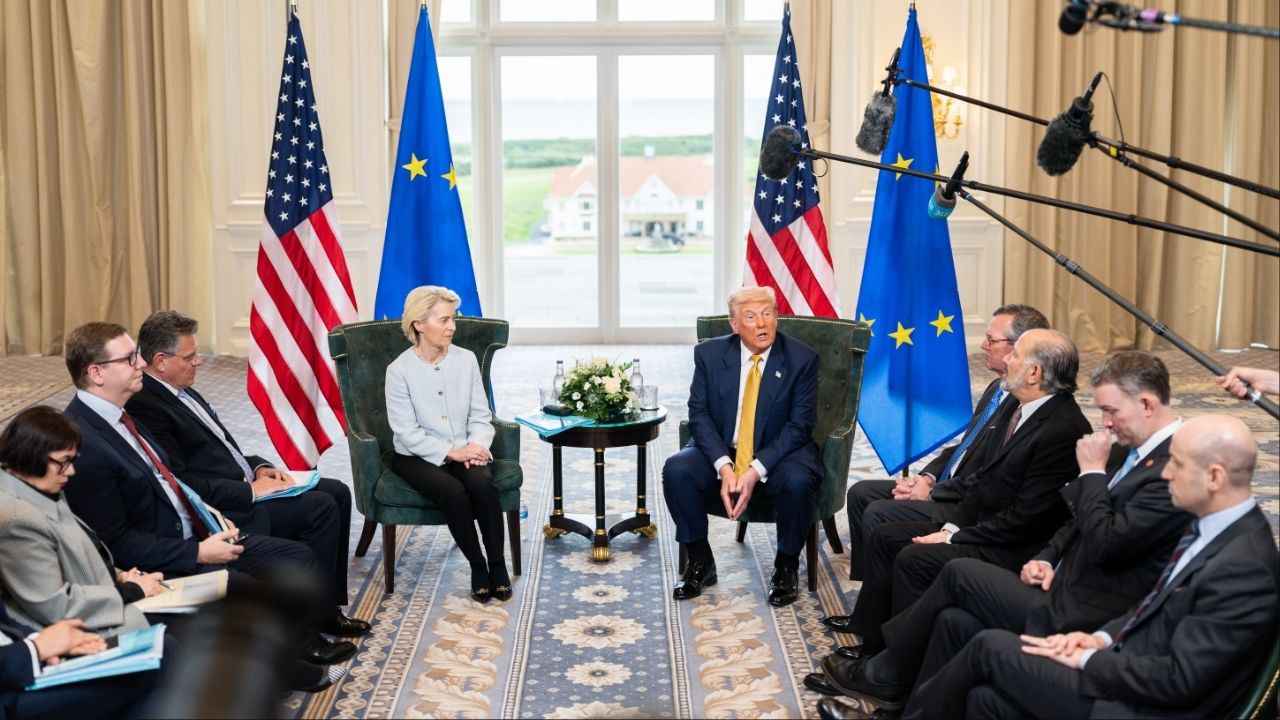
The European Parliament signed off on major provisions of the trade deal that the United States and the bloc struck last year at President Donald Trump’s golf course in Turnberry, Scotland. The decision came after months of wrangling, and despite big concerns on the part of many European lawmakers that the United States was no longer a reliable partner.
Here’s what to know.

What Took so Long?
The European Union rarely moves quickly, but this process was especially slow. Progress toward enacting the EU side of the trade agreement has been paused repeatedly. Lawmakers first put the deal on ice when Trump threatened to take over Greenland, which is an autonomous territory of Denmark, an EU member. Then they took a break when the Supreme Court said Trump’s across-the-board tariffs were unconstitutional, and it was unclear how the Trump administration would react to that.
What Did European Parliament Vote on, Exactly?
The European Parliament agreed Thursday that the bloc would eliminate tariffs on U.S. industrial goods — including machine parts, equipment and raw materials — and some agricultural products. This was a major part of the trade agreement the Europeans struck with the Trump administration last year.
Still, lawmakers remain wary that Trump could go back on the U.S. part of the deal, which would keep tariffs on most EU goods at 15%.
Bernd Lange, who is the head of the committee in European Parliament that worked on finalizing the trade deal, said Thursday that the Parliament’s version included a new stipulation that the deal would reverse if the Trump administration reneged and put new tariffs on the European Union.
In short, the European Parliament has tried to add clauses to Trump-proof the deal.
“Some of the elements are really important,” Lange said. “It’s the job of the European Union to defend European interests.”
What Happens Next?
Negotiations will start with member states and the European Union’s executive arm in mid-April, and then ambassadors from across the 27-nation bloc must choose whether to approve the deal. It is widely expected to make it through those remaining steps — clearing the European Parliament was the big hurdle.
“We’re close to the end zone,” said Jacob Funk Kirkegaard, a senior fellow at Bruegel, an economic think tank in Brussels.
He added, though, that the new Trump-proofing clauses would likely be dropped because the administration would probably not accept them. The European Parliament included them, he said, as political cover.
“It’s realpolitik, and it’s sausage making,” he said.
How Is the White House Likely to React?
The Trump administration welcomed the vote.
“You made the right decision for citizens on both sides of the Atlantic,” Andrew Puzder, the U.S. ambassador to the European Union, wrote on social media following the announcement.
Some businesses also reacted happily, welcoming the decision as a step toward restoring calm after a year of upheaval.
Mark Titterington, director general of Spirits Europe, an alcohol industry group, made a statement calling the decision a “responsible action to restore stability in trans-Atlantic trade.”
—
This article originally appeared in The New York Times.
By Jeanna Smialek/Tierney L. Cross
c. 2026 The New York Times Company