
|
Getting your Trinity Audio player ready...
|
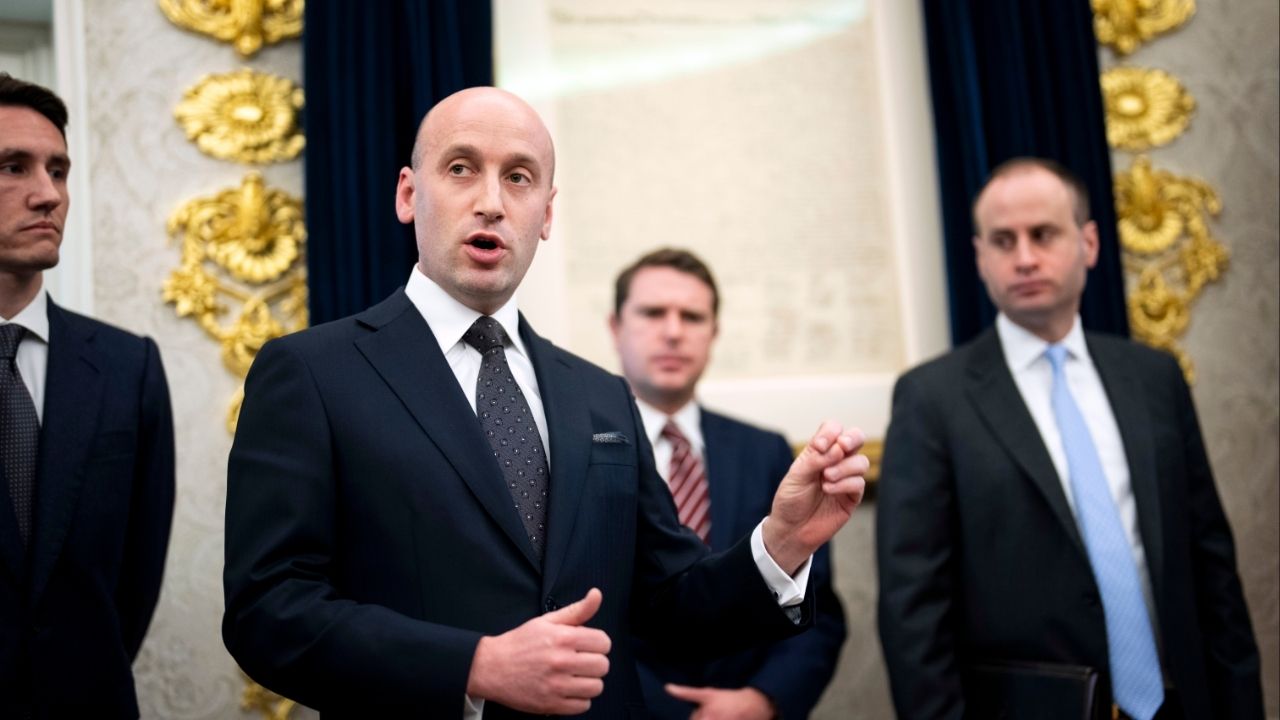
HOUSTON — Stephen Miller raised the idea of ending public education funding for children lacking legal status in a closed-door meeting with Texas lawmakers in Washington last week, a move that would challenge a decades-old U.S. Supreme Court precedent, according to two people who were in the meeting.
Miller, President Donald Trump’s hard-line immigration adviser, cited gridlock in Congress as he encouraged the state lawmakers to pass conservative legislation on immigration and other issues that are crucial to Republicans, hoping such action would spur on other red states and federal lawmakers.
Republicans have been bracing for the possible loss of control in the U.S. House after the 2026 midterm elections, elevating the importance of state legislatures to the Trump administration as it looks to push its agenda on health, immigration and the economy.

“He sees conservative states like Texas and Florida can be partners with the federal government,” state Rep. Tom Oliverson, chair of the Texas House Republican Caucus, said in an interview Monday. “We can be a place where some of those ideas can be tried out because they’re difficult to do at the federal level.”
On immigration, Miller asked why the Republican-dominated Texas Legislature had not passed a bill last year that would have funded public education only for children who are citizens or “lawfully present in the United States.” Doing so would break with the Supreme Court precedent set in Plyler v. Doe, a 1982 decision that determined that states must pay for the elementary school education of all students regardless of immigration status.
“There’s a lot of people that believe that that ruling has some pretty faulty logic associated with it,” Oliverson said.
Ending public school funding for students lacking legal status in Texas would be a major reversal that could be replicated by other red states with large immigrant communities. While federal law bars collecting of immigration data about children in schools, studies in Texas have estimated the number at more than 100,000 students, out of more than 5.5 million schoolchildren in the state.
State Rep. Ramon Romero, a Democrat who chairs the Mexican American Legislative Caucus, said that the meeting appeared to be part of an “effort from the White House to pressure lawmakers into passing extreme immigration policies that don’t reflect the needs of our state.”
“Texas is strong because of our people, especially our young and growing Latino population,” Romero said. “The Latino communities most impacted by these decisions will remember exactly who is behind them.”
In recent years, Gov. Greg Abbott of Texas has expressed support for challenging the precedent set by Plyler, which originated in Texas. In a statement Monday, a spokesperson for Abbott reiterated that stance.
“American citizens should be first in line for government services and not forced to bear the costs of supporting those whose entry into this country began with breaking its laws,” the spokesperson, Andrew Mahaleris, said. “The governor works daily to end unjust policies like this.”
The White House did not immediately respond to a request for comment about the meeting.
The discussion of the Plyler case, which was first reported by the conservative website Current Revolt, was part of a more than four-hour meeting that also included presentations by Health Secretary Robert F. Kennedy Jr., Commerce Secretary Howard Lutnick and Housing Secretary Scott Turner, Oliverson said.
Oliverson said he did not see Miller’s question about school funding for students lacking legal status as a directive, but as part of a broader policymaking discussion.
“He challenged us, and he encouraged us, and he asked us to partner with him,” Oliverson said.
That portion of the meeting started off awkwardly, he said, with Miller asking, “do we have a RINO problem in Texas?” using an acronym for “Republican in name only” that is used by conservatives to disparage party moderates.
“There was no answer — it was just uncomfortable silence,” Oliverson said.
Republicans dominate both chambers of the Legislature and hold all statewide elected positions in Texas. But Miller’s RINO remark landed awkwardly with the Republican attendees who have dealt with years of infighting between the party leadership and a small group of conservative hard-liners.
Asked if he thought Republicans in Texas had a problem with too many moderates in their midst, Oliverson said all Republicans believe that they are far enough to the right.
“Everyone to the left of them is a RINO,” he added. “And everyone to the right of them is crazy.”
—
This article originally appeared in The New York Times.
By Lauren McGaughy/Doug Mills
c. 2026 The New York Times Company