

|
Getting your Trinity Audio player ready...
|
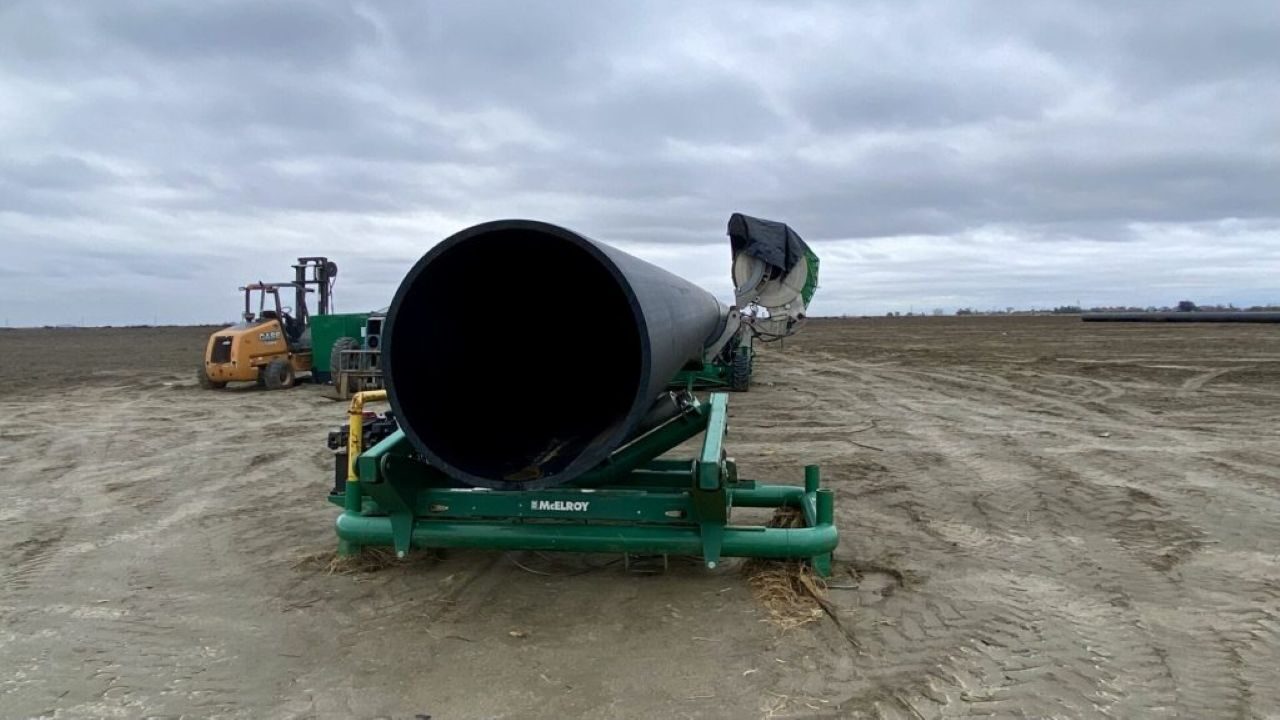
A massive pipeline that could move water from north of Lemoore south to Stratford — and beyond — in Kings County is still stuck in its tracks as the region’s largest growers continue to duke it out in court.

By Monserrat Solis
SJV Water
The pipeline, owned by Sandridge Partners, which is controlled by John Vidovich, began construction in late 2021. The 48-inch line piqued a great deal of speculation and generated both headlines and lawsuits after area farmers first noticed it being built.
But it was stopped cold at a canal owned by the Tulare Lake Canal Company in early 2022. That canal company is controlled by the J. G. Boswell Company, which parked heavy equipment on the canal banks that stymied further trenching.

A flurry of legal complaints by both sides quickly followed.
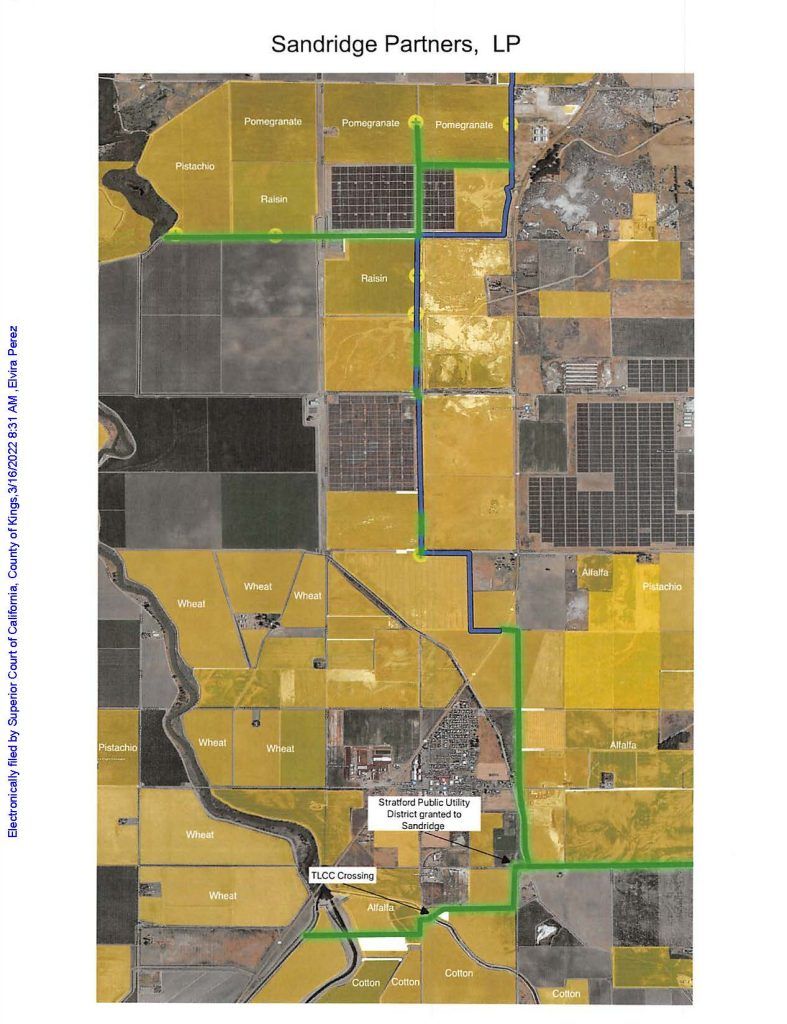
The legal actions eventually engulfed the Stratford Public Utilities District as the utility had granted Sandridge an easement over its land in exchange for an informal agreement that the 48-line may take Stratford’s wastewater.
Court Battle Highlights
A Kings County Superior Court agreed that an environmental report was required to study the impacts of the pipeline. After it was completed, though, Tulare Lake Canal Company sued under the California Environmental Quality Act saying the report was insufficient.
The other lawsuits between Sandridge and Tulare Lake Canal Company were settled through arbitration in March 2025. A negotiated agreement laid out the conditions under which Sandridge could restart pipeline construction and how the line would operate once complete. The canal company first required that the environmental impact report be completed.
The EIR was done, and Sandridge tried to broach the canal company with a “common use agreement” but says it was ignored, according to Sandridge’s motion to compel arbitration filed in October 2025.
Meanwhile, Tulare Lake Canal Company sought and won a preliminary injunction in its CEQA case, keeping the pipeline in limbo.
On Jan. 20, a Kings County denied Sandridge’s motion to lift the injunction and force Tulare Lake Canal Company back into arbitration, saying those issues are under the CEQA case and not subject to the settlement agreement regarding installation and operation of the pipeline.
Sandridge has since submitted another motion on the issue, according to Sandridge attorney Marshall Whitney.
“It is plain that J.G. Boswell-controlled entities are determined to do what they can to interfere with Sandridge’s internal irrigation system which is principally intended to replace wasteful open ditch water delivery with underground pipelines,” Whitney wrote in an email.
Leonard Herr, who represents Tulare Lake Canal Company, did not respond to requests for comment.
The Real Issue Is Water
Though these legal maneuvers are ostensibly about a pipeline, the real issue is water, where it’s coming from and where Sandridge plans to take it.
That was made clear early on.
During a Feb. 2022 hearing, Attorney Herr repeatedly asked what water would be moved in the pipeline and where it would end up. Questions Whitney said were irrelevant.
“Where my client plans to use the water has no bearing,” he said during the hearing.
Vidovich previously told SJV Water that the pipeline is an effort to conserve water as moving it in open ditches is wasteful. But he also declined to state whether he anticipated moving river water, imported state or federal water, or groundwater.
In recent months, Sandridge has threatened to sue the South Fork Groundwater Sustainability Agency for its policy to only allow native groundwater to be moved within one mile of South Fork’s boundaries.
“Sandridge has the largest amount of land and well waters in the South Fork GSA,” a letter from Sandridge to South Fork GSA states. “These lands were purchased so that Sandridge could legally pump water to its crops in the adjoining Basin South West.”
South Fork’s boundaries encompass the path of the Sandridge pipeline.
About the Reporter
Monserrat Solis covers Kings County water issues for SJV Water through the California Local News Fellowship Initiative.
About SJV Water
SJV Water is an independent, nonprofit news site covering water in the San Joaquin Valley, www.sjvwater.org. Email us at sjvwater@sjvwater.org