

|
Getting your Trinity Audio player ready...
|
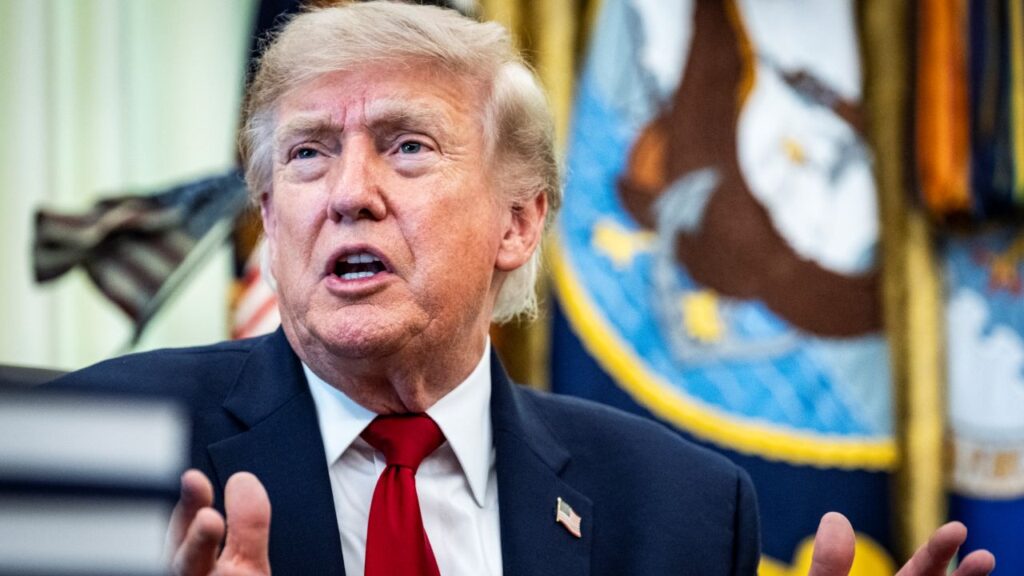
WASHINGTON — Defense Secretary Pete Hegseth said on Friday that the day would be the most intense and lethal of the U.S. air campaign in Iran so far, even as President Donald Trump sends conflicting signals on when the war might end.
“Never before has a modern capable military, which Iran used to have, been so quickly destroyed and been made combat ineffective,” Hegseth said at a morning news conference.
Gen. Dan Caine, the chair of the Joint Chiefs of Staff, echoed those remarks during the press briefing, saying, “Today will be our heaviest day of kinetic fires across the operating area.”

The increased pace of the attacks, in part, reflects the success of the U.S. and Israeli militaries at hitting Iran’s air defense systems. The strikes have allowed the two militaries to fly attack aircraft over Iran, dropping many relatively cheap precision-guided bombs and lessening the reliance on more expensive long-range missiles.
Hegseth said that long-range munitions now account for only about 1% of the ordnance fired, a major shift since the beginning of the campaign.
The increased intensity also reflects the overall strategy, which is to destroy Iran’s ability to project force and to ratchet up the pain on Iranian leadership, hoping that it will capitulate to U.S. demands.
“With every passing hour, we know, and we know they know, that the military capabilities of their evil regime are crumbling,” Hegseth said. “They can barely communicate, let alone coordinate. They’re confused, and they know it. Our response? We will keep pressing, we will keep pushing, keep advancing. No quarter, no mercy for our enemies.”
There is little indication that the Iranian government’s resolve is cracking with the war nearing the two-week mark.
Oil Prices Surge
As oil prices surged earlier this week, Trump suggested that the war could end “soon, very soon.” Since then, he and Hegseth have struck a more belligerent tone.
“We are totally destroying the terrorist regime of Iran, economically and otherwise,” the president wrote on social media early Friday. “Iran’s Navy is gone, their Air Force is no longer, missiles, drones and everything else are being decimated.”
But Iran has found a way to inflict pain back on the global economy by essentially halting traffic through the Strait of Hormuz, one of world’s most vital waterways. Hegseth said that the U.S. military had “no clear evidence” that Iran had placed mines in the strait. Iranian forces have used missile attacks and small boats to harass and damage shipping.
Reopening the narrow waterway is an extremely challenging military task, especially if the Iranians still retain control of the territory on their side of the strait. Hegseth gave no indication of how long it would take before the U.S. Navy could escort civilian cargo ships through the strait.
“There’s a reason we chose as one of our primary objectives to destroy their navy,” Hegseth said. “We have a plan for every option here. That’s not a strait we’re going to allow to remain contested.”
He described the operation to open the strait as “something we’re dealing with and have been dealing with it and don’t need to worry about.”
Hegseth also said he had appointed a general officer outside of U.S. Central Command to investigate the deadly Feb. 28 strike that hit an Iranian elementary school. Iranian officials have said the death toll was at least 175 people, most of them children. The New York Times reported that a preliminary military investigation had determined that the United States was responsible.
The investigation found that the strike on the school building was the result of a targeting mistake by the U.S. military, which was conducting strikes on an adjacent Iranian base of which the school building was formerly a part. Officers at U.S. Central Command created the target coordinates for the strike using outdated data provided by the Defense Intelligence Agency, people briefed on the investigation said.
Hegseth declined to provide any details on who might have been responsible for the strike, saying he would wait for the investigation to be completed.
—
This article originally appeared in The New York Times.
By Greg Jaffe/Kenny Holston
c. 2026 The New York Times Company