

|
Getting your Trinity Audio player ready...
|
In the city of Isfahan, Israeli airstrikes have damaged several of Iran’s most cherished cultural jewels, Iran’s Ministry of Culture and Heritage said. The Ali Qapu Palace and the Chehel Sotoun palace and garden, dating to the 17th-century Safavid dynasty, sustained serious harm, photos and videos released by the ministry show.
The blast waves Monday also sent the turquoise tiles of the iconic Jameh Mosque crashing to the ground, with ministry photographs showing a massive plume of smoke rising from behind the mosque. The mosque, with its brightly colored minarets and domes covered in Persian calligraphy, is renowned as a gem of Persian and Islamic architecture.
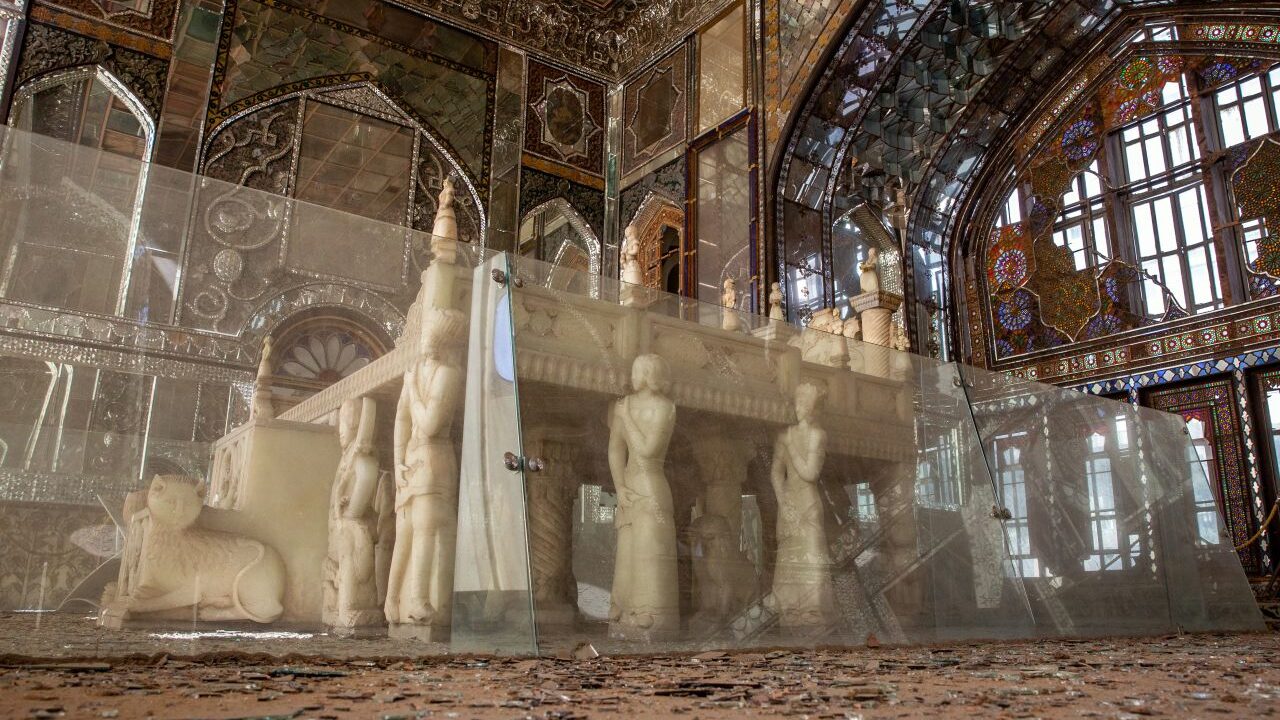
The strikes on Isfahan on Monday came a week after another cultural icon, the Golestan Palace, was badly damaged during an attack on a police station in downtown Tehran, according to the ministry. Golestan Palace dates to the 14th century and eventually became the seat of the Qajar dynasty. Its famed hall of mirrors was shattered, and its symmetrical garden was covered in debris, photos and videos show.

Israeli Missiles Target Building Near Cultural Landmarks
Israeli military strikes in Isfahan were targeting the governor’s building, which sits near Naqshe Jahan Square, according to Iranian government officials. Many cultural landmarks also sat in close proximity.
The images of renowned historic sites shattered by missiles have left many Iranians enraged. In interviews and in posts on social media, some are asking how a war waged by Israel and the United States supposedly against the Islamic Republic’s government and military has ended up damaging their cultural identity and sites.
“For me, ancient monuments are as important as human lives, because they connect me to my past,” Mojtaba Najafi, a prominent Iranian scholar and researcher, said in one post. “And their destruction means my memory is being demolished.”
A spokesperson for UNESCO, the United Nations agency that seeks to protect global culture, said her organization had been able to verify damage at several World Heritage sites in Iran. They include the Golestan Palace; the Chehel Sotoun pavilion of the Persian Garden, the Masjed‑e Jameh of Isfahan, as well as on buildings located near the buffer zone of the prehistoric sites of the Khorramabad Valley.
“UNESCO is deeply concerned by reports of destruction affecting cultural heritage sites in the Middle East, notably in Iran and neighboring countries,” said the spokesperson, Monia Adjiwanou.
In a statement last week, UNESCO said “cultural property is protected under international law.” It said it had contacted all parties in the Iran conflict and shared the geographical coordinates for sites on its world heritage list, as well as for national symbols. The hope was that they might be spared.
“These sites carry historical memory that transcend ideology,” said Naghmeh Sohrabi, a professor of Middle East history and director for research at Brandeis University’s Crown Center for Middle East Studies. “They are living breathing monuments to beauty and creation, not just for Iranians but for all of us in the world.”
Ancient Hilltop Castle Damaged by Airstrike
On Sunday, an ancient hilltop castle and military barracks dating to Persia’s Sasanian era, from the 220s to 650s A.D., was seriously damaged in a airstrike Sunday, according to Iran’s Ministry of Culture and Tourism, which said Israel struck the ministry’s local offices in the province. The castle, known as Shapur Khast Castle and Falak ol-Aflak, is in Khorramabad, in Lorestan province.
The ministry said that the strikes targeted Lorestan’s Cultural Ministry, destroying the building, and that the blasts had damaged the castle and two museums.
The mosque, the two palaces in Isfahan’s Naqshe Jahan Square and the Golestan Palace in Tehran are listed as UNESCO World Heritage sites, with the goal of protecting them from alterations. The castle is on Iran’s list of cultural heritage sites.
Iran’s Ministry of Culture and Heritage said it had installed blue flags, in keeping with international wartime protocol, on all of its cultural and heritage sites to signal to Israeli and U.S. jets that they were protected. But to no avail.
Israel’s military said it did not target these cultural sites directly. But it did not respond to questions about cultural sites being damaged as a result of strikes on nearby targets.
In Isfahan, the blast wave reverberated across Naqshe Jahan Square. The 964,000-square-foot plaza, constructed in 1598 during the Safavid empire, is known for the majestic green garden in its center and the labyrinth of its bazaar, along with its towering palaces, with turquoise domes and minarets adorned with Persian calligraphy.
At the Ali Qapu and Chehel Sotoun palace, videos and images on state television showed painted murals knocked to the ground, floral tiles broken into pieces, hand-carved wooden panels blown out and hanging off walls and ceilings. Tiny mirrors that had been arranged into ornate stars and hexagons shattered across the floor.
Destruction to 17th Century Persian Palace and Garden
A video verified by The New York Times shows the destruction to Chehel Sotoun, a 17-century palace with a Persian garden compound. There, the 20 towers of the palace are reflected in a shallow blue pool in the garden, creating the illusion of 40 accounting for the name. In Persian, chehel sotoun means 40 columns.
The strikes are damaging sites that have remained standing though history’s upheavals. They made it through centuries of different monarchs, of invasions, coups, World War II, the Islamic Revolution, an eight-year war with Iraq and waves of uprisings against the current government.
Iranians are reacting with outrage, sadness and fear.
“What happened to their claims that this was war on the regime and not on Iran and its people?” asked Laleh, a 36-year-old from Tehran, reached by telephone. “They are lying.”
Isfahan is the hometown of Nasim Alikhani, the Iranian American owner and chef of the acclaimed Persian restaurant Sofreh in New York City. Alikhani said she was devastated when she heard about the Isfahan strikes.
“Isfahan’s Naqshe Jahan Square is not just an extraordinary historical site — it is the heart and soul of every Iranian,” she said in an interview. “It has survived countless invasions, yet it did not survive the brutality of this unjust war. These places do not belong only to Iranians — they belong to humanity, and their destruction must never be accepted.”
Isfahan Is a Beloved City
Many consider Isfahan the most magical city in Iran. In Persian, it is often referred to as “Isfahan, Nesefeh Jahan” — meaning Isfahan is half of the world. An ode to the city by an Iranian pop star, Moein, is a staple singalong at Iranian parties and family gatherings.
Iran’s Red Crescent Society said Tuesday that since the start of the war on Feb. 28, almost 10,000 civilian structures had been destroyed or damaged in airstrikes. Of those, it said, 7,493 were residential; 1,617 commercial; 32 medical and pharmaceutical facilities; 65 schools and educational sites. Thirteen, it said, belonged to the Red Crescent.
And now at least six cultural gems: Naqshe Jahan Square, Jameh Mosque, Ali Qapu Palace, Chehel Sotoun Palace and Garden, Golestan Palace and Falak ol-Aflak Castle.
The governor of Isfahan, Mehdi Jamalinejad, called the attacks on his city barbaric. “They are targeting the world’s most ancient symbols of civilization with the most advanced weaponry,” he said in a social media post.
This article originally appeared in The New York Times.
c.2026 The New York Times Company