
|
Getting your Trinity Audio player ready...
|
On its face, Iran’s choice of a new supreme leader, Mojtaba Khamenei, sent a message of continuity to a country battered by war. It was also a show of open defiance to Iran’s attackers.
The United States and Israel killed the new leader’s father and predecessor, Ayatollah Ali Khamenei, in the opening salvos of their attack on Iran. They had openly warned Iran against replacing him with his 56-year-old son — a hard-line cleric seen as close to Iran’s top military force.
The group of 88 clerics known as the Assembly of Experts selected Mojtaba Khamenei despite those threats. That choice risks prolonging the war and creating more uncertainty for the country, should he meet the same fate as his father.

Iran was already deeply divided between those who support the clerical ruling system and those who oppose it. Choosing another hard-line leader may only deepen that divide.
The decision is “laden with peril,” said Ali Vaez, a senior Iran analyst at the International Crisis Group.
Iran’s new supreme leader lost not only his father to U.S.-Israeli strikes, but also his mother, wife and daughter, Vaez said. That means Iran is now “concentrating power in the hands of a man loathed by much of his own people and consumed by fury toward Israel and the United States.”
President Donald Trump called the younger Khamenei an “unacceptable” choice, and the Israeli military warned it would “continue to pursue every successor.”
As a political figure, the younger Khamenei is a relative unknown, both to Iranians and the world.
The older Khamenei was a known entity, unflinching in his resolve to crack down on internal dissent, as authorities killed thousands in protests in January, and insistent on the right to uranium enrichment as part of Iran’s nuclear program. Publicly, he ruled out actually building a nuclear bomb.
Nevertheless, the concern that under his leadership, Iran could seek a nuclear weapon was held up as a reason for the United States and Israel to go to war.
What is known about the new supreme leader is that he was influential behind the scenes while working in his father’s office and is closely tied to Iran’s powerful Revolutionary Guard.
Founded to defend the Islamic Republic that was established after Iran’s 1979 revolution, the Revolutionary Guard has not only become Iran’s most powerful military force, but it also wields considerable political and economic influence. Its leaders have directed the waves of retaliatory ballistic missile and drone attacks against Israel, Arab countries in the Persian Gulf, and U.S. bases and embassies in the region.
The younger Khamenei was considered the preferred choice of the Revolutionary Guard for the supreme leader post.
“It is definitely a consolidation and empowerment of the deep state in Iran,” said Abdolrasool Divsallar, an Iran expert at the Catholic University of Milan.
Some experts worry the younger Khamenei could take the step that experts say his father never did and race to build a nuclear bomb.
“A war that was meant to prevent Iran from having a bomb could be the war that actually pushed Iran beyond the Rubicon to reach a bomb,” said Danny Citronowicz, an analyst at the Atlantic Council, a think tank, and former head of the Iran branch of Israel’s military intelligence.
Iranian officials appear to be signaling that they are digging in for a longer fight. On Monday, Foreign Minister Abbas Araghchi warned against more attacks on the country’s energy infrastructure and nuclear sites.
“We know the U.S. is plotting against our oil and nuclear sites,” he wrote on social media. “And we, too, have many surprises in store.”
Internally, some political analysts argue that Khamenei could be more pragmatic than expected.
Hassan Ahmadian, a political analyst at the University of Tehran, said Khamenei’s position of strength among hard-liners opens the possibility for him to seek consensus in a way that weaker candidates could not.
“He could work with anyone and everyone within Iranian politics, based on the priorities he feels for Iran and for the country at this point,” he said.
Some Iranians were hopeful that Khamenei would choose to play a role similar to Crown Prince Mohammed bin Salman in Saudi Arabia — an authoritarian ruler who expanded social freedoms and rehabilitated the economy.
Farhad, a logistics manager in Tehran, said many Iranians might welcome a heavy security state coupled with improved foreign relations, and a slow, gradual easing of social restrictions. Like many Iranians inside the country, he asked to be identified by his first name only for fear of retaliation.
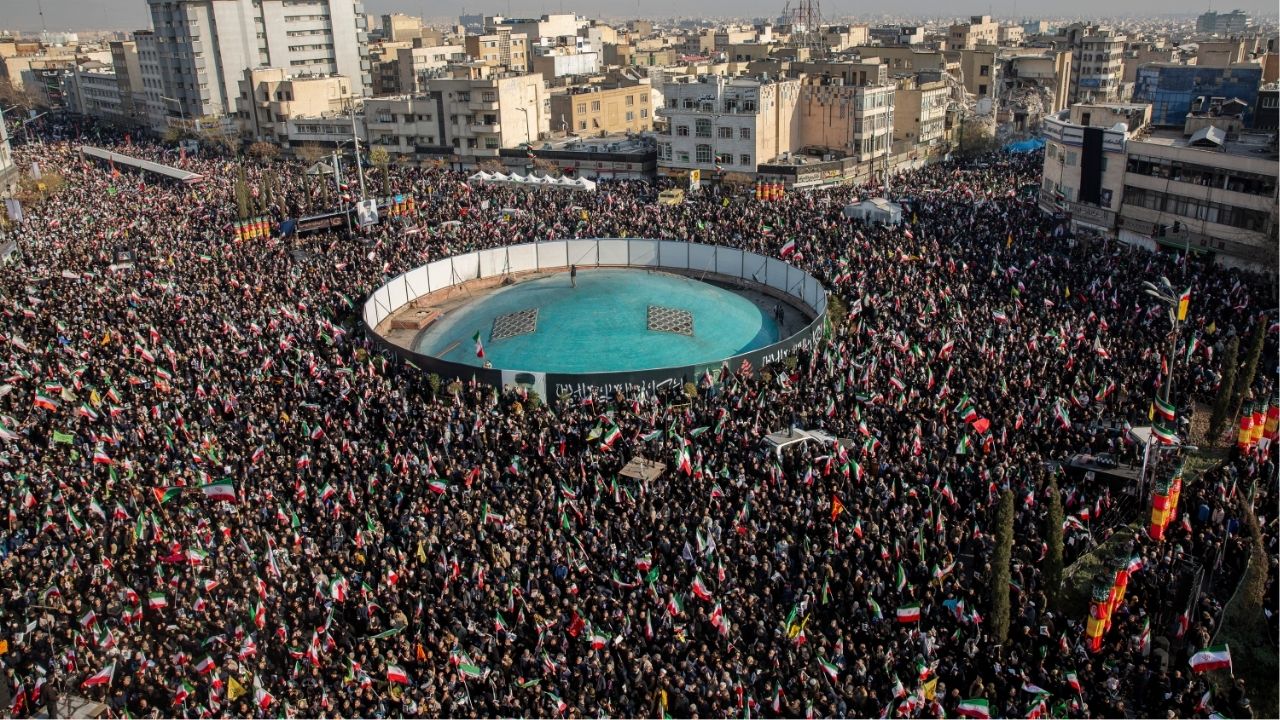
Across the country, government supporters have taken to the airwaves and rallied in the streets to pledge their allegiance to the new leader.
Khamenei’s rise may soon be seen as a predictable outcome the United States and Israel could have avoided, said Citronowicz, the analyst.
“Mojtaba is one example of really not thinking in depth how this war could develop,” he said. “Now, he will try to do his utmost to strengthen Iran’s position, and in that sense, maybe we were better off with the father.”
—
This article originally appeared in The New York Times.
By Erika Solomon/Arash Khamooshi
c. 2026 The New York Times Company