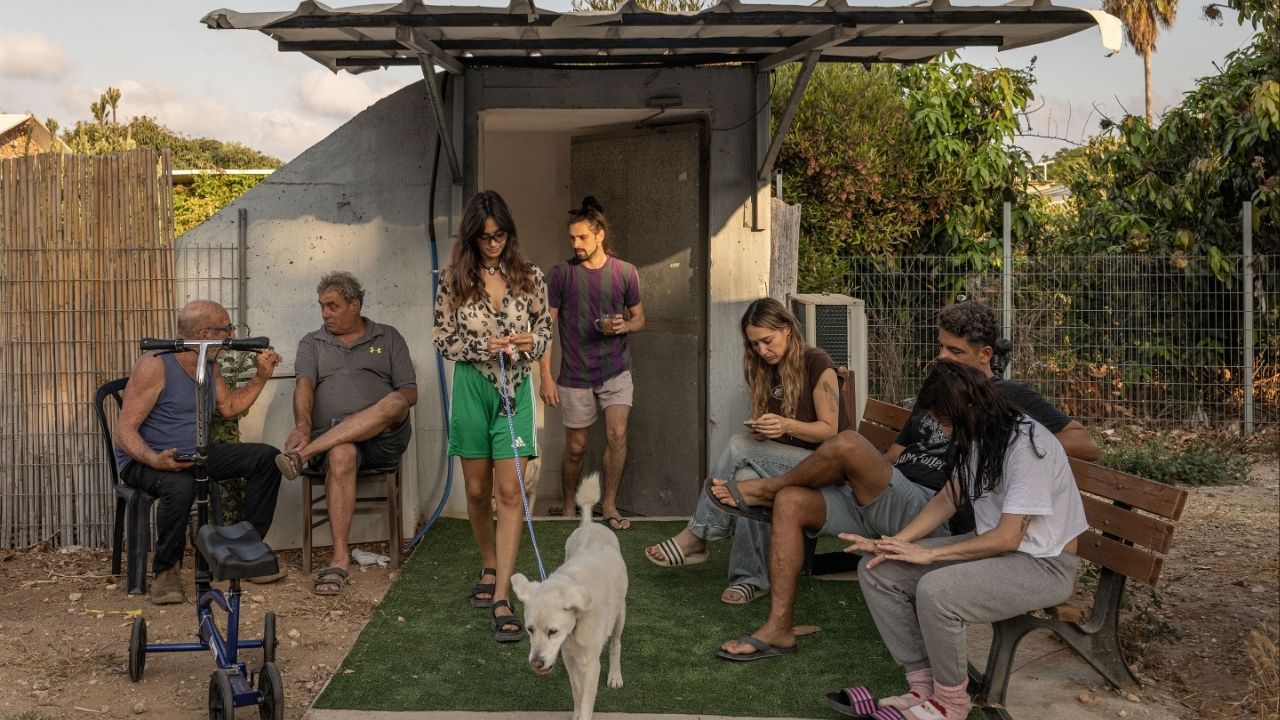
People sit near a bomb shelter between sirens during an Iranian missile attack in Rishpon, Israel, June 24, 2025. The national mood is somewhere between anxiety, resignation and anticipation as President Donald Trump considers whether to attack Iran. (Avishag Shaar-Yashuv/The New York Times)

Share
|
Getting your Trinity Audio player ready...
|
JERUSALEM — Across Israel, hospitals have been conducting emergency drills while neighbors share locations of bomb shelters in WhatsApp groups.
The national mood is wavering somewhere between anxiety, resignation and anticipation as President Donald Trump deliberates over whether to attack Iran. If he orders a strike, it will most likely pull Israel into its second war with Iran in less than a year, following a 12-day conflict in June.
Ruth Bahaj of Jerusalem, 38, said she was trying to maintain a semblance of normalcy, including by heading on a vacation this week. But she and her wife also made preparations, such as cleaning and organizing the fortified shelter in their apartment building.
“Plenty of people are anxious, aren’t sleeping at night because they’re checking the news,” Bahaj said. “But it’s impossible to be tense and at the ready constantly for so long.”
Trump first began threatening to attack Iran last month after Iran’s leaders began a bloody crackdown on mass protests calling for an end to the country’s authoritarian clerical rule. He has ordered a buildup of U.S. military power in the region unparalleled since the U.S.-led invasion of Iraq in 2003.
But he has also zigzagged between declaring his readiness to attack Iran and expressing a desire to use a moment of weakness in the country to reach a new diplomatic agreement to rein in Iran’s nuclear program.
U.S. officials have held rounds of talks with Iranian counterparts, so far without reaching any deal that could avert another round of conflict.
Jewish Israelis often do mandatory reserve duty in the military, leaving many clutching at rumors of who has been called up in an attempt to decipher whether a war could be imminent.
Many Israelis share Prime Minister Benjamin Netanyahu’s view that the Iranian government’s nuclear and missile programs pose an existential threat to their country, given that Iran’s leaders openly call for Israel’s destruction. And they eagerly cheered on the anti-government protests in Iran over the past few months.
But large parts of the Israeli public seem equally reluctant to join a second war with Iran in less than a year unless they think it necessary. In a survey by the Israel Democracy Institute, a research group, about half of respondents said they would support joining a U.S. war only if Israel were attacked first.
Underpinning that is a sense that another conflict between the countries could be longer and deadlier than June’s war, when Israel launched an air campaign against Iran’s nuclear programs and military leaders.
Iran retaliated by firing waves of ballistic missiles at Israel, forcing millions of residents to seek refuge in fortified shelters, often for hours. Israeli air defenses, bolstered by U.S. antimissile batteries, intercepted many of the missiles, but at least 32 people were killed, according to the Israeli government.
The missile attacks damaged a hospital, a university and an oil refinery, and hit in and around military bases in the Tel Aviv area.
Eldad Albow, 48, said he was forced to evacuate from his home in the coastal city of Bat Yam after an Iranian missile badly damaged his apartment complex. Several months later, he says he is trying to avoid discussing the situation with his two daughters, ages 12 and 9, wary of frightening them.
“We know that if something does happen, it could be much worse this time,” Albow said.
Israeli hospitals are preparing to move patients to underground shelters where they can continue treatment in the event of war. Israel’s Health Ministry has instructed medical centers to be ready for two to four weeks of conflict if necessary, said Steve Walz, a spokesperson for Sheba Medical Center outside Tel Aviv.
During the last war, an Iranian ballistic missile landed inside Soroka Medical Center in Beersheba, and the damaged ward has yet to be rebuilt. Dr. Shlomi Codish, the Soroka hospital director, said he could still see the destruction from his window.
Codish said in an interview that the center was preparing to move as many patients as possible to fortified shelters and was assessing stockpiles of essential medicines. He added that the hospital has been making contingency plans for an extended war in which supplies to Israel would be disrupted, among other scenarios.
While they await a U.S. decision, Israelis have been glued to incessant television news chatter in which commentators, many of them former security chiefs, seek to parse Trump’s shifting pronouncements.
Amos Yadlin, the former head of Israeli military intelligence, surprised many when he warned viewers this month on Channel 12, Israel’s most-watched news network, that they should “think twice about traveling this weekend.”
The weekend came and went without incident. The underlying tension remained.
Amit Zidkiyahu, 27, says he is trying to keep up normal life unless there is an immediate attack. Many of his family and friends, however, are “totally in a panic,” he said, and following every step in the slow U.S. military buildup.
“People are talking about it constantly, and I’m the one who’s trying to take a step back,” Zidkiyahu said. “At the end, it’s all in Trump’s hands.”
—
This article originally appeared in The New York Times.
By Aaron Boxerman/Avishag Shaar-Yashuv
c. 2026 The New York Times Company