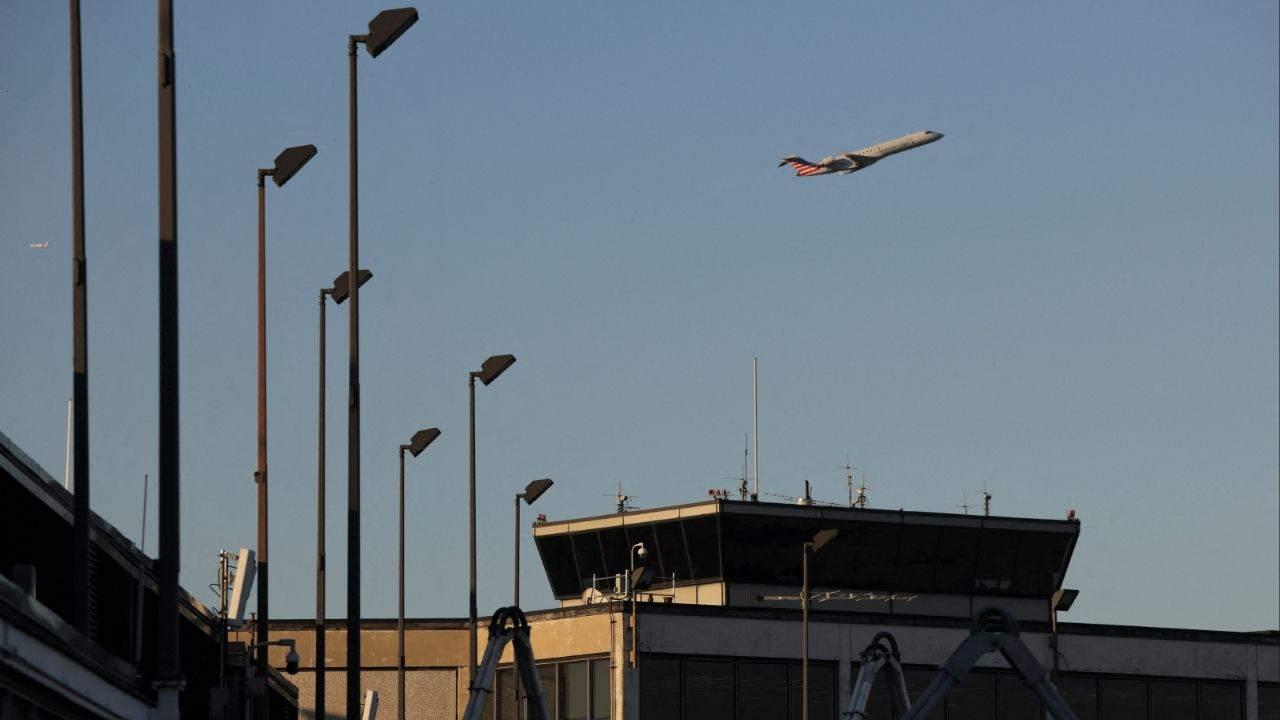
A plane takes off from Chicago O'Hare International Airport, in Chicago, Illinois, U.S., October 26, 2025. (Reuters/Daniel Cole)

Share
|
Getting your Trinity Audio player ready...
|
The U.S. House of Representatives on Tuesday failed to pass key aviation legislation despite pleas from lawmakers and relatives of those killed in the worst U.S. aviation disaster since 2001.
The House voted 264-133 in favor of the ROTOR Act, passed unanimously by the U.S. Senate in December, that would require aircraft operators to equip their fleets with a safety system known as the Automatic Dependent Surveillance-Broadcast system, or ADS-B, by the end of 2031. Under the fast-track rules, the bill needed a two-thirds majority to pass — and it fell one vote short.
ROTOR would require the military to use ADS-B on routine training flights but not on sensitive military missions. The legislation follows the January 2025 disaster, when an American Airlines regional jet and an Army Black Hawk helicopter collided in the crowded airspace over the nation’s capital, killing 67 people.
Safety System Would Have Prevented Crash: NTSB
National Transportation Safety Board Chair Jennifer Homendy said ADS-B would have prevented the 2025 collision and noted the agency has called for it to be mandated for more than 20 years.
NTSB said ADS-B could have alerted the passenger plane pilot 59 seconds before the collision and the helicopter crew 48 seconds before.
“How many more people need to die for us to decide that action needs to be taken?” she told reporters on Tuesday.
In December, the Pentagon said it supported the legislation, sponsored by Senate Commerce Committee Chair Ted Cruz and the panel’s top Democrat, Maria Cantwell. But in a statement released on Monday, the Pentagon said the bill could create “significant unresolved budgetary burdens and operational security risks affecting national defense activities.”
House Transportation Committee chair Sam Graves said Tuesday the panel will take up a rival aviation safety bill as soon as next week.
Audrey Patel, whose husband died in the crash, was pregnant at the time and noted other recent near-collisions. “We know why this happened and how to prevent it,” Patel said at a Capitol Hill press conference urging the legislation’s passage.
House Armed Services Committee Chair Mike Rogers, a Republican, criticized the ROTOR Act, saying it would undermine national security. But he added some military aircraft should be equipped with and transmit ADS-B in congested civilian airspace and noted a rival safety bill was introduced last week.
Cantwell said it was incorrect that the bill would mandate ADS-B on B-52 or F-35 aircraft, but would ensure use in congested airspace to ensure safety.
The ROTOR Act also boosts oversight of commercial jet and helicopter traffic and flight routes near commercial airports.
—
(Reporting by David ShepardsonEditing by Rod Nickel and Nick Zieminski)
RELATED TOPICS:
Categories


Fresno Stabbing Leaves Man Dead, Suspect at Large