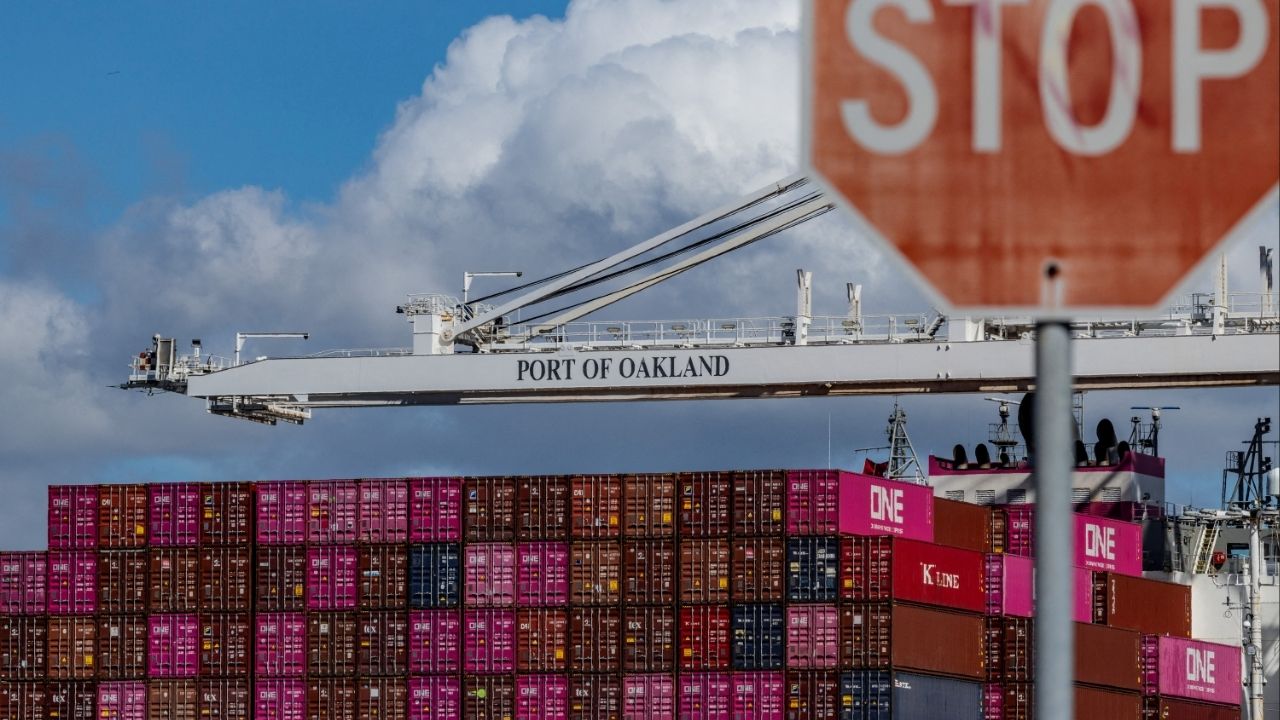
A cargo ship full of shipping containers is seen at the port of Oakland as trade tensions escalate over U.S. tariffs, in Oakland, California, U.S., March 6, 2025. (Reuters/Carlos Barria)

Share
|
Getting your Trinity Audio player ready...
|
The United States began collecting a temporary new 10% global import tariff on Tuesday, but the Trump administration was working to increase it to 15%, a White House official said, sowing confusion over President Donald Trump’s tariff policies after last week’s Supreme Court defeat.
Trump initially signed an order on Friday for a 10% tariff to last 150 days to replace broad duties under an emergency law that were struck down by the Supreme Court, but on Saturday, he said he would increase the rate to 15%.
On Monday night, before the midnight start of collections, the U.S. Customs and Border Protection agency notified shippers that the rate would be 10%.
The White House official told Reuters that Trump has had “no change of heart” in his desire for a 15% tariff under Section 122 of the Trade Act of 1974, but offered no details on the timing for that increase.
As of Monday, Trump had not signed a formal presidential order for the increase to 15% and CBP can only act on published presidential executive orders and proclamations.
CBP’s notice referred to his Friday order, saying that aside from products covered by exemptions, imports would “be subject to an additional ad valorem rate of 10%.”
Unclear Why Lower Rate Is Imposed
The move added to confusion surrounding U.S. trade policy, with no explanation offered in the notice for why the lower rate had been used.
“Trump is delivering the State of the Union address tonight, so it’s possible we might get a better sense of the next steps on tariffs,” Deutsche Bank said in a note.
“Net-net we still think the effective tariff rate will fall this year and that the world post-SCOTUS will see lower tariffs than the pre-SCOTUS world,” its analysts said, using the acronym for the Supreme Court of the United States.
Although a 10% tariff is less punitive than expected, traders cited uncertainty about the trade outlook as one reason global stocks opened lower on Tuesday. Major U.S. indexes traded higher by midday, with the Dow Jones Industrial Average up 0.65%, the S&P 500 Index gaining 0.5% and the tech-heavy Nasdaq up 0.8% as Anthropic introduced new AI tools.
The new tariff took effect at midnight, while collection of the tariffs annulled by the Supreme Court was halted. They had ranged from 10% to as much as 50%.
EU Reassured on Trade Deal
The new 10% tariff represents a conundrum for the European Union, which agreed to a trade deal with a 15% base tariff rate. European Commission Trade Minister Maros Sefcovic said the bloc faces a “transitional period” over Trump’s new temporary tariff, but added U.S. trade officials have reassured him Washington will stand by the agreement.
It remains unclear whether and how companies will be refunded for tariff payments made under the program annulled by the Supreme Court.
The Section 122 law allows the president to impose the new duties for up to 150 days to address “large and serious” balance-of-payments deficits and “fundamental international payments problems.”
Trump’s tariff order argued that a serious balance-of-payments deficit existed in the form of a $1.2 trillion annual U.S. goods trade deficit, a current account deficit of 4% of GDP and a reversal of the U.S. primary income surplus. But some economists and trade lawyers argue the U.S. is not on the cusp of a balance-of-payments crisis, making the new duties vulnerable to a legal challenge.
Trump Warns Against Reneging on Trade Deals
On Monday, Trump warned countries against backing away from previously negotiated trade deals with the U.S., warning he would hit them with much higher duties under different laws.
Japan said it had asked the United States to ensure its treatment under a new tariff regime would be as favorable as in an existing agreement. The European Union, Britain and Taiwan all indicated a preference to stick to their deals, too.
Carsten Brzeski, global head of macro at ING, noted that even with the 150-day limit of the current set of measures, the trade uncertainty was unlikely to go away soon.
“Because the next thing that he (Trump) could do is always, with the interruption of one day, theoretically endlessly extend by 150 days,” he said.
China urged Washington to abandon its “unilateral tariffs,” indicating it was willing to hold another round of trade talks with the world’s largest economy, the country’s commerce ministry said in a statement on Tuesday.
—
(Additional reporting by Mark John and Francesco Canepa in Frankfurt; Writing by Mark John; Editing by Peter Graff, Sharon Singleton, Rod Nickel)
RELATED TOPICS:
Categories