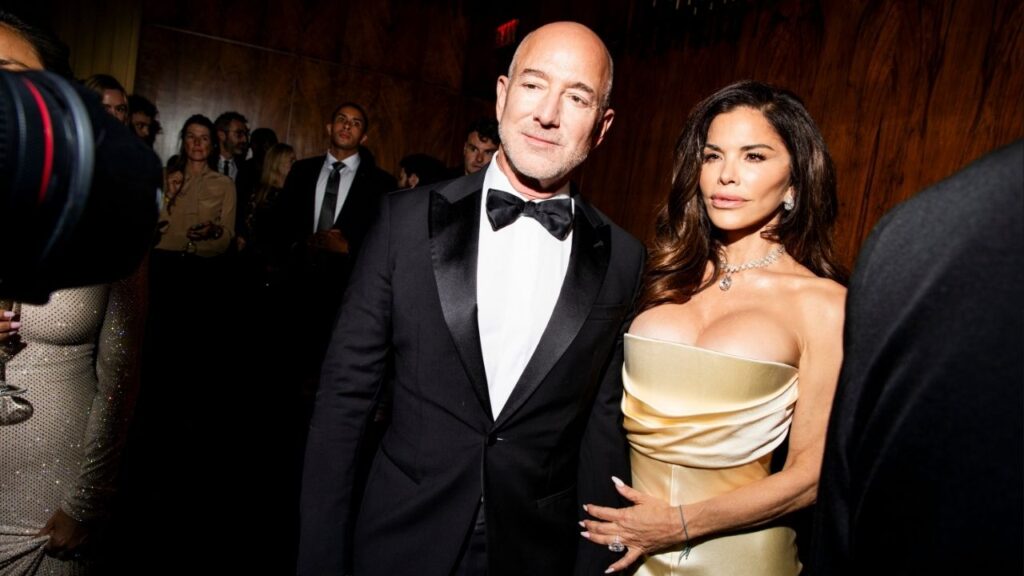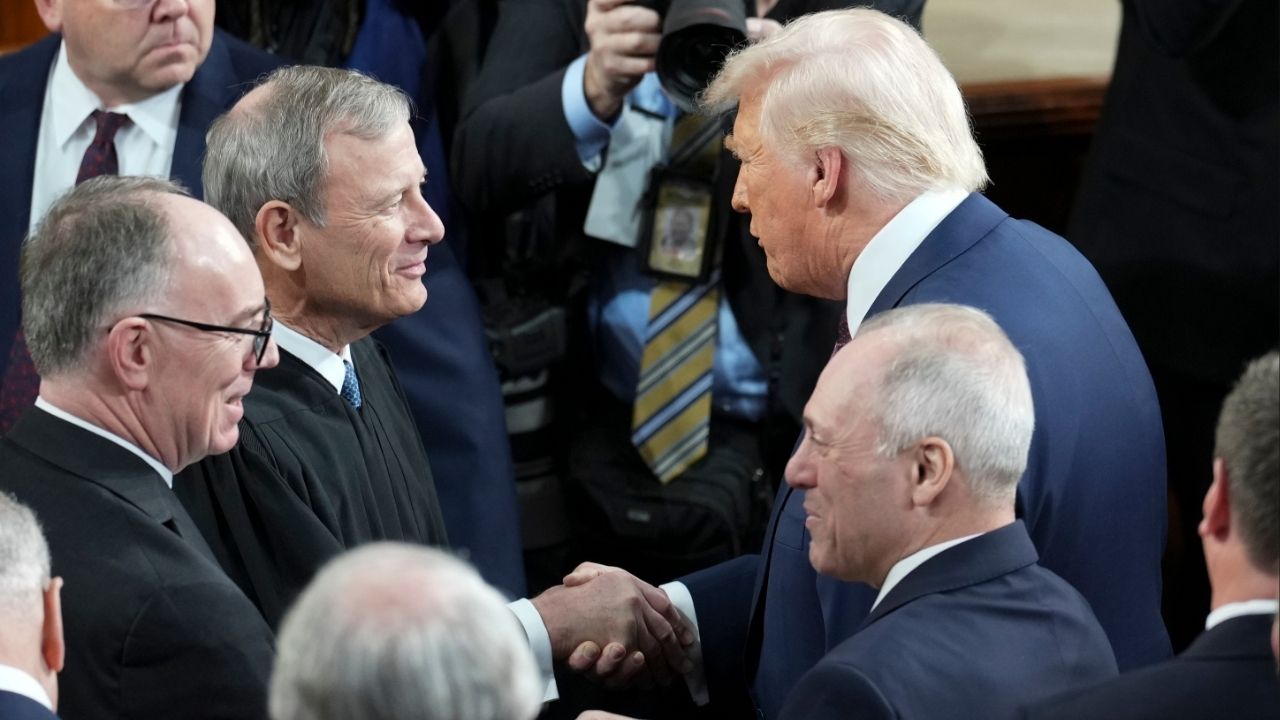
President Donald Trump greets Chief Justice John Roberts at his address to a joint session of Congress at the Capitol in Washington, March 4, 2025. If tradition holds, members of the Supreme Court will attend Trump’s annual speech, just days after ruling against the legality of his tariffs. (Doug Mills/The New York Times)

Share
|
Getting your Trinity Audio player ready...
|
WASHINGTON — Just once a year do the justices of the Supreme Court and the president routinely gather in the same place, as the justices file onto the floor of the House of Representatives and sit silently in their robes while the president delivers his State of the Union address.
There have been tense moments before as the jurists have perched within easy eyesight of a sitting president they have ruled against. But perhaps never before has the moment been so fraught as it will be Tuesday night.
The justices will cross paths with President Donald Trump just days after he bitterly criticized them in personal terms for dealing a major blow to his signature economic initiative by ruling against the legality of his tariffs.
Chief Justice John Roberts wrote the opinion, declaring that Trump had exceeded his legal authority when he relied on an emergency statute to impose sweeping tariffs without congressional approval. The chief justice was joined by the three liberal justices but also two of Trump’s first-term picks for the bench, Justices Neil Gorsuch and Amy Coney Barrett.
In a news conference Friday, the day the court released its ruling, Trump called the group “disloyal,” a “disgrace to our nation” and “lap dogs.” Trump had particularly harsh words for his two nominees who had voted against him. They were, he said, “an embarrassment to their families.”
If the past is any guide, not all nine justices will attend Tuesday evening. But a handful will almost certainly be present. Their arrival will be announced before they sweep down the aisle to be seated in the front rows.
What the justices will do is not much of a mystery. They typically remain seated throughout the speech and take pains not to applaud or react, even to lines that bring members of Congress and the galleries of guests to their feet.
What Trump will do, on the other hand, is the subject of intense speculation.
When asked at his news conference Friday whether the justices who voted against him were still invited to the State of the Union, he responded, “Barely. They’re barely invited.” He added: “Honestly, I couldn’t care less if they come.”
Roberts has had a perfect attendance record at the annual speeches since he joined the court in 2005. Other recent regulars have included Justices Elena Kagan and Brett Kavanaugh. Retired justice Anthony Kennedy has also attended in recent years.
Last year, there was plenty of attention on the justices and to their interactions with the president. When Trump greeted the chief justice, he could be heard saying, “Thank you again. I won’t forget it.”
Roberts had written the court’s opinion granting the president broad immunity from criminal prosecution, and there was speculation that the favorable decision prompted the president’s gratitude. Trump later said that he was thanking the chief justice for swearing him in at his inauguration.
Barrett’s body language after she greeted the president was also the subject of scrutiny from Trump’s allies who were critical of one of her early votes ordering the administration to repay global health groups. Steve Bannon played video clips on his podcast suggesting the justice had given the president “stink eye.” “That’s not a look of admiration,” he said.
In the days since the tariffs opinion landed, Trump has continued to rail against the court. For the time being, he wrote in a social media post Monday, he would refer to the court using lowercase letters “based on a complete lack of respect!”
“Our incompetent supreme court did a great job for the wrong people, and for that they should be ashamed of themselves (but not the Great Three!),” he added in reference to the three conservative justices who dissented Friday, indicating they would have allowed Trump’s tariffs to remain in place — Justices Clarence Thomas, Samuel Alito and Brett Kavanaugh.
Despite the praise, Alito may not show up for Trump’s moment. He has referred to the addresses as “very political events” and “very awkward.”
“We have to sit there like the proverbial potted plant most of the time,” he said during a 2010 speech at the Manhattan Institute.
He has not attended since 2010, when President Barack Obama took aim at the Supreme Court during his speech for ruling days earlier that corporations and unions have First Amendment rights to spend freely on political ads for and against candidates.
The Citizens United decision, Obama said, had “reversed a century of law” and would “open the floodgates for special interests, including foreign corporations, to spend without limit in our elections.”
“Not true,” mouthed Alito from his seat in the well, a pronounced break with the court’s tradition that spurred controversy in the days after the speech.
Later that year, Roberts suggested it was Obama’s remarks that were the true break in tradition.
In response to a question from law students at an appearance at the University of Alabama, Roberts said criticism of the court during the address had been “very troubling.”
“To the extent the State of the Union has degenerated into a political pep rally,” he said, “I’m not sure why we’re there.”
—
This article originally appeared in The New York Times.
By Ann E. Marimow/Doug Mills
c. 2026 The New York Times Company
RELATED TOPICS:
Categories

US Halts Plan for ICE Facility in New Hampshire, Governor Says

Ukraine Does Not Feel Abandoned by US Government, Envoy Says