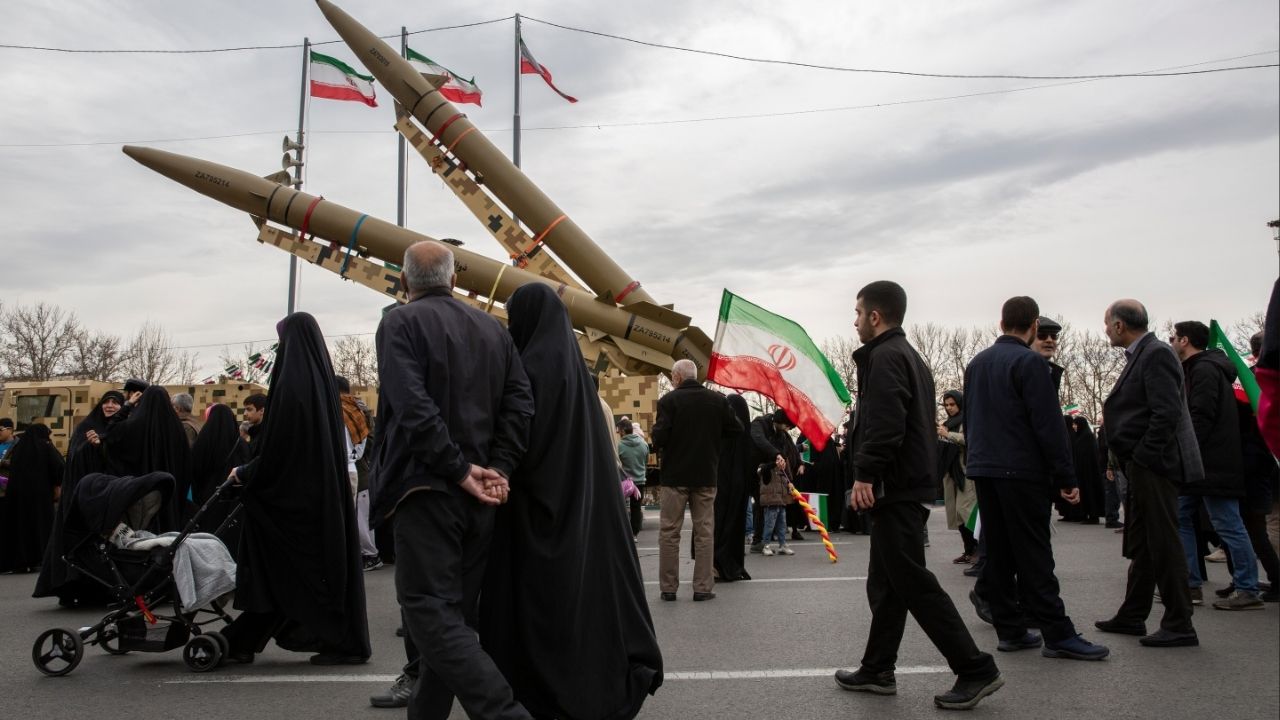
People pass missiles on display during a march marking the anniversary of the Islamic revolution in Tehran, Feb. 11, 2026. The government in Tehran sees capitulating to Washington’s demands on uranium enrichment and ballistic missiles as riskier to its survival than going to war, analysts say. (Arash Khamooshi/The New York Times)

Share
|
Getting your Trinity Audio player ready...
|
Facing high-stakes brinkmanship as U.S. warships and fighter jets mass off its shores, Iran has refused to concede to President Donald Trump’s demands on its nuclear program and weapons — a stance that has bewildered U.S. officials.
The authoritarian clerics who rule Iran see those concessions — which, in their view, could compromise their core ideology and sovereignty — as a greater threat to their survival than the risk of war.
A dangerous mismatch in perceptions between Iran and the United States is why efforts to negotiate a deal over Iran’s nuclear and military capabilities look increasingly fragile, experts say, and a new regional conflict seems almost inevitable.
“Avoiding war is indeed a high priority, but not at any cost,” said Sasan Karimi, a political scientist at the University of Tehran who served as the deputy vice president for strategy in Iran’s previous government. “At times, a political state — especially an ideological one — may weigh its place in history as heavily as, or even more heavily than, its immediate survival.”
U.S. and Iranian negotiators are struggling to break an impasse over their respective red lines.
The Trump administration says it wants Iran to agree to zero nuclear enrichment to ensure it cannot build a nuclear weapon. U.S. officials have also sometimes insisted on limiting the range of Iran’s ballistic missiles and ending the country’s support for allied militias across the region.
For Iran, which says its nuclear program is for peaceful purposes only, nuclear enrichment is a right that the supreme leader, Ayatollah Ali Khamenei, upholds and that his officials cannot abandon. And Iran sees possessing missiles that can reach as far as Israel as critical for self-defense.
U.S. and Iranian officials are set to meet in Geneva on Thursday for talks seen as a last-ditch effort to find a compromise before Trump orders a strike. According to people briefed on internal administration deliberations, the two sides will consider a proposal that offers an off-ramp to war: Allowing Iran a limited nuclear enrichment program for civilian purposes.
Trump’s administration views Iran as so weak that it should accept U.S. demands, regional officials have said.
In June, Iran suffered heavy blows during a 12-day war launched by Israel and briefly joined by U.S. warplanes. That conflict coupled with biting international sanctions have plunged Iran’s economy deeper into crisis.
In January, authorities used deadly force to crush nationwide protests demanding Khamenei’s ouster. Some smaller protests reemerged over the weekend, demonstrating how hostile many Iranians are toward their leaders.
On top of that, the Iranian government is facing a major buildup of U.S. firepower in the Persian Gulf, including two aircraft carrier strike groups, and a massing of reconnaissance and refueling jets across the Middle East.
Trump’s lead negotiator with Iran, Steve Witkoff, described the president as “curious as to why they haven’t” capitulated, in an interview with Fox News over the weekend.
Vice President JD Vance told Fox last week that despite the threat of war, Iranians “are not yet willing to actually acknowledge and work through” the president’s demands.
Yet it is the very perception of Iran’s weakness that experts say makes Iran determined to resist.
“For Iran, submitting to U.S. terms is more dangerous than suffering another U.S. strike,” said Ali Vaez, the Iran director of the International Crisis Group. “They don’t believe that once they capitulate, the U.S. will alleviate the pressure. They believe that would only encourage the U.S. to go for the jugular.”
Khamenei has repeatedly stressed his view that Washington’s eventual aim is to topple Iran’s system of governance.
“Nuclear energy is not the problem, nor are human rights; America’s problem is with the very existence of the Islamic Republic,” he said in a speech in 2024.
Two of the main questions before any potential confrontation are whether a U.S. attack would go as far as trying to topple the political system in Iran, and whether Iran would be able to retaliate enough to make the conflict painful for Trump, too.
Iran could try to create a protracted and deadly confrontation that could hurt Trump in a midterm election year, analysts said.
One unknown is whether Iran could launch strikes on oil tankers passing through strategic shipping lanes like the Strait of Hormuz, or have its Houthi allies strike vessels in the Red Sea, said Mohammad Ali Shabani, an Iran analyst and editor of the regional news website Amwaj.media.
If a new conflict were to drive gasoline prices up one or two dollars per gallon, that could feel very risky for Trump before midterm elections this fall, he said.
U.S. and Israeli forces could deal a quick and devastating blow, as they did in June, when a string of top Iranian military officials were killed within hours and Iran’s nuclear and military facilities were battered.
But Iran learned lessons from that war, Iranian and regional officials say, and has prepared several layers of leadership to replace anyone killed. This aims to ensure that the system survives the conflict even if Khamenei and other leaders did not.
Regional officials speaking to Iran and the U.S. say that if Trump chooses to strike, his aim will probably be to jolt the Iranian leadership severely enough to force it back to the negotiating table on his terms.
But several experts said Iran refused to capitulate to U.S. terms after the last war and that if it survived another, it would probably refuse again.
“To think that a war every time either makes Iran more flexible or facilitates diplomacy is nothing but a delusion,” Vaez said.
—
This article originally appeared in The New York Times.
By Erika Solomon/Arash Khamooshi
c. 2026 The New York Times Company
RELATED TOPICS:
Categories