

|
Getting your Trinity Audio player ready...
|
WASHINGTON — This is a story about mud and power in Washington.
It begins at the turn of the 20th century, when this was a smaller, swampier place. Back then, there were great mud flats clogging up the Potomac River, just south of where the Washington Monument stood. Ships could not pass over the shallows. Sewage collected there. A plan was made to build them up into something pretty. The U.S. Army Corps of Engineers got to work, dredging the river, piling mud atop the marsh.
The crescent-shaped island that appeared became an important piece of Washington’s modern geography. The Jefferson Memorial was built on the island’s western lip, which backs up to the Tidal Basin and the National Mall. The rest of the human-made island was turned into a public park called East Potomac.

It’s a neat place. There are hundreds of cherry blossom trees, a road for cycling that wraps around the perimeter of the island, and a primo picnic area at its eastern tip. Most of the park is taken up by an affordable golf course that has been there in some form since the beginning. The course, East Potomac Golf Links, is a bit shabby, but the prices are unbeatable: $42 for 18 holes.
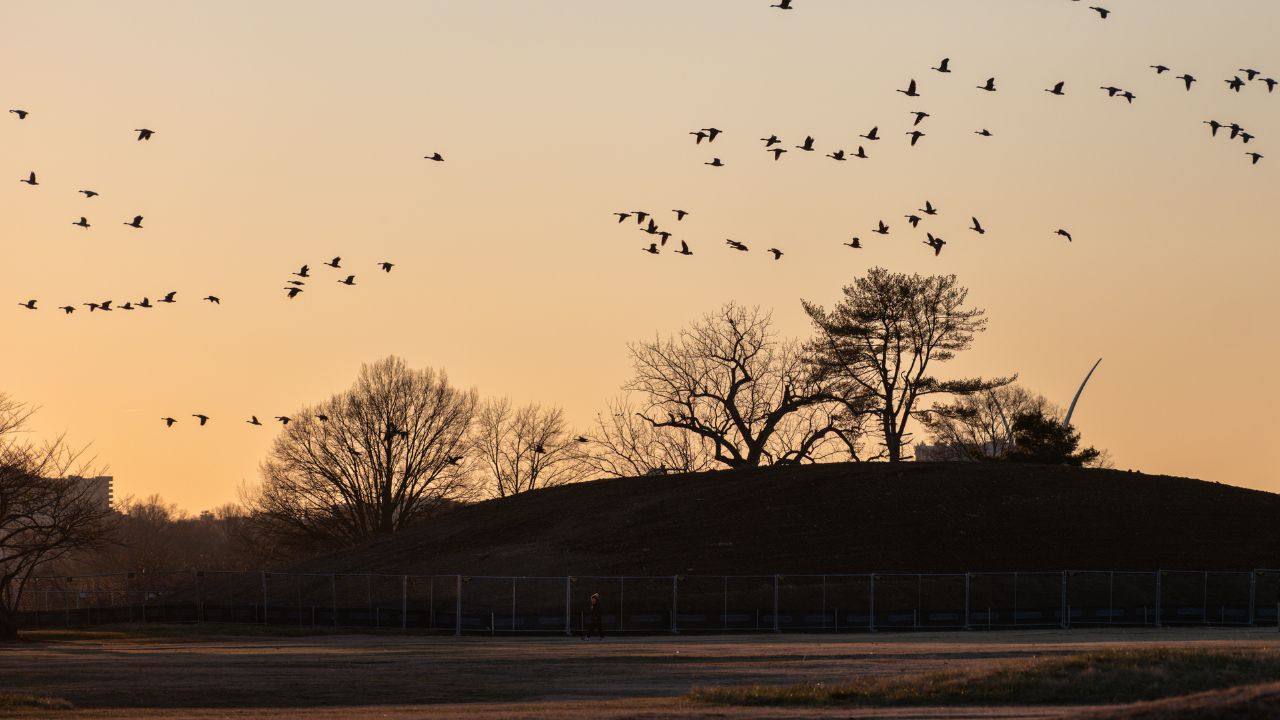
Not much had changed about East Potomac over the decades until one day last October when some dump trucks showed up. The trucks were sent by the White House. They were carrying mud.
The trucks drove onto the golf course and, somewhere between the fourth and ninth holes, began dumping mounds and mounds of the stuff. Tiny bits of rebar, wiring and specks of white plaster poked out from the piles. Word quickly spread among the golfers about the mystery mud. Turned out it was the remains of the East Wing, which President Donald Trump had demolished days earlier.
His destruction of one piece of Washington history heralded his destruction of another.
Trump has big plans for the little island. He wants to make it into a luxury golf destination. How exactly will he do this, you ask? Even he doesn’t seem to know yet, but one thing is certain: It’s going to take a lot of dirt to get it done. And there is a lot of dirt out back of the White House, where the big dig for the president’s ballroom grinds on.
And so, week after week, the trucks show up, and the mound in the middle of the golf course grows. A National Park Service memo estimated that there would be 30,000 cubic yards of soil in all. That would be about 2,000 truckloads.
“We’re going to make it a beautiful, world-class, U.S. Open-caliber course,” Trump said when asked about this last month. “Ideally, we’re going to have major tournaments there and everything else. It’s going to bring a lot of business into Washington.”
Not long after the dumping began, the Trump administration took full control of the course in East Potomac Park, terminating a lease that the park service had with a nonprofit called National Links Trust, which managed that course as well as two others in the city.
Administration officials said it’s too soon to say how the government will manage such a course while keeping it affordable, or what will become of it after Trump leaves office in three years.
Several of the top golf course architects in the country expressed puzzlement as to how Trump would go about constructing a “world-class” course that could host major tournaments on this peculiar spit of land.
“I think it’s a crazy idea,” said Mark A. Mungeam, the president of the American Society of Golf Course Architects.
It’s even crazier, some of the other architects mused, when you consider that Trump does actually know a lot about what goes into making an elite golf course. What would compel him to push for one here?
“President Trump built some of the greatest golf courses in the world, and he is now extending his unmatched design skills and excellent eye for detail to D.C.’s public golf courses,” said Taylor Rogers, a White House spokesperson. “The president and his extraordinary team will redevelop these decrepit golf courses in our nation’s capital to restore glamour and prestige.”
But it’s a public park. It wasn’t designed to be glamorous or prestigious.
The president seems to be in some sort of Pharaonic legacy-building mode, treating the capital as his great sandbox. He has initiated so many construction projects, it’s hard to imagine how all of them will be completed (or even funded) by the time he leaves office. There’s the ballroom, the triumphal arch across the river, a proposed statue garden, plans to rip up Lafayette Park, whatever it is that’s about to happen to the John F. Kennedy Center for the Performing Arts and now, a bit down river from that, there is this.
A pattern emerges. His takeovers come suddenly and without warning. Vaguely defined promises of something gilded and grand follow. Blueprints, to the extent that they exist, are shrouded in opacity. There is no input accepted from the public or lawmakers. And people panic because, as Trump has demonstrated, he is willing to bulldoze things that have been around for a long time and that mean a lot to a lot of people — even if he promised he wouldn’t. This is how he operates. This is how he has always operated.
Can He Really Do That?
The preeminent expert on all things East Potomac Park is a man named Mike McCartin.
McCartin, 44, grew up learning to play golf in the park with his father; wrote about the park for his master’s thesis on affordable golf; and eventually came to be in charge of the park’s course in 2020, when National Links Trust, the nonprofit he helped start, was awarded a 50-year-lease from the government at the end of the first Trump term.
The park was, and is, in need of some tender loving care. It seems to be sinking back into the river at certain points. After years of flooding, the ground is seriously squishy in certain places. Sections of the walking trail at the water’s edge are closed off. The sea wall needs rebuilding, and the course could use some work, too.
That’s what McCartin and National Links Trust were brought in to do. The group managed two other golf courses in the city: One is a historically Black golf course, and the other is in Rock Creek Park. Renovations in East Potomac Park, in particular, were slow going for all sorts of bureaucratic reasons.
Shortly after Trump returned to office, an official from the Interior Department reached out to National Links Trust. The Trump administration saw potential in the waterfront park. Maybe they could all work together.
But as the spring turned to summer, the administration grew impatient and started to take a stronger hand. Communication broke down. In October, the truckloads of dirt started to arrive. By December, the president was telling The Wall Street Journal he wanted National Links Trust out. “I think what we’re looking to do is just build something different,” he said. The group’s lease would be terminated a few days later.
It was a classic Trumpian takeover. Before he knew it, McCartin was getting steamrollered. A group of Democratic senators from Maryland and Virginia put out a joint statement decrying Trump’s “extreme overreach” and “disregard for ongoing investment projects,” and a pair of golfers filed a lawsuit last week. But, as with the Kennedy Center and the East Wing, by the time people are asking, “Can he really do that?” it’s usually too late.
‘The People’s Course’
An administration official helping to oversee the project in East Potomac Park said it was too soon to know how exactly the president’s course would be built. The official could not share cost projections or a timeline. No architect has been announced.
Mungeam, the current president of the American Society of Golf Architects, said that “the whole issue of it being an island, and there’s only one way in and out,” spelled disaster for a tournament scenario. Plus, he pointed out, the site does not provide “topographic interest for golf. It’s a man-made island. It’s flat.”
Beyond any topographical considerations, Mungeam bristled at the idea that the entirety of the park should be given over for championship golf. “The park now is a public park,” he said. “The golf is very much affordable, public-access golf.”
He said he’d followed the work that National Links Trust had been doing over these last five years. “I admire what they’ve done to date,” he said, “and, you know, I think it’s a shame that their lease was terminated.”
One unseasonably warm day in January, the park’s driving range was filled with people swinging clubs. A man and his son finished up a round and stopped to chat.
The man was Bryan King, a 68-year-old mural painter from Arlington, Virginia. His son’s name is Eamon. They’d heard about the president’s plan to turn it into something flashy. They were worried they wouldn’t be able to afford whatever it was about to become.
“It’ll be a real loss for a lot of people in the city,” Bryan King said, a Callaway bag slung over his shoulder.
“There’s plenty of very expensive country clubs in this area already,” Eamon King said. “This has always been kind of, like, the people’s course.”
Father and son stared in the direction of the mud, piled high and surrounded by fencing a few hundred yards from where they stood. “I’m not happy about it,” Bryan King said.
More showed up the next week.
—
This article originally appeared in The New York Times.
By Shawn McCreesh/ Kent Nishimura
c.2026 The New York Times Company