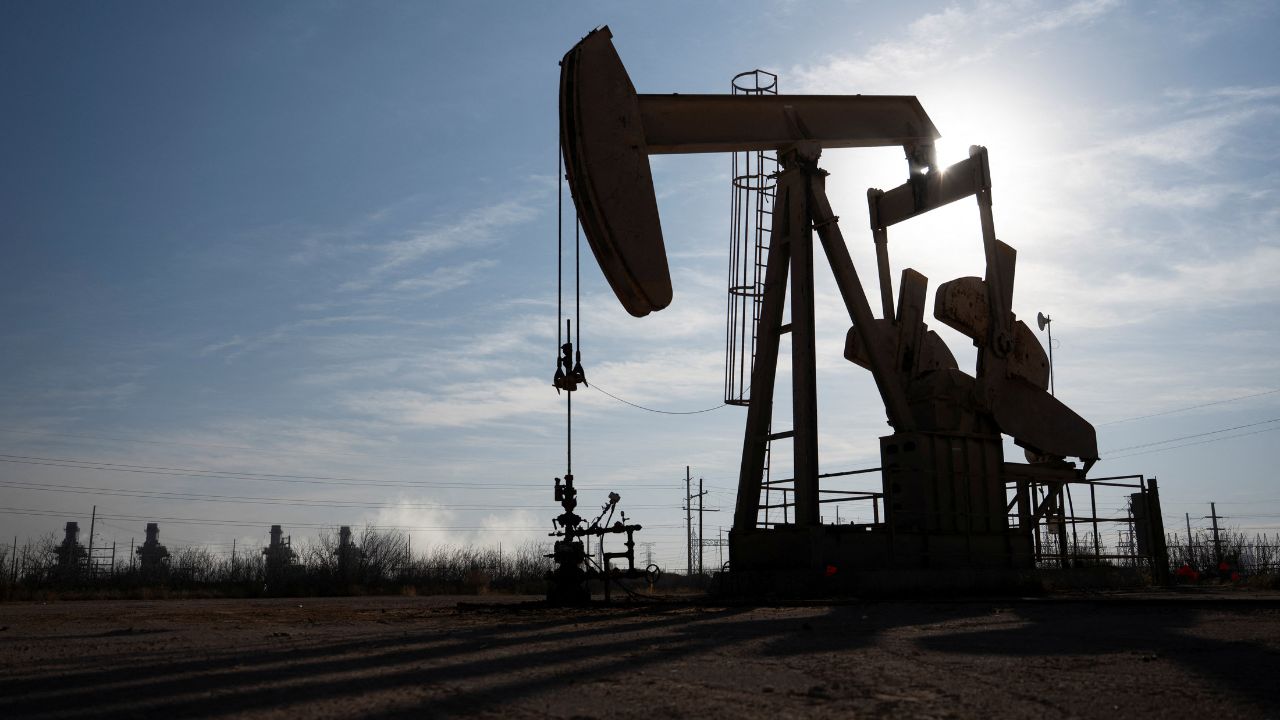
A pump jack operates near a gas turbine power plant in the Permian Basin oil field outside of Odessa, Texas, U.S. February 18, 2025. (Reuters/Eli Hartman)

Share
|
Getting your Trinity Audio player ready...
|
Oil prices fell about 2% to a two-week low on Tuesday on hopes tensions between the United States and Iran were easing after Iran’s foreign minister said the countries had reached an understanding on the main “guiding principles” of their nuclear talks.
Brent futures fell $1.41, or 2.1%, to $67.24 a barrel at 11:50 a.m. EST (1650 GMT), while U.S. West Texas Intermediate (WTI) crude fell 65 cents, or 1.0%, to $62.24 in volatile trading, putting both crude benchmarks on track for their lowest close since February 2. Earlier in the session WTI prices rose more than $1.
Iran and the United States reached an understanding on the main “guiding principles” in a second round of indirect talks in Geneva over their nuclear dispute on Tuesday, but that does not mean a deal is imminent, Iranian Foreign Minister Abbas Araqchi said.
The talks took place amid a U.S. military buildup in the Middle East. Iran’s supreme leader said on Tuesday that any U.S. attempt to depose his government would fail.
Oil prices are likely to stay volatile, with sharp two-way swings driven by diplomatic signals rather than pure demand-supply fundamentals, said Sugandha Sachdeva, founder of SS WealthStreet, a New Delhi-based research firm.
Investors are closely watching U.S.-Iran relations as any escalation or conflict could lead to Iran closing the Strait of Hormuz. About a fifth of the oil consumed globally passes through the Strait of Hormuz between Oman and Iran, making any disruptions in the area a major risk to global oil supplies.
Iran and fellow Organization of the Petroleum Exporting Countries (OPEC) members Saudi Arabia, United Arab Emirates, Kuwait and Iraq export most of their crude via the Strait, mainly to Asia.
In 2025, Iran was the third-biggest crude producer in OPEC behind Saudi Arabia and Iraq, according to U.S. Energy Information Administration data.
Another factor weighing on prices was the gradual increase in oil production at Kazakhstan’s giant Tengiz oil field after an outage in January, Russian news agency Interfax reported.
Russia and Ukraine
Also in Geneva on Tuesday, Ukrainian and Russian officials were set to meet for a new round of U.S.-brokered peace talks, which the Kremlin said would likely focus on territory – the main sticking point.
Any peace resolution could see a lifting of sanctions on Russia, bringing Russian oil back to the mainstream market. In 2025, Russia was the third-biggest crude producer in the world behind the United States and Saudi Arabia, according to data from the U.S. EIA.
Ukraine, meanwhile, continued its attacks on Russian energy infrastructure. The Ukrainian military said on Tuesday it struck the Ilsky refinery, while a drone attack was also reported at the port of Taman.
—
(Reporting by Scott DiSavino and Siddharth Cavale in New York, Robert Harvey in London, Mohi Narayan in New Delhi and Anushree Mukherjee in Bengaluru; additional reporting by Stephanie Kelly; Editing by Thomas Derpinghaus, Will Dunham, David Holmes, Chizu Nomiyama and Andrei Khalip)