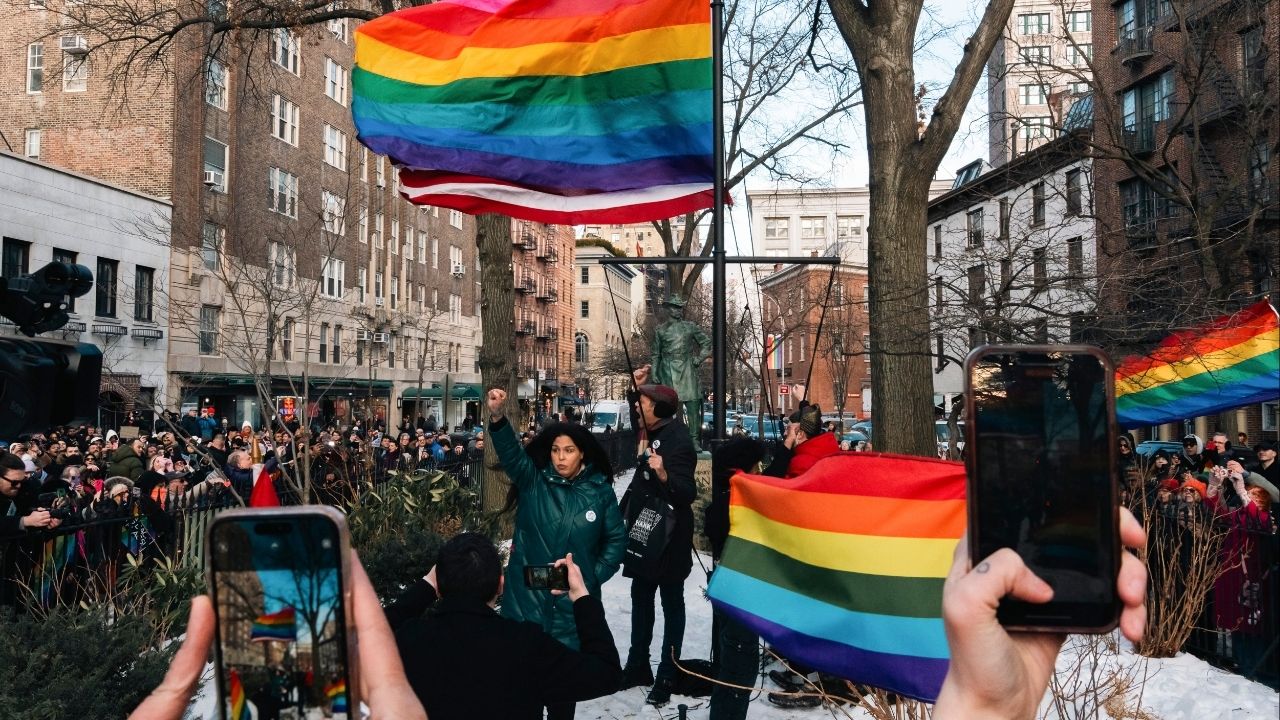
Activists add a Pride flag to the flagpole at Stonewall National Monument, where one previously flew before the Trump administration had it removed, in Manhattan’s Greenwich Village neighborhood, Feb. 12, 2026. A group of nonprofits filed a lawsuit in federal court on Tuesday, Feb. 17, 2026, against the Trump administration, arguing that its decision to remove the Pride flag from the Stonewall National Monument in Manhattan this month violated a federal law that allows national parks and monuments to fly Confederate flags. (Cristina Matuozzi/The New York Times)

Share
|
Getting your Trinity Audio player ready...
|
A group of nonprofits filed a lawsuit in federal court Tuesday against the Trump administration, arguing that its decision to remove the Pride flag from the Stonewall National Monument in New York City this month violated a federal law that allows national parks and monuments to fly Confederate flags.
The lawsuit, led by a foundation honoring Gilbert Baker, the artist who created the rainbow Pride flag in 1978, seeks to restore the official Pride flag to the monument in Manhattan’s Greenwich Village.
The flag was removed from the monument’s small triangular park, the symbolic heart of the gay rights movement, apparently during the night of Feb. 8. Employees at the historic Stonewall Inn, the gay bar for which the monument is named, noticed the flag was missing when they arrived for work the next morning.
Hundreds Gather to Replace Flag
Days later, hundreds of people gathered in the park on Christopher Street to replace the flag. A Pride flag was still flying there Tuesday morning. But only the official flag that was removed is sanctioned by the National Park Service, meaning that any replacement flags can be taken down at any time, said Alexander Kristofcak, a lawyer representing the Gilbert Baker Foundation in the lawsuit.
When asked about its decision to remove the sanctioned Pride flag, the park service referred to a federal memo issued Jan. 21 stating that, with some exceptions, only the U.S. flag and other flags authorized by Congress or the agency can be flown on flagpoles managed by the park service.
In the lawsuit, the Gilbert Baker Foundation argued that the original Pride flag fell under one of the allowed exceptions: to provide historical context at national monuments. This is the exception that allows Confederate flags to be flown at properties managed by the park service, including Gettysburg National Military Park.
Rather than following the law, the lawsuit argues, the decision to remove the flag was part of an effort by the Trump administration to discriminate against the LGBTQ+ community.
The Department of the Interior and the National Park Service did not respond to emails seeking comment Tuesday morning.
“It’s not just any park, and it’s not just any flag,” said Karen Loewy, a lawyer for Lambda Legal, a civil rights group participating in the suit. “It’s hard not to view this removal in the broader context of the Trump administration’s efforts to erase the existence of LGBTQ+ people, and transgender people in particular.”
Park Removes References to Transgender People
Last February, the park service removed references to transgender people from sections of the Stonewall National Monument’s website. In June, during Pride Month, Defense Secretary Pete Hegseth stripped the name of Harvey Milk, one of the country’s first openly gay elected officials, from a U.S. Navy ship. In October, Kash Patel, the FBI director, fired an agent in training after he hung a Pride flag near his desk.
The Trump administration has broad powers to interpret federal rules, Kristofcak said. However, it must follow federal law when doing so, and any changes “can’t be motivated by animus toward a particular group,” he said.
After so many decisions by the administration to strip the symbols and history of the gay rights movement from federal properties and agencies, the removal of the Pride flag from the Stonewall monument “raises the inference that this is really targeted at the LGBTQ community,” Kristofcak said. The Stonewall Inn, on Christopher Street, has long been seen as a cradle of the movement after a police raid there in June 1969 set off three days of protests and riots in the surrounding streets.
The lawsuit was filed by the Gilbert Baker Foundation, Village Preservation (formerly the Greenwich Village Society for Historic Preservation) and Equality New York, an advocacy organization.
—
This article originally appeared in The New York Times.
By Christopher Maag/Cristina Matuozzi
c. 2026 The New York Times Company
RELATED TOPICS:
Categories



Venezuelan Housing Prices Jump as Emigres Consider Buying