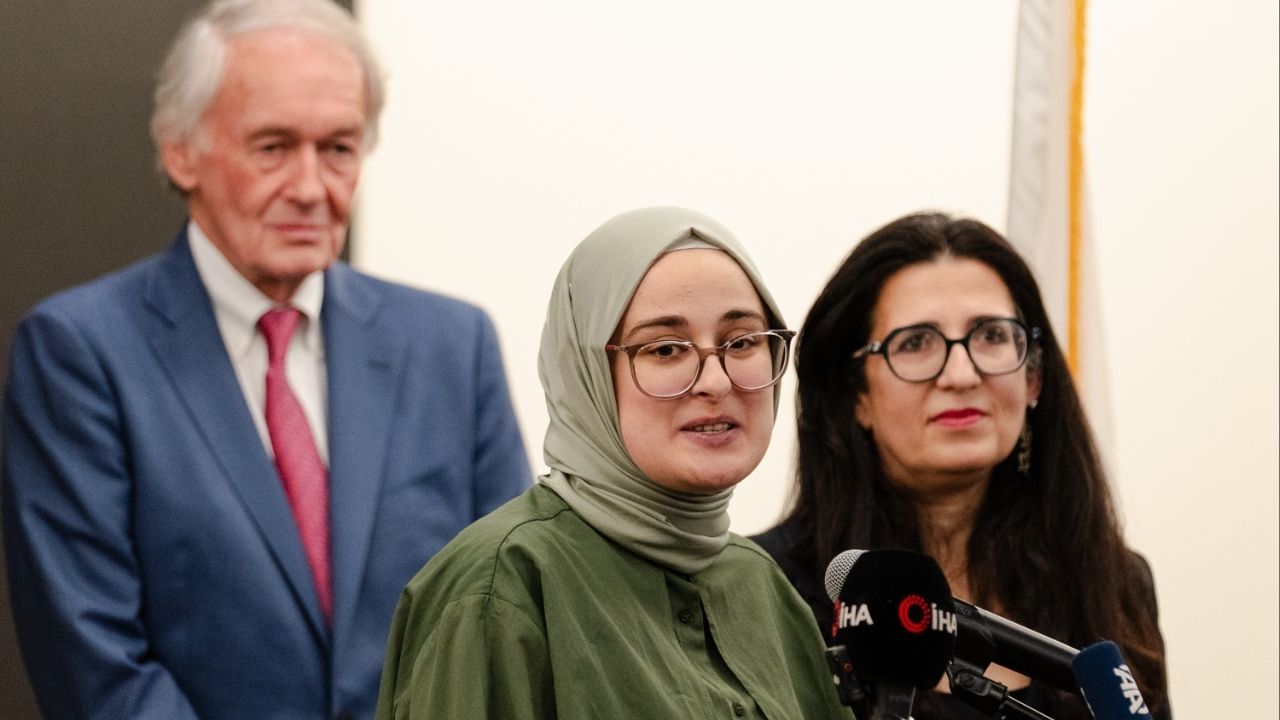
Rumeysa Ozturk speaks during a news conference with her legal team at Boston Logan Airport in Boston, May 10, 2025. An immigration judge has found there were no grounds to deport a Turkish graduate student whose arrest by masked agents last year was an early salvo in the Trump Administration’s crackdown on migrants. (Sophie Park/The New York Times)

Share
|
Getting your Trinity Audio player ready...
|
An immigration judge has found there were no grounds to deport a Turkish graduate student whose arrest by masked agents last year was an early salvo in the Trump administration’s crackdown on migrants.
The decision by the judge, Roopal Patel, came last month and was disclosed in federal court by lawyers for the student, Rumeysa Ozturk, this week. It effectively means that the government has no legal justification to deport Ozturk, a graduate student at Tufts University.
Patel, who as an immigration judge is a Justice Department employee, blocked any further proceedings against Ozturk, but the government can appeal the decision to the Board of Immigration Appeals.
A State Department official said in an email in response to the decision that the Trump administration would abide by all laws, regulations and court orders.
Ozturk said in a statement that she had breathed a sigh of relief at the decision, knowing that her case “may give hope to those who have also been wronged by the U.S. government.”
Mahsa Khanbabai, a lawyer for Ozturk, said that the decision was a “powerful affirmation of fairness and the rule of law.”
“We hope this decision serves as a reminder that immigration enforcement must always be guided by justice,” she said in an email, adding, “If the Sec. of State can on a whim decide to revoke a person’s visa what does that say about impartiality, the rule of law, and transparency?”
Starting in March, the Trump administration made a number of high-profile arrests of international students who had been involved in the pro-Palestinian movement. Almost all of those students were freed — after weeks and sometimes months — by federal district judges who questioned the legality of their detentions.
In September, a judge ruled that the government had unlawfully targeted the students over their speech. But his rulings have carried no penalties for the administration, which has long since moved on to a different phase of the immigration crackdown, evidenced in its large-scale operation in Minnesota and a new State Department policy blocking immigrants from 75 different countries.
Ozturk was arrested in Somerville, Massachusetts, in March, and footage of the terrified student being whisked into a car by masked government agents led to an outcry from critics of the Trump administration. She was held in detention in Louisiana for 45 days until a federal judge in Vermont, where she had been driven before she was moved to Louisiana, released her on bail.
After her release, the government continued its fight to deport her, as it has with many other international students who were detained, then freed.
Documents from a different legal case in Massachusetts revealed that the sole reason the government sought to deport Ozturk was that she had co-written an editorial in the Tufts student newspaper calling on the school’s leadership to consider pro-Palestinian student resolutions related to Israel.
Shortly after Ozturk’s arrest, Secretary of State Marco Rubio announced that her F-1 student visa had been revoked, saying that she had participated in a pro-Palestinian movement that upended American university campuses.
“Why would any country in the world allow people to come and disrupt?” he said, adding that it was a privilege to study in the United States — not a right.
Roopal found, though, that Rubio’s revocation of Ozturk’s visa did not require her removal from the country, because Ozturk’s legal status in the United States is not predicated on the visa. The mere revocation of a visa does not automatically justify a person’s deportation, the judge found.
Ozturk and other similarly situated students, including Mahmoud Khalil and Mohsen Mahdawi, who attended Columbia University, won their freedom last year. But all three are involved in federal appeals court cases that evolved from their initial attempts to win release and could fundamentally reshape immigration law in favor of the Trump administration.
Last month, a New Jersey federal appeals court considering Khalil’s case found that federal district judges are not the proper authorities to weigh the constitutionality of immigration detention. Khalil’s lawyers are appealing that ruling, but if it stands, it would likely make it more difficult for immigration lawyers to free their clients from detention.
Ozturk is fighting a similar case in a New York appeals court, which is where her lawyers disclosed Patel’s ruling this week.
They argued the ruling underscored the dangers of the government’s interpretation of a key immigration law, the Immigration and Nationality Act, given how little justification Roopal had found for the deportation proceedings against Ozturk.
“Under the government’s view, it could punitively detain any noncitizen in retaliation for her speech for many months, so long as it simultaneously institutes removal proceedings — no matter how unmeritorious — all without any federal court review of the lawfulness of detention at any time,” they wrote.
—
This article originally appeared in The New York Times.
By Jonah E. Bromwich/Sophie Park
c. 2026 The New York Times Company