
|
Getting your Trinity Audio player ready...
|
KYIV, Ukraine — For over a year, Russian forces have slogged through battlefields in Ukraine without seizing a single urban stronghold.
Now, these attritional advances are on the verge of paying off. Russia appears poised to complete the capture of three strategic areas in the coming weeks or months, according to military experts and independent battlefield monitors.
Capturing all three areas — the town of Huliaipole in the southeast and the cities of Pokrovsk and Myrnohrad, about 60 miles northeast — would give Russia an urban foothold to base troops and organize logistics for future offensives, as well as new leverage in U.S.-mediated peace talks.

Russia is unlikely to rapidly convert these gains into further territorial expansion given how slowly its troops have advanced over the past year, experts say. But the gains would reinforce Moscow’s argument that its ground advance, while slow, is inevitable, and that Ukraine would be better off ceding land now as part of a deal, rather than losing it later in bloody fighting.
Russia is making new advances in the south.
Russia’s Most Threatening Push
Russia’s most threatening push is in the southeastern Zaporizhzhia region. Huliaipole, a town that anchored part of this front for years, is almost entirely under Russian control, according to battlefield maps from independent groups and to Capt. Dmytro Filatov, a Ukrainian officer fighting in the area.
Filatov, commander of the 1st Separate Assault Regiment, said in text messages last week that Ukrainian forces still held a few buildings inside Huliaipole. But “the majority of the town is fully under enemy control,” he said, adding that 95% of the troops there were Russian.
Huliaipole, with a prewar population of 12,000, was one of the last Ukrainian-held urban centers in the region outside the regional capital, the city of Zaporizhzhia. Beyond Huliaipole lie open fields, giving Ukrainian troops few built-up areas to hunker down and thwart Russian advances.
About 40 miles west of Huliaipole, Russian forces are closing in on the outskirts of the city of Zaporizhzhia, an industrial hub of 700,000 people known for its steel. Battlefield maps show Moscow’s troops about 15 miles from the city’s southern entrance. Military experts warn that further advances would put the area within range of small attack drones, exposing residents to round-the-clock aerial assaults.
Analysts attribute Russia’s gains in the area to thin Ukrainian defenses, as Ukraine concentrates its forces on holding cities in the neighboring Donetsk region.
Even there, Ukrainian troops are in a tough spot.
Pokrovsk and Myrnohrad are on the brink.
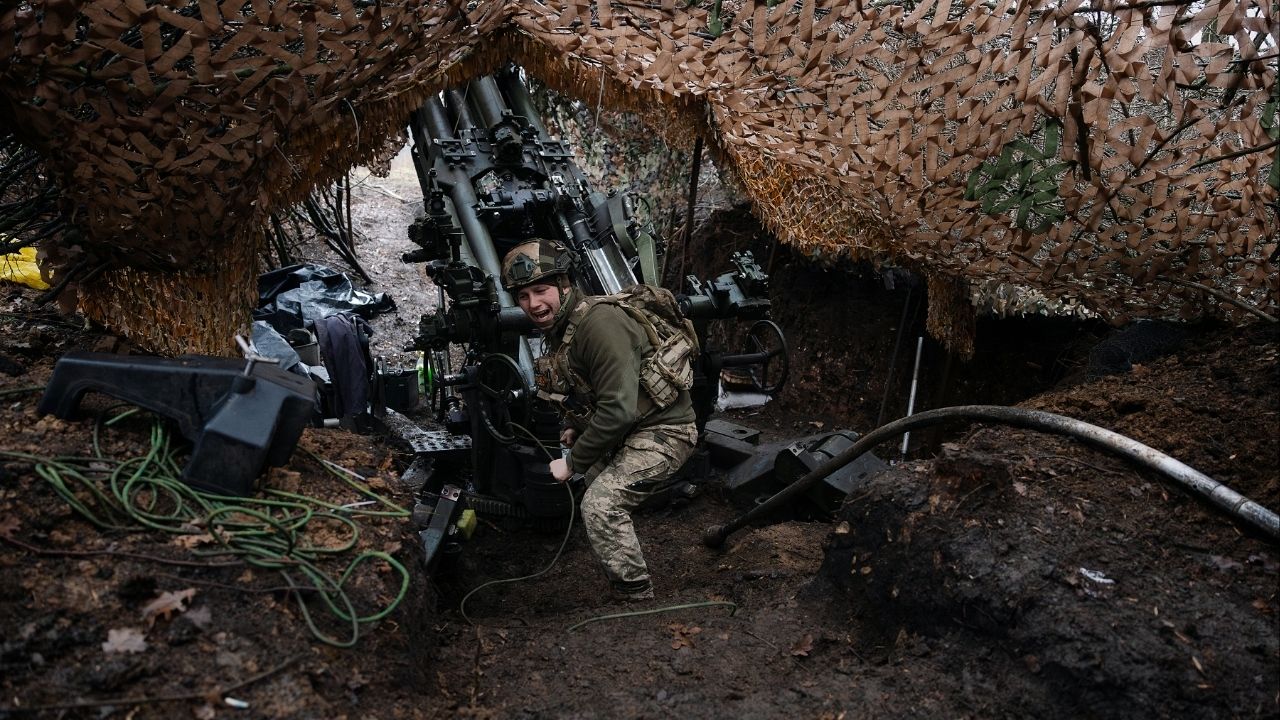
In Donetsk, Ukraine has focused on defending the cities of Pokrovsk and Myrnohrad, which together had a prewar population of more than 100,000. Troop deployments there, combined with sophisticated drone warfare, have slowed Russian assaults to a crawl.
A report in January from the Center for Strategic and International Studies, a Washington-based think tank, found that Russian troops had advanced only 230 feet per day in their year-and-a-half-long offensive on Pokrovsk and Myrnohrad — slower than the movement by Allied troops in the Battle of the Somme during World War I.
Russia has captured less than 1.5% of Ukrainian territory since 2024, according to the report.
The think tank also estimated that Russian forces suffered about 415,000 dead, wounded and missing last year in battles that were largely focused on the two cities. Russia has sustained about 1.2 million battlefield casualties since it invaded Ukraine in 2022, according to the think tank, roughly double Ukraine’s losses.
Despite the toll, Moscow believes it can outlast Ukraine in a war of attrition, relying on constant recruitment to replenish its ranks. Russia has repeatedly poured troops into Pokrovsk and Myrnohrad. Only small sections on their outskirts remain contested.
Should Russia fully capture those cities, it could use them to conceal drone operators and exploit roads and railways to streamline logistics.
Next Target
The next target is Kostyantynivka.
Military experts say capturing Pokrovsk and Myrnohrad would give Moscow a springboard to push north and pursue its goal of taking all of the Donetsk region, about three-quarters of which it already controls.
A major target could be Kostyantynivka, 25 miles farther east.
Kostyantynivka is the southern gateway to a chain of cities forming Ukraine’s last major defensive belt in Donetsk. Should it fall, nearly all cities farther north would come within range of Russian drones, and Moscow would gain access to a key road linking these cities.
After partly surrounding the city last year, Russian forces began infiltrating it this winter, according to battlefield maps. Moscow has also intensified drone strikes against roads that Ukrainian troops use to resupply the city.
A Ukrainian brigade commander recently said that approaching Kostyantynivka had become so dangerous that most supply missions into the city were entrusted to robot-like remotely operated vehicles.
If Russian troops advance on the battlefield, Ukraine is likely to face more pressure on the diplomatic front — including from President Donald Trump, who has echoed Moscow’s argument that Ukraine should cede land in a peace deal to avoid more fighting.
At a meeting in December with President Volodymyr Zelenskyy of Ukraine, Trump asked: “Are you better off making a deal now?”
—
This article originally appeared in The New York Times.
By Constant Méheut/Tyler Hicks
c. 2026 The New York Times Company