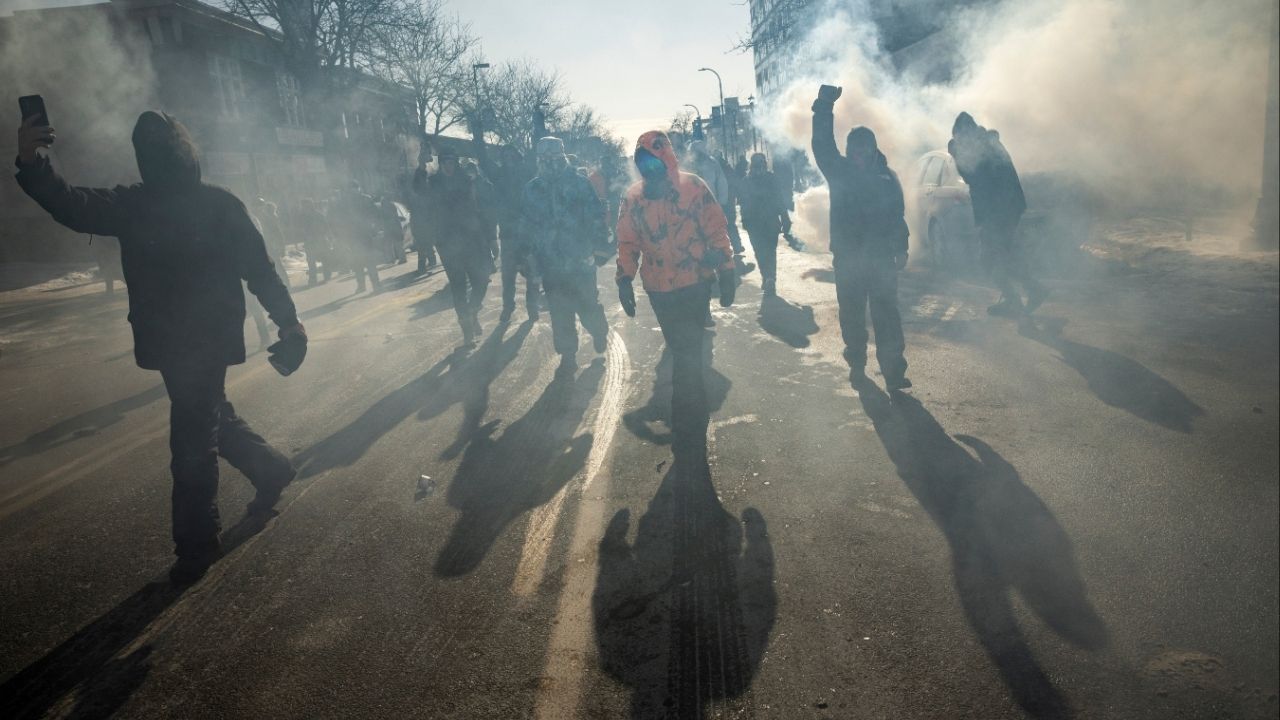
Protesters are surrounded by tear gas after confronting federal agents in Minneapolis, on Saturday, Jan. 24, 2026. The Trump administration’s Justice Department touted federal charges against 16 people over assaulting federal agents, but later decided to pursue more than half of the cases as low-level misdemeanors, including some that were downgraded after being filed as serious felonies. (David Guttenfelder/The New York Times)

Share
|
Getting your Trinity Audio player ready...
|
When the Justice Department charged 16 people last week with assaulting federal agents involved in the Trump administration’s immigration crackdown in Minnesota, Attorney General Pam Bondi flew halfway across the country to be “on the ground,” as she put it, when the cases were unsealed.
Bondi talked tough, posting on social media that “NOTHING will stop President Trump and this Department of Justice from enforcing the law.” She even included images of some of the defendants — dramatic photos showing them standing with their captors, whose backs were turned to the camera.
But now that the cases have moved from the headlines into the courthouse, things look somewhat different. The U.S. attorney’s office in Minnesota has decided to pursue more than half of the cases as low-level misdemeanors, including some that were downgraded after being filed as serious felonies, court papers show.
While all of the cases are still in an early stage, the decision to proceed with most as misdemeanors, not felonies, fits a pattern that has played out in other cities where the administration has conducted immigration surges and taken a muscular stance against those accused of assaulting or impeding federal officers.
Grand Juries Refused to Charge in Agent Encounters
In places like Los Angeles, Washington and Chicago, grand juries have refused at times to bring indictments against people charged in encounters with agents. Prosecutors have also dropped charges to misdemeanors from felonies or dismissed cases altogether because the underlying facts could not sustain the initial allegations.
And in some instances, trial juries have acquitted people accused of assaulting officers — including prominent defendants like Sean C. Dunn, the Washington man who hurled a sandwich at an agent in an act of opposition to President Donald Trump’s law enforcement policies that went viral.
Administration officials have repeatedly asserted that federal agents in Minnesota have been under constant attack as they carry out the White House’s hard-line deportation efforts — especially after immigration officers fatally shot two people, Renee Good and Alex Pretti, in Minneapolis last month. Justice Department leaders, including Bondi, have made charging protesters who assault or interfere with agents a top priority, pushing local prosecutors to act as aggressively as they can in bringing such cases.
But in their zeal, department officials may have stepped over the line of rules governing the release of sensitive information in criminal cases.
Defense lawyers have taken issue with Bondi’s decision to publish the images of some of the 16 protesters charged last week in an apparent violation of department policy. The Justice Department also released videos of the arrest Thursday of Kyle Wagner, a purported member of the leftist anti-fascist movement known as antifa, who was accused of making online statements threatening federal agents.
The Justice Department did not immediately respond to a request for comment.
Already, prosecutors in Minnesota have dismissed one officer assault case in its entirety, acknowledging last week that they would no longer press charges against a man named Jose Espinoza-Espinoza. Espinoza-Espinoza was initially accused of ramming his vehicle into federal agents during an immigration operation outside a Mexican restaurant in Virginia, Minnesota, last month.
Prosecutors have also moved to dismiss assault charges against another man, Maxwell Collyard, who was accused of interfering with the arrest of a fellow demonstrator during a protest in Minneapolis in December and then joining a group of protesters who tackled an Immigration and Customs Enforcement officer.
Court papers have offered little reason for why prosecutors have decided to drop the charges against the men.
16 Protesters Charged
When the 16 protesters were arrested last week, all of them were charged in criminal complaints with violating a statute that makes it illegal to assault, interfere with or impede a federal law enforcement agent. Most of the demonstrators were charged under a section of the statute that permits prosecutors to proceed with the charges either as a felony or a misdemeanor, but a few were charged under a different section reserved for serious felony cases.
In one of those cases, a woman named Gillian Etherington was accused of ramming her car into two federal vehicles and then, after agents tracked her down and sought to detain her, reaching for one of their service weapons. But Etherington’s case was dropped to a misdemeanor Tuesday without explanation.
That same day, prosecutors downgraded another officer assault case that was not part of the 16 cases promoted by Bondi. It involves a woman named Emily Baierl, who was originally charged with a felony after biting the finger of a federal agent during a protest of Pretti’s killing; she will now be charged with a misdemeanor.
Most of the 16 assault cases filed last week involved relatively minor offenses that seemed to lack the intent to do bodily harm and did not involve the use of a deadly weapon, both of which are needed to bring felony charges.
The protesters were accused of a range of activity, including throwing eggs at agents, slapping their hands, hitting an agent’s vehicle with a cane or kicking a car door that ultimately struck an agent in the leg.
—
This article originally appeared in The New York Times.
By Alan Feuer/David Guttenfelder
c. 2026 The New York Times Company
RELATED TOPICS:
Categories


US Booed, Cheered During Milano Cortina Olympics Opening Ceremony