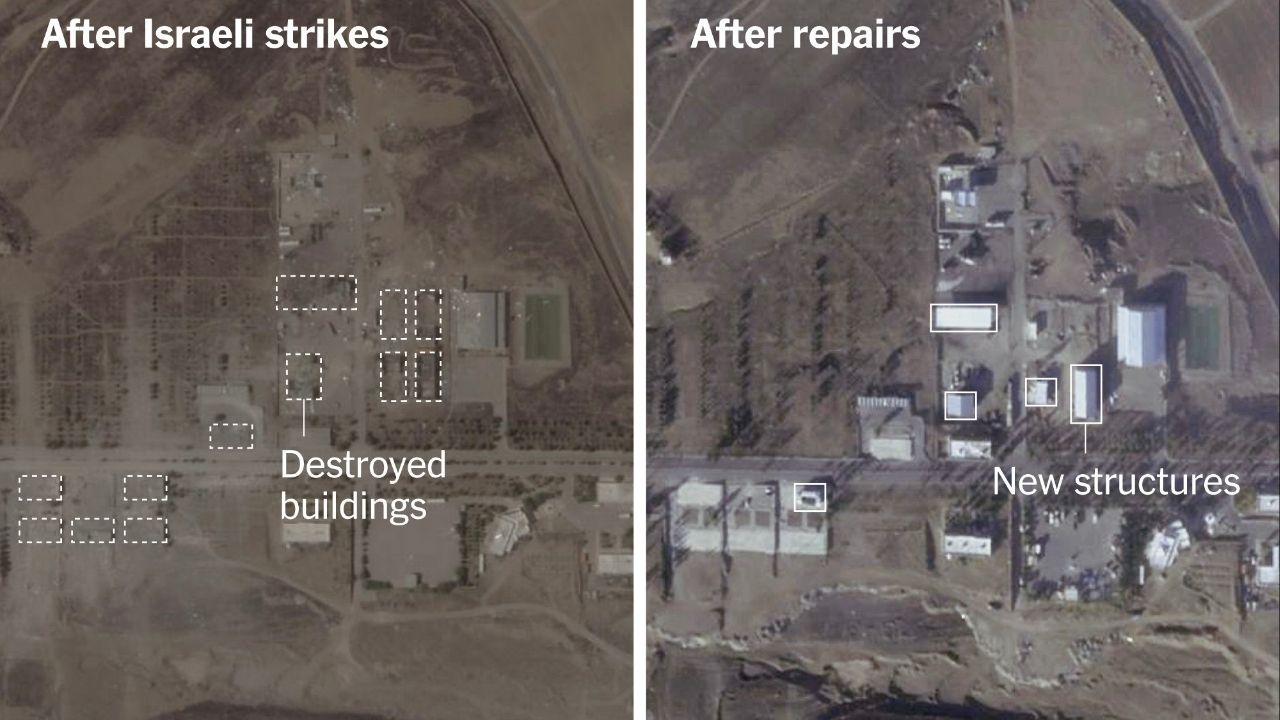
Images of a missile facility near Amand, Iran, at left on June 29, 2025 after Israeli airstrikes, and on Nov. 11, 2025, after repairs were made. Iran appears to have rapidly repaired several ballistic missile facilities damaged in strikes last year, but it has made only limited fixes to major nuclear sites struck by Israel and the United States, a New York Times analysis of satellite imagery suggests. (Planet Labs via The New York Times)

Share
|
Getting your Trinity Audio player ready...
|
Iran appears to have rapidly repaired several ballistic missile facilities damaged in strikes last year, but it has made only limited fixes to major nuclear sites struck by Israel and the United States, a New York Times analysis of satellite imagery suggests.
The uneven pace of reconstruction offers clues about Iran’s military priorities as the United States amasses forces near it and President Donald Trump weighs new military action. If the United States were to attack, Iran would most likely retaliate with ballistic missiles targeting Israel and U.S. assets in the region.
The United States and Iran were expected to meet in Oman on Friday in an attempt to stave off another conflict. The scope of the talks were not immediately clear, but Iran’s nuclear program was likely to be a key focus.
Experts who closely track Iranian nuclear and missile programs corroborated the analysis by the Times, which looked at around two dozen locations struck by Israel or the United States during the 12-day conflict in June. The Times found construction work at more than half of them.
The experts cautioned that the full extent of the repairs remains unclear, given that satellite imagery offers only an aboveground view of the construction.
The imagery reviewed by the Times indicates that some fixes came soon after the strikes at several missile facilities, suggesting that Iran has made missile production its short-term priority.
“Threatening Israel and U.S. bases and allies in the region with missile attacks is one of Iran’s few options to deter repeat strikes on its nuclear facilities,” John P. Caves III, an expert consultant with the Center for the Study of Weapons of Mass Destruction at National Defense University in Washington, wrote in an email.
By contrast, experts say, the images of Iran’s damaged major nuclear facilities show only partial repairs and fortification efforts, which picked up pace only in recent months.
Western and Israeli officials have found few signs that Iran has made significant progress toward rebuilding its ability to enrich nuclear fuel and to fashion a nuclear warhead.
Replenishing a Missile Arsenal
Satellite images analyzed by the Times show that repair work has been carried out over the past few months at a dozen missile facilities or more, including production sites.
Intelligence assessments have found that Iran has largely rebuilt its ballistic missile program since the attacks in June.
“The emphasis that’s been put on rebuilding the missile program stands in contrast to the nuclear program,” said Sam Lair, a research associate at the James Martin Center for Nonproliferation Studies in Monterey, California.
Lair said that the Shahroud missile test facility appeared to have been rebuilt particularly quickly and that it was believed to have become operational again within months of the strikes. When snow fell last month, he noted, roads at the facility were quickly cleared and snow melted off roofs, suggesting the site is active.
“Shahroud is their largest and newest solid-propellant missile production plant,” he said. “So it makes sense that it got all of the attention.”
Limited Nuclear Rebuilding
The White House’s National Security Strategy, published in November, says that the strikes “significantly degraded Iran’s nuclear program.”
Experts say that despite some visible work, Iran’s three main enrichment facilities — Isfahan, Natanz and Fordo — appear inoperative.
Since December, Iran has erected roofs at two of the facilities, which makes it hard to determine whether any rebuilding is happening inside the structures. Experts say that could mean it is trying to recover assets without being observed from above. Much of the other aboveground damage caused in June remains visible.
At the Natanz nuclear complex roughly 140 miles south of Tehran, which is considered Iran’s main center for uranium enrichment, damage visible in early December has since been covered by a white roofing structure. The damaged building has been identified as the pilot fuel enrichment plant by the Institute for Science and International Security, a private group in Washington that tracks nuclear proliferation.
At the Isfahan nuclear complex, strikes destroyed several buildings aboveground, including uranium conversion facilities. One image taken in December shows destroyed buildings that appear to have been covered with a roof.
Less than a mile from the Isfahan aboveground facility, new barriers have been installed at one of the entrances to a nearby mountain tunnel complex, which some experts believe could host a secret enrichment facility. And at a new, underground site less than 2 miles from Natanz known as Pickaxe Mountain, tunnel entrances have been reinforced in recent months.
The Institute for Science and International Security said in a report last week that it had detected an uptick in activity at the Isfahan nuclear complex in past days, most recently to bury tunnel entrances with fresh soil.
David Albright, the president of the institute, said that piling up dirt was likely in “anticipation of an attack, which would imply there’s something in there that’s valuable,” possibly enriched uranium.
Albright said it was not clear what Iran was doing. “But it is increasing suspicion that they’re reconstituting a program to be able to build nuclear weapons,” he said. “We don’t think it is urgent or imminent by any means.”
Another significant development is visible at the Parchin military complex, southeast of Tehran, where Iran has tested high explosives that can be used as triggers for nuclear warheads. Images from recent months show that a large cylindrical chamber about 150 feet long appears to have been recently built at the facility.
The site was not attacked in June, but was targeted by Israel in 2024. It has also been fortified with defenses like antiaircraft artillery, according to a recent report by the Institute for Science and International Security.
“Although the new facility’s intended purpose could not be determined from the imagery, the new construction indicates its strategic significance,” the report said about the new chamber.
—
This article originally appeared in The New York Times.
By Samuel Granados and Aurelien Breeden/Planet Labs
c. 2026 The New York Times Company
RELATED TOPICS:
Categories


Fresno Teen Killed in Pedestrian Crash on Highway 99 Identified

White House Deletes Racist Trump Post Depicting Obamas as Apes