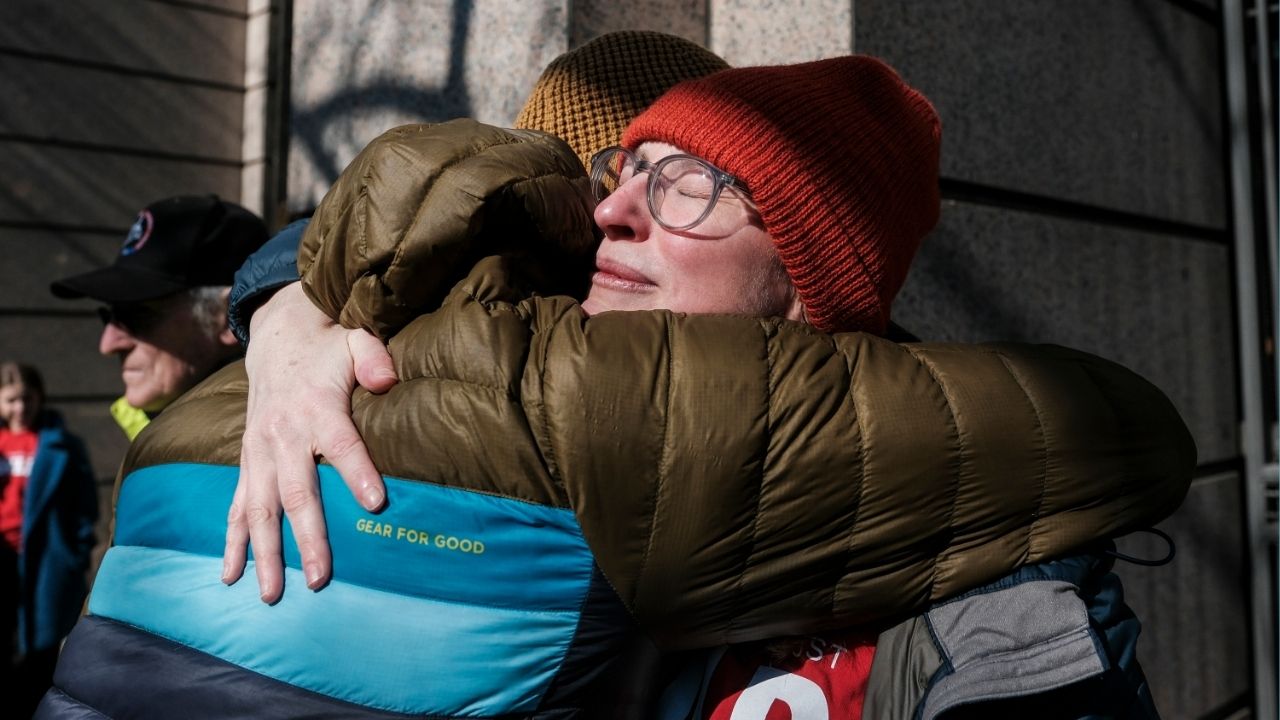
People exchange a hug as former employees of The Washington Post and supporters rally outside of the company’s offices in Washington, on Thursday, Feb. 5, 2026. The Washington Post carried out a widespread round of layoffs on Wednesday that decimated the organization’s sports, local news and international coverage. (Michael A. McCoy/The New York Times)

Share
|
Getting your Trinity Audio player ready...
|
WASHINGTON — Not long into his career at The Washington Post, Martin Weil learned to ignore most of the crackles on the police scanner. One night in June 1972, though, he paused upon hearing this: “Doors open at the Watergate.”
He decided against chasing down the meaning of those words that night. But the next day, he approached the city desk to ask if anything was afoot. The answer was yes — the headquarters of the Democratic National Committee at the Watergate complex had been burglarized.
And the Post, of course, was pursuing that story and many, many others, until it attained what the newspaper’s publisher at the time, Katharine Graham, later termed a position of “dominance” in the Washington region.
On Wednesday, the Post announced plans to move on from that legacy as part of widespread cuts to the newsroom. The layoffs, affecting more than 300 of the roughly 800 journalists at the paper, are landing hard on the local news desk, where Weil has worked since 1965. He was among those laid off, one of the last ties to the paper’s Watergate era.
“I worked there for 60 years, and how many people get to say that about any occupation whatsoever?” asked Weil, who said he had started in his mid-20s but declined to give his current age. The thrill of seeing his work in print “never vanished,” he said. “It never went away. It never got old.”
Weil’s long tenure — he watched at least seven buyouts come and go — has straddled the ascent and the dissolution of the Post’s regional business model. As Weil gathered bylines, the paper blanketed Washington and its suburbs with reporters, and reaped advertising dollars from the car dealerships, department stores and cultural venues across Greater Washington. Now the outlet is embracing more of the national news model that Jeff Bezos, the Amazon founder, has pushed since he bought the Post in 2013.
By the early 2000s, the paper’s metro department had around 200 journalists, said Jo-Ann Armao, a former top local editor at the Post. When calamity struck, the section’s reporters served as the paper’s foot soldiers, fanning out across the region and often delivering prizewinning work. Examples include the Jan. 6 riot at the Capitol, the Virginia Tech shootings, the Beltway sniper attacks and Sept. 11, when the Post published a special late edition that included an article by Weil on the Pentagon attack.
As of Wednesday, that number had shrunk below 20, according to people with knowledge of the cuts.
Weil, when asked about the rise and fall of the department, replied with a chuckle. “It’s like that story about the king of France, who had 40,000 men,” he said. “He marched them up the hill and then marched them down again.”
For most of his Post career, Weil worked the night shift, an assignment that resulted not from management fiat but rather from Weil’s insistence on tinkering with articles for successive editions of the paper. “I’d say, ‘Oh, this needs improvement,’” he recalled.
Killings, robberies and other criminal activity were staples of the Post’s regional focus. “Over the years we’ve covered murders, double murders, triple murders, quadruple murders, a sextuple murder in Prince George’s County, a murder under the dome of the Capitol and a murder in the Washington Post cafeteria,” Weil said in remarks to colleagues for a celebration of his 50th year at the newspaper. “And then fires: brush fires, car fires, barn fires, house fires and a fire in the house of the speaker of the House.”
When mayhem unfolded, Weil made extensive use of a printed directory that listed phone numbers by address, the better to track down possible crime witnesses. Leonard Downie Jr., a former top editor at the Post, recalled Weil’s spiel: “‘Hello, so-and-so, this is Martin Weil of The Washington Post. I’m very sorry to disturb you, but did you know that the fellow next door has been murdered?’”
There was also room for whimsy. More than a decade ago, Weil eyed the layout of the paper’s second print edition and spotted unfilled space. So he wrote about the weather. It became a habit, and his weather reviews — belletristic riffs on the sociology of clouds, rain and sun — quickly earned him an ardent following among Post readers.
“Even 40 days after the winter solstice, it appeared that the ice and snow clogging many streets in the Washington area in sheets, clumps and curbside Everests would be dislodged only by the ministrations of heavy machinery,” Weil wrote last month.
Colleagues commonly mention a routine that he followed for nearly all his years: He circled through much of the newsroom — a time for salutations and small talk — before settling into his work.
He also tells stories, like the time in 1972 that he left the Post building to chase down the story of a youth who had been shot by a police officer after allegedly stealing a bicycle. Weil ended up facing an emergency room attendant at George Washington University Hospital with notebook in hand. “Where are they?” Weil asked.
The attendant pointed to a pair of swinging doors.
The scene behind those doors — bright lights, a large crew of medical personnel, a surgeon struggling to keep the victim alive — startled Weil, who had expected to encounter a corridor full of detectives.
“This doesn’t look good, does it?” he recalled telling the person next to him.
The comment landed him in the hospital’s security office, where the person on duty threatened to arrest him. That’s one firsthand account he never put in the paper.
—
This article originally appeared in The New York Times.
By Erik Wemple/Michael A. McCoy
c. 2026 The New York Times Company