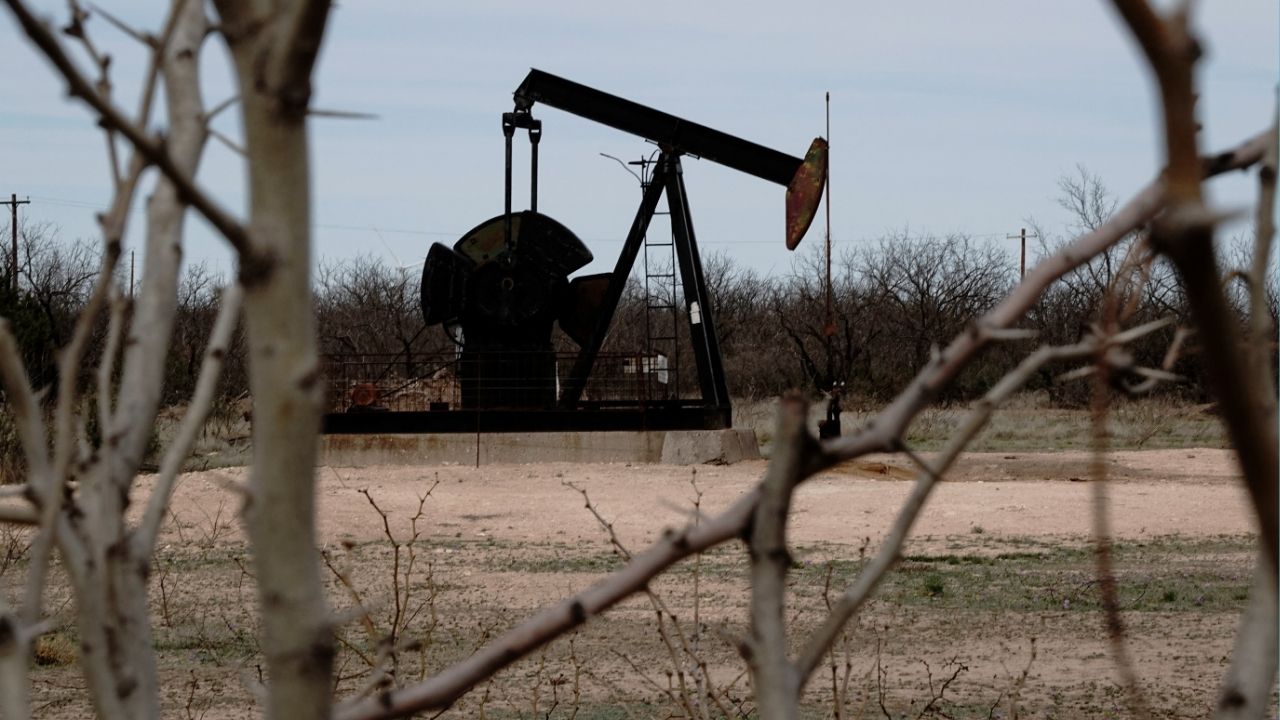
A pump jack drills oil crude from the Yates Oilfield in West Texas’s Permian Basin, near Iraan, Texas, U.S., March 17, 2023. (Reuters/Bing Guan)

Share
|
Getting your Trinity Audio player ready...
|
Oil prices slipped by more than 3% on Thursday after the U.S. and Iran agreed to hold talks in Oman on Friday, easing concerns around any bottlenecks in Iranian crude supplies.
Brent crude futures were down $2.33, or 3.35%, at $67.13 per barrel at 11:12 a.m. EDT (1612 GMT). U.S. West Texas Intermediate crude was down $2.23, or 3.42%, at $62.91.
Oil prices are strongly influenced by tensions in the Middle East, with markets closely watching the talks in Oman, said UBS analyst Giovanni Staunovo.
The discussions come as the U.S. builds up forces in the Middle East, and regional players seek to avoid a military confrontation that many fear could escalate into a wider war.
“Differing expectations around the scope and objectives of the talks are sustaining uncertainty, injecting volatility into crude prices as traders reassess the likelihood of escalation versus diplomacy,” analysts at Aegis Hedging said in a note.
About a fifth of the world’s total oil consumption passes through the Strait of Hormuz between Oman and Iran. Other OPEC members, Saudi Arabia, the United Arab Emirates, Kuwait and Iraq, export most of their crude via the strait, as does Iran.
Volatility has led investors to rush to lock in oil prices this year, trading a record number of WTI Midland at Houston contracts in January, amid concerns around Middle Eastern supply risks and more Venezuelan barrels heading to the U.S. Gulf Coast.
Strength in the U.S. dollar and volatility in precious metals also weighed on commodities and risk sentiment more broadly on Thursday, analysts said.
On the supply side, discounts on Russian oil exports to China widened to new records this week as sellers cut prices to attract demand from the world’s top crude importer and offset the likely loss of Indian sales, traders said.
This comes after a trade deal announced between the U.S. and India earlier in the week where the latter agreed to halt purchases of Russian crude.
Argentina’s energy trade surplus could rise in 2026 from last year’s record due to crude output from the Vaca Muerta shale formation, into a range of $8.5 billion to $10 billion, three analysts told Reuters.
—
(Reporting by Georgina McCartney in Houston, Seher Dareen in London, Additional reporting by Enes Tunagur in London, Katya Golubkova in Tokyo and Siyi Liu in Singapore. Editing by Jan Harvey and Mark Potter)
RELATED TOPICS:
Categories



Iran’s Foreign Minister Heads to Muscat for Nuclear Talks With US

I Was Arrested for Doing My Job as a Reporter. Who’s Next?