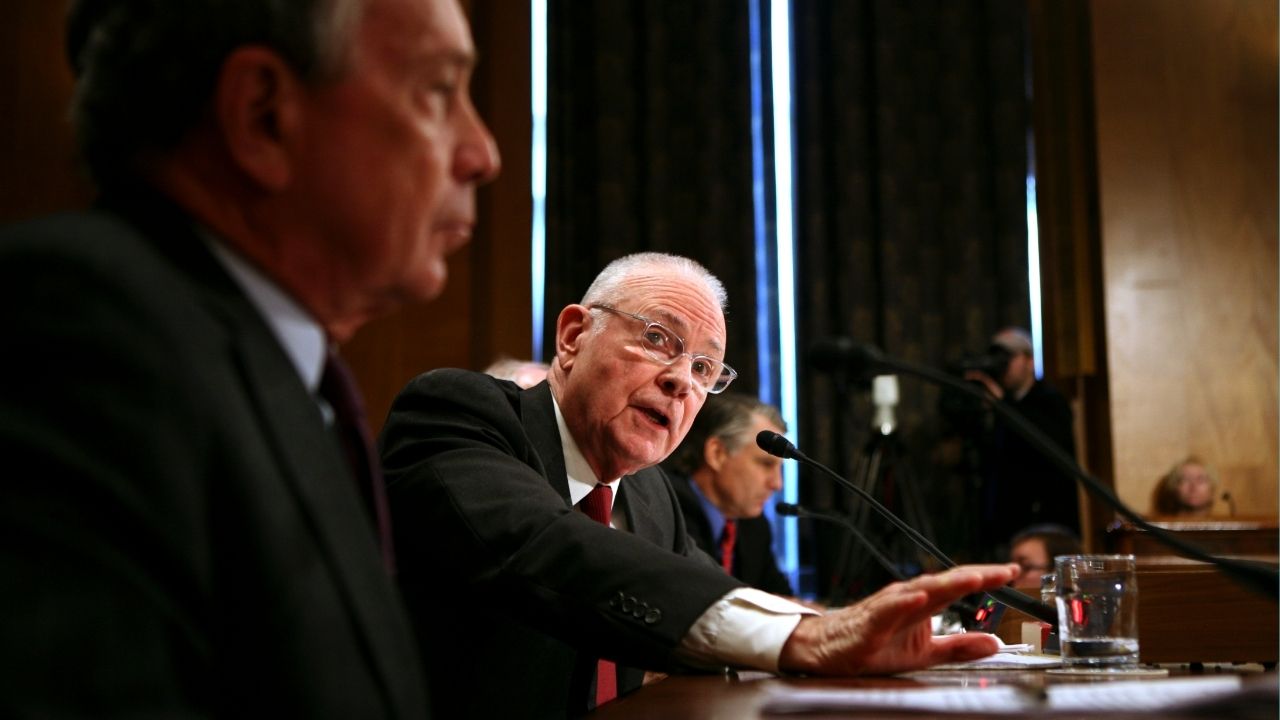
Rep. Lee Hamilton (D-Ind.), chairman of the 9/11 Commission, speaks during a hearing on Capitol Hill in Washington, Jan. 9, 2007. New York Mayor Michael Bloomberg is at left. Hamilton, a former Democratic congressman from rural Indiana who became a major voice in foreign policy during the Iran-Contra affair in the 1980s and in national security investigations after the terrorist attacks of 2001, died on Tuesday, Feb. 3, 2026, at his home in Bloomington, Ind. He was 94. (Doug Mills/The New York Times)

Share
|
Getting your Trinity Audio player ready...
|
Lee H. Hamilton, a former Democratic member of Congress from rural Indiana who became a major voice in foreign policy during the Iran-Contra affair in the 1980s and in national security investigations after the terrorist attacks of 2001, died Tuesday at his home in Bloomington, Indiana. He was 94.
His daughter Deborah Kremer confirmed the death but did not provide a specific cause.
Even at the start of his 34-year congressional career (1965-99), Hamilton displayed a moderation and independence more common to experienced legislators. Open to compromises, voting with Republicans and Democrats, and responsive to constituents (he quickly secured 13 new post offices for his district), he was chosen president of his party’s 89th Congress freshman class.
Reelected 16 Times
Reelected 16 times in a largely Republican district encompassing an 18-county farming region of southeast Indiana, Hamilton in time became head of the House Foreign Affairs and Intelligence committees, a confidant of congressional leaders and the presidents of both parties from Lyndon B. Johnson to Barack Obama, and the author of white papers and books on foreign policy and intelligence matters.
Hamilton was not more widely known until 1986-87, when he and Sen. Daniel Inouye, D-Hawaii, were named the chairs of twin congressional committees to investigate the White House conspiracy known as the Iran-Contra scandal.
The news reports seemed preposterous at first. They suggested that officials of Ronald Reagan’s National Security Council, perhaps with the president’s knowledge, had for years secretly and illegally sold military arms to Iran to unlawfully fund right-wing guerrillas, called Contras, who were fighting to topple a duly elected leftist regime, the Sandinista government, in Nicaragua.
After weeks of some of the most extraordinary testimony ever heard in Congress, Hamilton put out a statement about “a depressing story” of foreign policy run amok in the hands of “private individuals,” of evidence destroyed, lies to Congress and the American people, and fortunes spent in covert operations without accountability.
The Enterprise, as the conspirators called their scheme, raked in $48 million from arms sales to Iran, Hamilton said, had secret Swiss bank accounts, and had its own airplanes, pilots, airfield, secure communications and ship. The group, he said, became a hidden arm of the National Security Council, and carried out a Contra aid program that Congress had specifically prohibited.
“Our government cannot function cloaked in secrecy,” Hamilton told the hearings in June 1987. “It cannot function unless officials tell the truth. The Constitution only works when the two branches of government trust one another and cooperate.”
Among the conspirators were Vice Adm. John Poindexter, the president’s national security adviser, and his deputy, Lt. Col. Oliver North. Both were eventually convicted of multiple felonies, but the rulings were reversed on appeal and the cases dismissed. Reagan’s role was never fully known, though a congressional report said he bore “ultimate responsibility” for subordinates’ actions.
Hamilton’s political standing soared. In 1992, Bill Clinton considered him as a possible running mate, but Hamilton reportedly lost his chance by endorsing a Supreme Court ruling that upheld a Pennsylvania statute limiting abortion rights. Clinton called the ruling “very disturbing,” campaigned for women’s rights and selected Sen. Al Gore of Tennessee for his winning ticket.
Hamilton became chair of the House Foreign Affairs Committee in 1993, succeeding Rep. Dante Fascell, D-Fla., who left Congress after nearly 40 years.
“Mr. Hamilton, 61, is one of his party’s brightest stars, smart, knowledgeable and experienced on television, with a knack for commanding attention,” The New York Times reported. “When Mr. Hamilton walks onstage, Democratic leaders say, they will have their best foot forward, a position they have not had since J.W. Fulbright and Mike Mansfield left the Senate in the 1970s.”
Hamilton Leaves Congress in 1999
After he left Congress in 1999, Hamilton remained influential in national affairs. In 2002, President George W. Bush named him vice chair of the 9/11 Commission, deputy to Thomas H. Kean, the former Republican governor of New Jersey. The panel of five Democrats and five Republicans conducted the most comprehensive inquiry of the terrorist attacks of Sept. 11, 2001.
It wrote a 567-page report in 2004 that laid bare failures by the CIA, the FBI, the Pentagon, the National Security Council and virtually every other agency responsible for defending the nation. It recommended a complete overhaul of intelligence and national security operations, the creation of a Department of Homeland Security and the consolidation of budgets of 15 intelligence agencies.
“A critical theme that emerged throughout our inquiry was the difficulty of answering the question: Who is in charge?” Hamilton said at the time. “Who oversees the massive integration and unity of effort necessary to keep America safe? Too often, the answer is no one.”
Hamilton’s image as a compromiser was on display again in 2006 when, as co-chair of the Iraq Study Group, a bipartisan congressional panel studying dilemmas of the U.S.-led coalition tangled in an ever-deepening war in Iraq, he helped craft a report that called for a phased withdrawal from the conflict over two years.
The report avoided blame for the mess and stuck to recommendations on how to strengthen Iraqi forces and extract America and its allies from a morass that was killing about 3,000 Iraqis and 100 Americans every month.
“At a time when foreign policy issues are part of the partisan trench warfare of Washington, there aren’t many people who can rise above it, but Lee is one of them,” Leon Panetta, a Democratic member of the Iraq group, told the Times in 2006.
Lee Herbert Hamilton was born in Daytona Beach, Florida, on April 20, 1931, the younger of two sons of Frank Hamilton, a Methodist minister, and Myra (Jones) Hamilton. The family moved to Evansville, Indiana, where Lee and his brother, Richard, attended public schools.
At Central High School, Lee was an outstanding basketball player, a high-scoring 6-foot-4 forward-center. His team lost the final game of the state championships in 1948, the year he graduated.
At DePauw University in Greencastle, Indiana, he majored in history, starred on the basketball team (he was inducted into the Indiana Basketball Hall of Fame in 1982), participated in student government and graduated in 1952 with honors and a bachelor’s degree. He studied at Goethe University in West Germany on a scholarship in 1952-53.
In 1954, he married Nancy Nelson, an artist. She died in 2012. In addition to his daughter, Hamilton is survived by two other children, Tracy Souza and Douglas; five grandchildren; and a great-granddaughter.
In 2015, he received the Presidential Medal of Freedom, the nation’s highest civilian honor, from President Barack Obama, who cited the former congressman’s commitment to bipartisanship.
—
This article originally appeared in The New York Times.
By Robert D. McFadden/Doug Mills
c. 2026 The New York Times Company
RELATED TOPICS:
Categories

Fresno Police Arrest 2 in Homicide of 19-Year-Old