
|
Getting your Trinity Audio player ready...
|
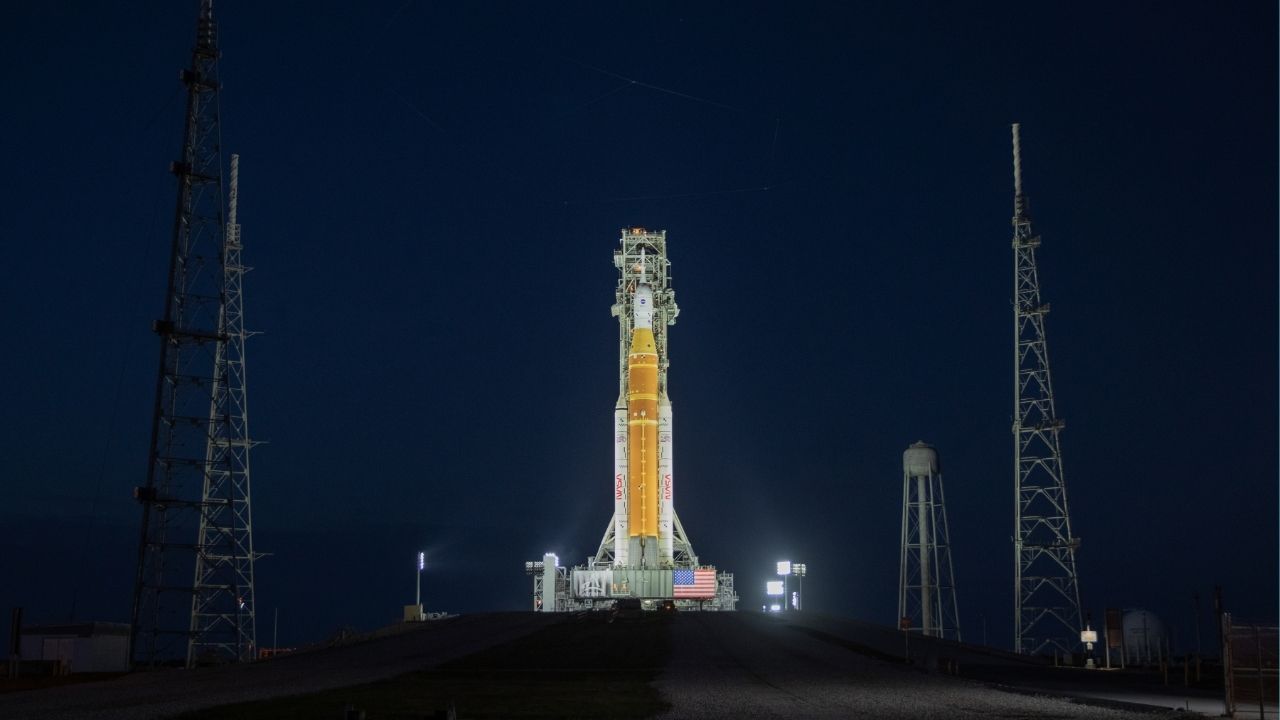
NASA announced Tuesday that it would not try to launch astronauts on an around-the-moon trip until at least March. The decision was made after the agency was unable to complete a countdown rehearsal that started Sunday.
NASA officials had hoped that the Artemis II mission, which would be the first time humans leave low-Earth orbit since the end of the Apollo moon landings more than 50 years ago, might be able to launch as soon as Sunday.
But that would have required a smooth run-through of what the space agency calls a wet dress rehearsal. This two-day test includes filling up the tanks of the giant Space Launch System rocket, a vehicle that includes leftover parts from the space shuttle program, with millions of pounds of liquid hydrogen and liquid oxygen propellants.

Engines Would Not Ignite
For the test run on Launchpad 39B at the Kennedy Space Center in Florida, no astronauts were aboard, and the engines would not ignite. The countdown clock was to tick down to about half a minute to check that the rocket and other systems were operating properly.
But during fueling, leaks of hydrogen occurred. That was an echo of problems that delayed for months the launch of Artemis I, an uncrewed test flight that circled the moon in 2022.
Running hours behind schedule Monday, mission managers persevered, and the rocket’s propellant tanks were eventually filled. That allowed the countdown to proceed into the last 10 minutes. But the hydrogen leak reappeared, and the rehearsal was scrubbed shortly after midnight with about five minutes left in the countdown.
“With more than three years between SLS launches, we fully anticipated encountering challenges,” Jared Isaacman, the NASA administrator, said on social media early Tuesday morning. “That is precisely why we conduct a wet dress rehearsal. These tests are designed to surface issues before flight and set up launch day with the highest probability of success.”
In an update, NASA said the hydrogen leak during fueling had required pauses to let seals warm up and make adjustments in the rate of propellants flowing into the rocket.
Other problems encountered during the countdown included a loose valve and dropouts in audio communications, the agency said.
Mission managers will review data, make fixes to the rocket and launch systems, and run another dress rehearsal before setting a launch date. A NASA news conference that will provide more information is scheduled for 1 p.m. Eastern time.
“We will only launch when we believe we are as ready to undertake this historic mission,” Isaacman said.
Next Launch in March
The next available launch time is Friday, March 6, one of five possible dates in March.
Artemis II will send four astronauts — three from NASA, one from Canada — on a 10-day journey that will swing around the moon without landing. That will provide a crucial test of the life support systems on the Orion capsule before the following mission, Artemis III, is to land on the surface of the moon.
The delay of Artemis II would have cleared the way for a different NASA mission to send a new group of astronauts to the International Space Station on a SpaceX rocket.
That mission, known as Crew-12, was to launch as soon as Feb. 11. But SpaceX also encountered trouble Monday, when the second stage of one of its Falcon 9 rockets did not perform a final engine burn to push back into the atmosphere for disposal.
The problem occurred after the rocket had successfully deployed 25 of SpaceX’s Starlink internet satellites. In a statement, SpaceX said it would investigate and make fixes before resuming Falcon 9 launches, which include the Crew-12 mission.
Russia’s ability to launch astronauts to orbit is also grounded for the moment after a service platform at the launch site was badly damaged in November. In December, Roscosmos, the state corporation that oversees Russia’s space program, said the launchpad would be repaired by the end of February.
—
This article originally appeared in The New York Times.
By Kenneth Chang/Cassandra Klos
c. 2026 The New York Times Company