
|
Getting your Trinity Audio player ready...
|
WASHINGTON — When Nekima Levy Armstrong was transported from the federal courthouse in St. Paul, Minnesota, to the Sherburne County Jail with three layers of shackles on her body — around her wrists, waist and feet — it was the closest, she said, that she had ever felt to slavery.
Still, she walked calmly, her face resolute, her head held high.
But if you saw a photograph that the White House disseminated of Levy Armstrong, who was arrested for protesting at a church service, you would not know it.

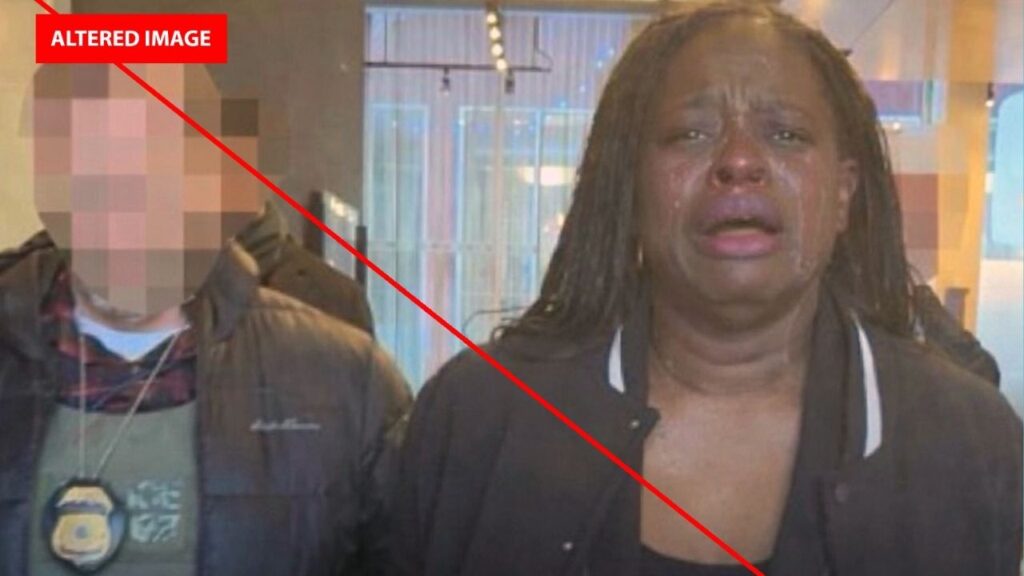
The White House posted a manipulated photo of her arrest to its official social media account, depicting Levy Armstrong, a civil rights attorney and activist, as hysterical — tears streaming down her face, her hair disheveled, appearing to cry out in despair. “ARRESTED” was emblazoned across the photo, along with a misleading description of Levy Armstrong as a “far-left agitator” who was “orchestrating church riots in Minnesota.”
While President Donald Trump and the White House regularly circulate imagery altered by artificial intelligence, including demeaning and racist deepfakes, it is usually so over the top that the goal seems more about cartoonish mockery than outright deceit.
The photograph of Levy Armstrong was different. It has the hallmarks of brazen disinformation from the top level of government: smearing and humiliating one citizen in order to influence public opinion, while sending a warning to other critics to beware of crossing the administration. And it adds a new, social media-era dimension to Trump’s long record of distortions and lies in the service of his policies and political standing.
Levy Armstrong, a 49-year-old mother of four, said she learned about the photo while she was in jail, during a phone call with her husband. When she saw it for herself after she was released the next day, she said, she was “disgusted.”
The exaggerated features and the darkened skin, she said, reminded her of when the bodies of enslaved people were left disfigured to deter uprisings on plantations, or during Jim Crow when racist propaganda would depict Black people as caricatures. She said she remained “cool, calm and collected” during her arrest and the transport to jail.
“They couldn’t break me by arresting me,” Levy Armstrong said, “so they doctored an image to show the world a false iteration of that time to make me look weak.”
“Reducing my image to some scared crying woman was just so degrading, and it just shows how far the office of the president has fallen,” Levy Armstrong said. “The presidency, the White House, is supposed to symbolize the world’s greatest superpower, but instead, they acted like a $2 tabloid.”
When asked about the doctored image, which The New York Times independently confirmed had been manipulated, the White House was unapologetic. Kaelan Dorr, the deputy communications director, brushed it off last week as a “meme.”
“Enforcement of the law will continue,” Dorr wrote on social media, reposting the doctored photograph. “The memes will continue.”
‘A Trophy for MAGA’
The Justice Department sought to prosecute Levy Armstrong under a law that bars using or threatening force and physical obstruction to interfere with or intimidate someone worshipping at a religious institution. But she now faces charges of “conspiracy against rights,” which had been used to protect Black people from harassment by the Ku Klux Klan.
Six other protesters and two journalists, including Don Lemon, also face charges for their roles in the protests, alarming First Amendment experts. Attorney General Pam Bondi has pointed to the cases as evidence that the administration does “not tolerate attacks on places of worship.”
Levy Armstrong, who is an ordained pastor, said that she led the protest Jan. 18 at Cities Church to stand up for immigrants’ right to worship without fear of arrest. A leader at the church, David Easterwood, is the acting director of the Immigration and Customs Enforcement field office for enforcement and removal operations in St. Paul. Easterwood, who was not present at the time of the protest, has been named in a lawsuit challenging aggressive enforcement tactics.
Protesters interrupted the church service with chants of “ICE out” and “Hands up, don’t shoot.” When the pastor yelled, “Shame!” at her from the pulpit, Levy Armstrong began to lead a chant of “Justice for Renee Good,” referring to the 37-year-old woman who was killed by an ICE agent in Minneapolis in early January.
Videos posted on social media show the protest bringing the service to a halt and congregants moving to leave as the chants continue and worship music begins to play.
The protest lasted about 20 minutes, Levy Armstrong said.
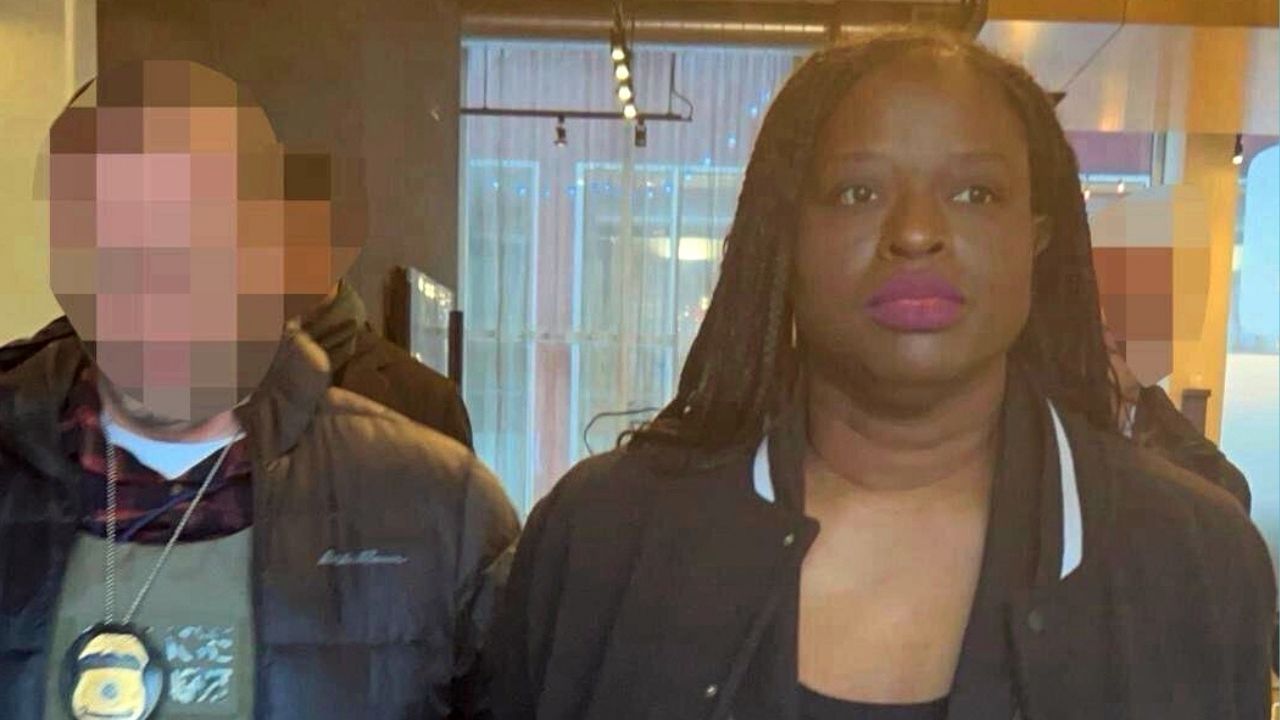
Four days later, on Jan. 22, federal officers arrested Levy Armstrong at a downtown Minneapolis hotel, just minutes from the federal courthouse. While her husband filmed the encounter, she asked the agents to treat her with “dignity and respect.”
She asked one of the agents why he was filming the arrest.
“It’s not going to be on Twitter,” the agent assured her.
“We don’t want to create a false narrative,” the agent added.
She said she responded that she did not want to be a “trophy for MAGA.”
But soon after her arrest, an image of Levy Armstrong was on Twitter. Kristi Noem, the homeland security secretary, posted an arrest picture of Levy Armstrong, apparently without digital manipulation. But within hours, the doctored photo that the White House posted had ricocheted around the country. It has been viewed more than 6 million times.
In a social media post 48 hours before her arrest, Trump called the church protesters “agitators and insurrectionists” who should be “thrown in jail, or thrown out of the Country.”
Legal experts said that the fake image could hurt the Justice Department’s case against Levy Armstrong. Her lawyers could use it to accuse the Trump administration of making what are known as improper extrajudicial statements.
In a court filing, Levy Armstrong’s lawyer pointed to the doctored photo as an example of political persecution and what he called an effort to “defame her” as part of the government’s “fascist offensive against the American people.”
But even if the case is not airtight legally, the social media campaign is a potent signal to protesters that they will pay a very public price for standing up to the administration.
‘We Don’t Know What to Believe’
Hany Farid, a professor at the University of California, Berkeley who researches digital forensics, deepfake imagery and misinformation, said that the White House response was a troubling escalation in its use of artificial intelligence.
“I think reasonable people can say that this one was really different, because the photo was real, and it was AI-modified to change her facial expression, and it was not labeled such, and it wasn’t at all obvious from the context that it was a meme, as the White House wanted to say,” he said.
Farid, who is also the co-founder and chief science officer at GetReal Security, a firm that identifies AI misinformation, added that posting fake content alongside official business not only risked eroding the public trust; it could also backfire.
“If you are so seamlessly intermixing real and fake, why should I believe anything you do?” he asked. “Where are we as an electorate when we don’t know what to believe anymore?”
Some scholars said the doctored photo was the latest example of a history of racialized propaganda that has been weaponized against Black people, especially in eras in which they are challenging the government.
“It goes back to the images of slavery, but also of Jim Crow abuse by law enforcement, and that abuse with impunity to send a message to the Black community as a whole that we are going to not only assault but humiliate Black people who join in protest effort across the country,” said Gloria J. Browne-Marshall, a law professor at John Jay College of Criminal Justice in New York.
‘A Wake-Up Call’
Levy Armstrong, who spent more than a decade as a law professor, has had prominent roles in protests over the last decade.
She went to Ferguson, Missouri, in 2014 as a legal observer after the shooting death of Mike Brown and went on to help organize Black Lives Matter protests after his death. She also led protests against police killings of Black men by the police, including Philando Castile, Jamar Clark and George Floyd.
She has been arrested before for leading demonstrations, including in 2015 when she and others were accused of shutting down an interstate after the killing of Clark.
“I’ve been in it — 10 toes down, in the fight for justice,” she said.
Now she sees a silver lining in the White House’s release of the doctored photo.
“It was a wake-up call for the nation in terms of really understanding political persecution,” she said, “and that people are being targeted and penalized for speaking out against the tyranny and fascism of the federal government.”
—
This article originally appeared in The New York Times.
By Erica L. Green/Department of Homeland Security via The New York Times
c. 2026 The New York Times Company