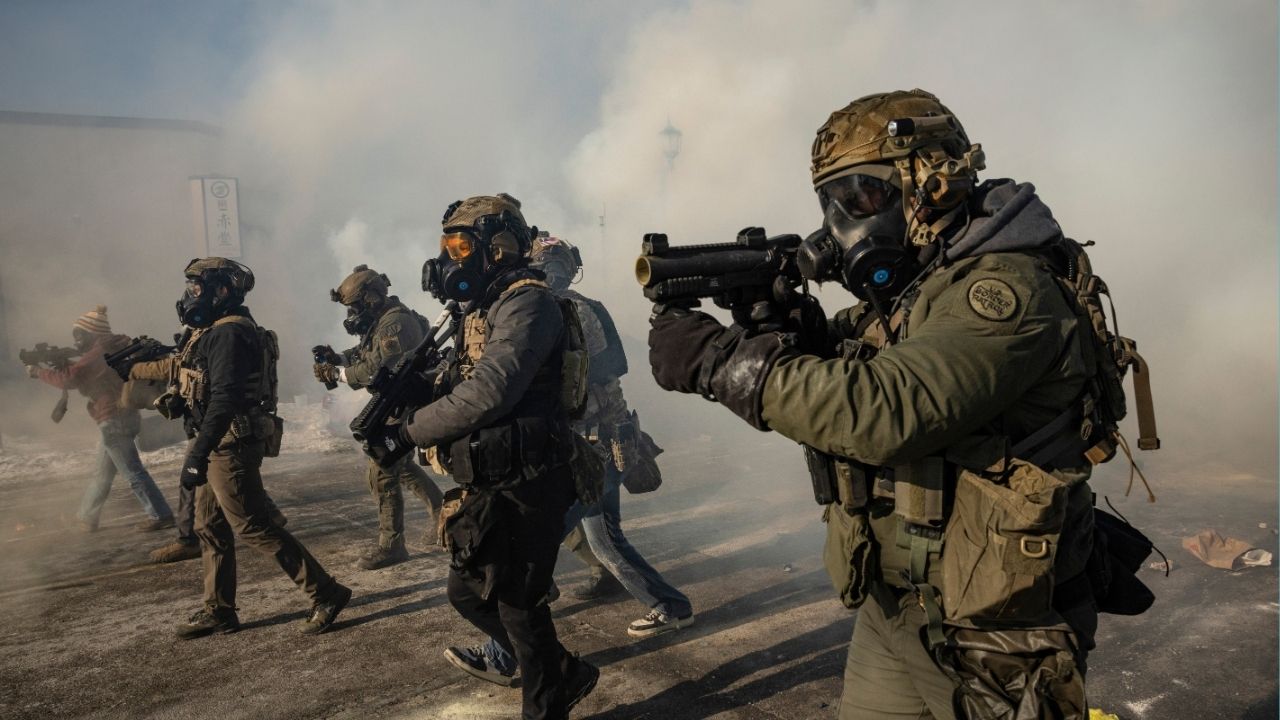
Federal agents confront protesters in Minneapolis, Jan. 24, 2026. A proposal in a 1987 law review article could address a gap that makes it all but impossible to sue federal officials for violating the Constitution. (David Guttenfelder/The New York Times)

Share
|
Getting your Trinity Audio player ready...
|
WASHINGTON — The key to holding Immigration and Customs Enforcement agents accountable for constitutional violations may lie in a 1987 law review article by a young law professor named Akhil Reed Amar.
“I think it was a good idea then,” he said last week, “and it’s only taken more than half a lifetime for people to actually read the thing.”
The article has, in truth, been quite influential. It has been cited, for instance, in seven Supreme Court opinions. But it was also 96 pages long and touched on many issues.
“I was actually trying to do a bunch of different things — and get tenure,” Amar, now a leading constitutional scholar at Yale Law School, said of the article, “Of Sovereignty and Federalism.”
His central point for present purposes was that state legislatures can authorize lawsuits against federal officials for violating the Constitution. If that is right, such state laws would close an odd gap in federal law that — broadly speaking — allows such suits against state and local officials, like police officers, but not against federal ones, like ICE agents.
Congress Authorized First Kind of Lawsuit in 1871 Law
Congress authorized the first kind of lawsuit in an 1871 law that most people call Section 1983. But Congress has not enacted legislation allowing suits against federal officials for violating the Constitution.
“It’s an enormous problem that federal officials are in some ways the hardest people to hold accountable for violating people’s constitutional rights, even harder than state and local officials,” said Carolyn Shapiro, a professor at Chicago-Kent College of Law and a former solicitor general of Illinois.
The Supreme Court tried to address the gap in 1971 in Bivens v. Six Unknown Named Agents, allowing the victim of an unconstitutional search by federal agents to sue them. But the court has essentially abandoned that approach, saying instead that Congress must act if suits against federal officials are to be allowed.
That is where state lawmakers come in, Amar said.
“Sometimes the federal government will misbehave,” he said, “and you can’t count on Congress always to rein the federal government in.”
His article drew on two principles often associated with conservatives: federalism and originalism.
“This is exactly what the framers imagined: state law protecting us against federal abuses,” Amar said.
Over the years, some states — including California, Maine, Massachusetts and New Jersey — have enacted laws along the lines that Amar proposed, though they are largely untested, and Illinois recently adopted one tailored to address the conduct of ICE agents.
The Illinois law says that lawsuits may be filed “against any person who, while conducting civil immigration enforcement, knowingly engages in conduct that violates the Illinois Constitution or the United States Constitution.”
Trump Administration Sues
The Trump administration promptly sued, saying the law violated the Constitution’s supremacy clause, which generally prohibits states from enacting measures at odds with federal law. Whether to allow lawsuits against federal agents for violating the federal Constitution, the administration’s complaint said, “is a policy choice for Congress.”
Amar said aspects of the Illinois law might be problematic. But its core idea, he said, is sound.
“States can’t just generally regulate ICE conduct, because the federal government gets to regulate that,” he said. “But states can provide remedies against federal officials when federal officials violate federal constitutional rights.”
Whether that is correct is a complicated question in light of another federal statute, and it has not yet gotten sustained judicial attention. But Judge Justin Walker, who was appointed to the U.S. Court of Appeals for the D.C. Circuit by President Donald Trump, did consider the matter in a 2023 concurring opinion in a case arising from a protest outside the White House in 2020.
Citing Amar’s article, Walker concluded that “nothing would stop a state from creating a new cause of action allowing plaintiffs to directly allege federal constitutional violations.”
The Illinois law did that, but in imperfect fashion, according to a critique from Vikram David Amar, a law professor at the University of California, Davis (and Akhil Amar’s brother), and Jason Mazzone, a law professor at the University of Illinois at Urbana-Champaign.
The law is “important and innovative,” they wrote, and “in keeping with the proudest tradition of federalism.”
But it is, they added, both too narrow and too broad. It allows suits against only a subset of federal officials, those engaged in civil immigration enforcement.
“It suggests that what you’re trying to do is influence federal enforcement in an area of policy that you disagree with, rather than trying to make sure everyone stays within the Constitution,” Vikram Amar said in an interview.
As for the part of the law that lets people sue federal agents for violations of the Illinois Constitution, the two professors wrote, “that provision won’t stand” under the supremacy clause.
Still, Amar said, such state laws can serve a larger purpose.
“In the spirit of federalism,” he said, “not only can states experiment in this way, but doing so would likely lead Congress to address the problem, because it’s unlikely that Congress would want to leave a patchwork of different state regulations and different remedies.”
—
This article originally appeared in The New York Times.
By Adam Liptak/David Guttenfelder
c. 2026 The New York Times Company
RELATED TOPICS:
Categories





NASA Delays Artemis II Moon Launch to March After Hydrogen Leaks

Trump Seeks $1 Billion From Harvard as Deal Proves Elusive