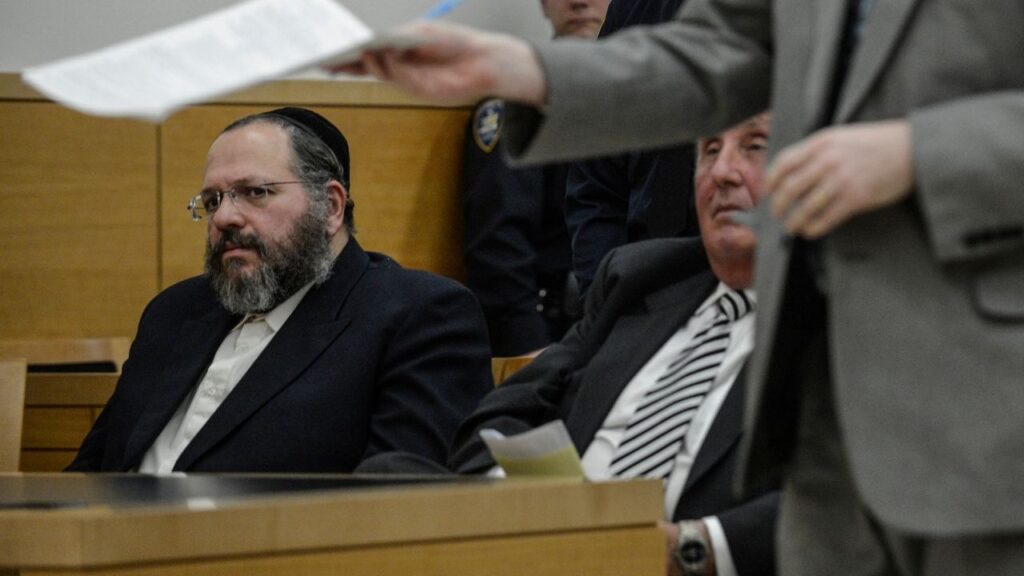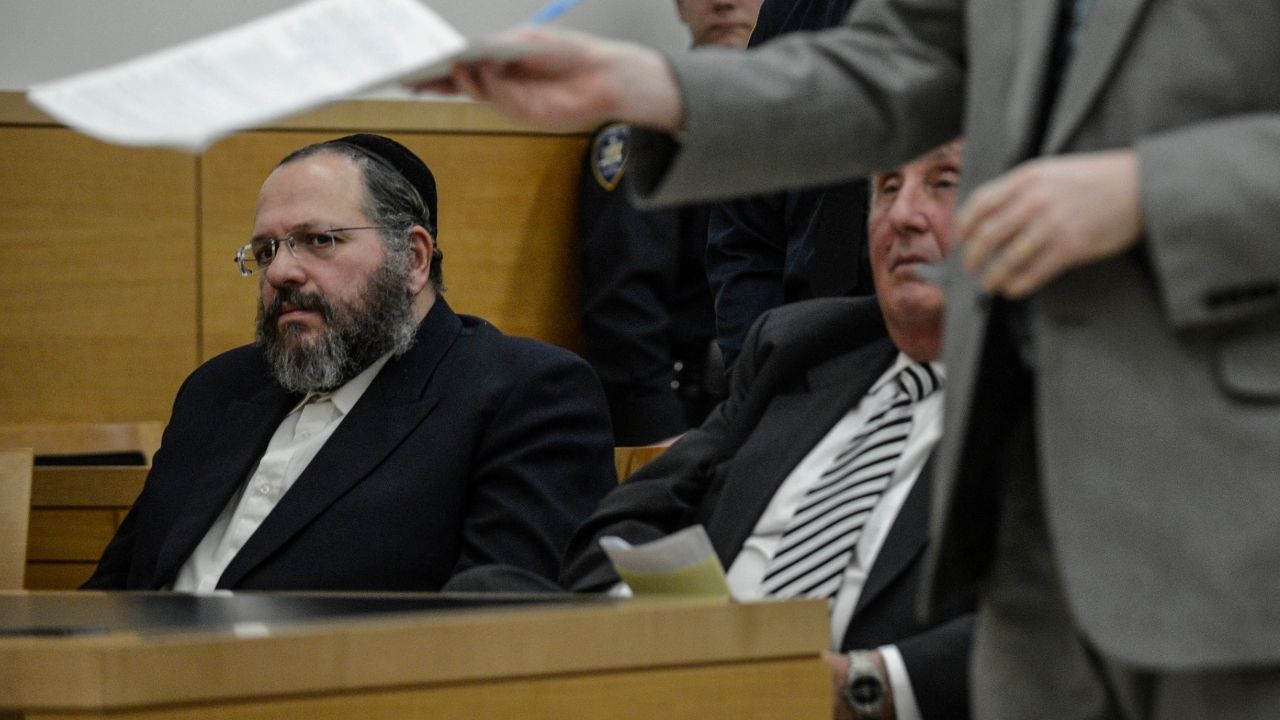
Nechemya Weberman sits in Brooklyn Supreme Court while the judge hands down a sentence of 103 years in New York, Jan. 22, 2013. Weberman’s sentence for child sexual abuse was reduced to 18 years, making him eligible for release within five years. He admitted his guilt for the first time on Tuesday. (Robert Stolarik/The New York Times)

Share
|
Getting your Trinity Audio player ready...
|
NEW YORK — An unlicensed religious therapist whose child molestation conviction pierced a veil of silence in the ultra-Orthodox Jewish community in New York City may now be released in a few years, after Brooklyn prosecutors supported a lighter sentence.
The new sentence of 18 years, ordered Tuesday by Judge Matthew J. D’Emic in Brooklyn State Supreme Court, means that the therapist, Nechemya Weberman, could leave prison in five years instead of likely dying there. Weberman, 67, was sentenced to 103 years in 2013, but a state law capping prison terms for such crimes had cut his sentence to 50 years.
Appearing at the court hearing via a video call from an upstate New York prison, Weberman accepted that he was guilty of the molestation charges for the first time. He had claimed his innocence ever since his arrest in 2011, arguing that the victim, a girl, had fabricated the allegations as an act of revenge.
Addressing and apologizing to the victim, who attended the hearing and is now 31 years old, Weberman told her that she was “an innocent child,” and described his actions as “a desecration of God’s name.”
‘I Violated You’
“You deserved a protector,” Weberman said, wearing a green prison uniform and with a noticeably grayer beard than when he was convicted. “Instead, I violated you.”
It was once unimaginable that someone like Weberman would go to prison. Victims of sexual abuse in the Satmar Hasidic community, of which Weberman is a member, had long been intimidated into silence, and Weberman’s conviction was viewed as a sea shift for victims of sexual abuse among ultra-Orthodox Jews.
But in recent months, the Brooklyn district attorney, Eric Gonzalez, had been criticized by those victims as it surfaced that he was supporting Weberman’s early release, a position they characterized as a betrayal.
“It’s a significant blow to the possibility of victims seeking justice,” Asher Lovy, the director of Za’akah, an organization that promotes awareness of sexual abuse in the Jewish community.
The victim, who was 12 when she met Weberman, had been referred to him for counseling by her religious school in Williamsburg. The school told her parents that she would be expelled unless they paid Weberman $150 per hour, according to a close family member who spoke with The New York Times in 2012.
Counseling Aimed to Make Victim More Religious
The counseling sessions, the victim testified in court, were aimed at making her more religious. But Weberman forced her to perform oral sex on him, she said.
The prosecution came during a politically charged time in Brooklyn. Charles J. Hynes, the district attorney in 2012, had faced criticism for decades that his office had not prosecuted cases of sexual abuse in the politically powerful Satmar community.
Facing reelection, Hynes took a hard-line approach to Weberman’s case, even calling for a long prison term in an opinion essay in The Daily News before Weberman’s sentencing. Weberman’s lawyers have pointed to that environment, along with what they say was an unfairly long sentence, as evidence of an unjust prosecution.
Donna Aldea, a lawyer for Weberman, said D’Emic had dispensed “a measure of justice” by vacating what she said was “an incredibly unjust sentence.”
“In order for a legal system to ever really be just, there has to be justice to the victim and the accused,” Aldea said.
DA Calls Case ‘Horrific’
In a statement Tuesday, Oren Yaniv, a spokesperson for the Brooklyn district attorney’s office, called the case “horrific” and said that Weberman’s crimes warranted a “significant prison term.” But he called Weberman’s original sentence excessive and the product of a politicized environment, and said that the new 18-year term was “within the normal range for this type of criminal conduct.”
Elected during a wave of progressive-minded prosecutors in 2017, Gonzalez has aggressively re-evaluated cases with long prison sentences such as Weberman’s. In an interview with the Times in November, Gonzalez said that his office stood by the conviction, but criticized the sentence and said Weberman should not die in prison.
The victim’s supporters have rejected that argument. They say that the district attorney has cowed to pressure from Weberman’s Satmar supporters, who went as far as lobbying New York Gov. Kathy Hochul.
On Tuesday in court, the victim described in harrowing detail her experience, and argued that if released, Weberman would go back to advising — and sexually molesting — young people.
Yet despite the district attorney’s support for Weberman’s eventual freedom, prosecutors on Tuesday offered him little sympathy. His apology, a prepared statement, seemed insufficient to them.
Joseph Alexis, a prosecutor, pressed Weberman to recall the specific ways in which he had violated the victim. Furrowing his brow, Weberman claimed he did not remember the victim’s exact age. Nor could he remember that he had put his hands on her breasts or forced her mouth on his penis at his office and at her home.
Addressing the judge afterward, Alexis said he found it hard to believe that Weberman could forget the abuse he had inflicted. Alexis had prepared to ask the judge for a sentence in which Weberman would be released in two years, he said, but decided against it after Weberman’s meandering, evasive responses to his questions.
“Mr. Weberman can’t remember them?” Alexis said. “The victim can’t forget.”
Supporters of the victim wept as she and Weberman spoke separately. At one point, as Alexis continued his questioning, a man called Weberman an animal and stormed out of the courtroom.
—
This article originally appeared in The New York Times.
By Santul Nerkar/Robert Stolarik
c. 2026 The New York Times Company