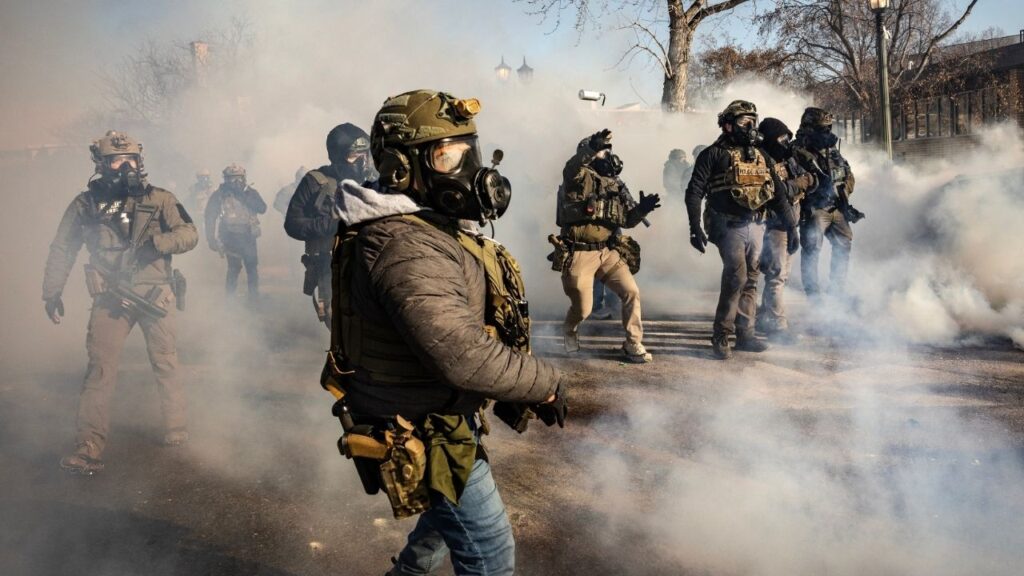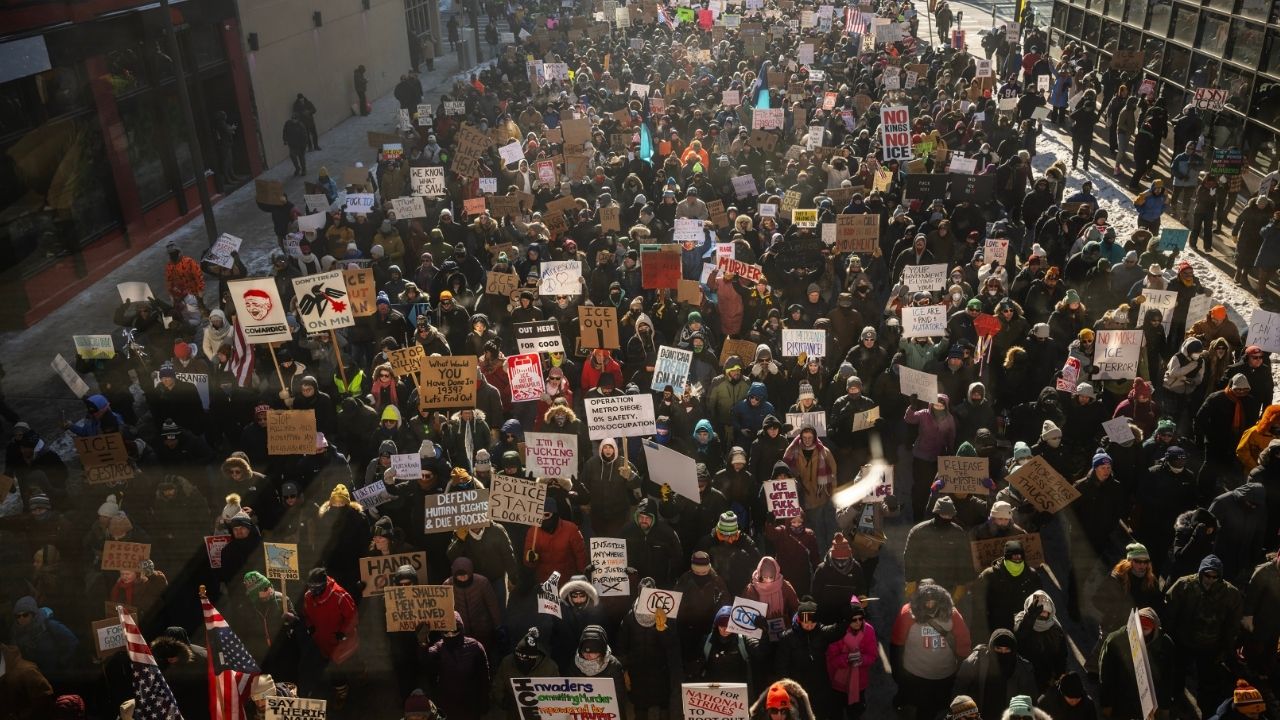
Demonstrators march to protest federal immigration enforcement operations and to demand justice for Renee Good and Alex Pretti, both of whom were fatally shot by federal immigration agents, in Minneapolis on Sunday, Jan. 25, 2026. Even as the second death of a protester in Minnesota brought demands for accountability, President Donald Trump, insulated from dissenting voices, stuck to his pattern of reflexively blaming opponents. (Victor J. Blue/The New York Times)

Share
|
Getting your Trinity Audio player ready...
|
Minneapolis on Saturday, President Donald Trump was in the Oval Office, where an aide, Natalie Harp, sat close by with a laptop.
Along with input from aides who called throughout the day by phone, the two pumped out several presidential social media posts that blamed local law enforcement officials and the victim for the killing and accused Minnesota officials of covering up an unrelated fraud scandal.
Trump also spoke with Stephen Miller, his deputy chief of staff, who called the victim — Alex Pretti, a U.S. citizen and intensive care unit nurse who had been using his cellphone to record immigration agents on the street and was carrying a licensed handgun — a “would-be assassin.”
In the afternoon, Trump posted a photo of an agent whose hand was bleeding after a different encounter, and a photo of a fingertip in a jar. The president wrote no additional commentary, but a few hours later, Attorney General Pam Bondi, who also spoke with Trump throughout the day, wrote that federal prosecutors would charge a suspect in the finger biting.
When that work was done, Trump went over to the residence to attend a screening of a documentary that the first lady has produced about herself.
Second Fatal Shooting of Protester in January
The killing of Pretti, the second fatal shooting of a protester in Minneapolis by federal agents this month, came amid an increasingly militarized deportation campaign directed by Trump and his aides, and after years in which the president has excused violence by his allies, characterized opponents as traitors and terrorists and threatened to invoke the Insurrection Act.
If, as many Democrats say, the death was a consequence of Trump’s embrace of extreme measures to reverse the tide of immigration, the nature of his response was also in keeping with a pattern of reflexively attacking his critics and insulating himself from dissenting voices. Even as some Republicans voiced concern about the conduct of the federal agents and as Democrats demanded accountability, his instinct was not just to evade responsibility but also to assign blame to his opponents.
In an interview with The Wall Street Journal on Sunday, Trump seemed to show some willingness for an investigation, if only after he and his aides had made clear their view of who was at fault. “We’re looking, we’re reviewing everything and will come out with a determination,” he said.
But the White House has repeatedly asserted that the problem is not that federal agents are killing protesters. It is that liberals, encouraged and backed by elected Democrats in Minnesota, are seeking to impede a deportation push that in the name of targeting criminals has swept up children, citizens, longtime neighbors and refugees who are in the United States legally.
On Sunday, Trump posted that the blame rested with “Democrat run Sanctuary Cities and States” that he said “are REFUSING to cooperate with ICE, and they are actually encouraging Leftwing agitators to unlawfully obstruct their operations to arrest the Worst of the Worst People.”
Trump Blames Democrats
In doing so, Trump said, “Democrats are putting Illegal Alien Criminals over Taxpaying, Law-Abiding Citizens and they have created dangerous circumstances for EVERYONE involved. Tragically, two American citizens have lost their lives as a result of this Democrat ensued chaos.”
During Trump’s first term, there were one or two voices in the mix who sometimes curbed his instincts to punch back or crack down on any opposition to his political agenda. In his second term, though, Trump has built around himself a wall of advisers who reinforce and celebrate his instincts to demonize opponents and escalate a conflict rather than prevent one.
So at a moment when the scene in Minneapolis is a result of the hard-line policies and pugilistic politics that brought him twice to the White House, Trump is only encouraged to double down and blame others for not making it easier for thousands of masked agents to enact a military-style occupation of an American city.
Trump has long dismissed protests against his administration as the work of professional and paid agitators. After the killing of George Floyd by police officers in Minneapolis in 2020, Trump addressed the nation and said that the voices of “peaceful protesters” had been drowned out by “professional anarchists.”
Nearly six years later and faced with growing protests and outrage over the violent outcome of his policies, Trump and his advisers are describing protesters as domestic terrorists who have impeded efforts of federal agents to arrest immigrants.
Confronted with reports of violence and killing, Trump has not allowed for the possibility that the operation in Minneapolis had gone too far. Instead, he suggested that ICE agents would continue to do their work with his complete support.
“They’re going to make mistakes sometimes,” Trump said last week. “ICE is going to be too rough with somebody or, you know — they deal with rough people. Are they going to make a mistake? Sometimes it can happen. We feel terribly.”
Four days later, Pretti was shot dead.
Trump Challenged
Even before the killings in Minnesota, Trump was being challenged about whether he is living in a bubble and out of touch.
With midterm elections coming this year, Trump and his fellow Republicans are under political pressure from American voters who are signaling that they are not better off than they were before he was elected to another term and do not see the same progress he touts in bringing down inflation.
And the White House can be a lavish, glossy bubble. On Saturday evening, the East Room documentary event was attended by Queen Rania of Jordan; boxer Mike Tyson; self-help author Tony Robbins; Erika Kirk, CEO of Turning Point USA; and Andy Jassy, CEO of Amazon, the movie’s distributor.
“The evening was defined by extraordinary warmth, grace and a palpable sense of love,” said Marc Beckman, an adviser to Melania Trump who called the event “an atmosphere as moving as it was unforgettable.”
—
This article originally appeared in The New York Times.
By Katie Rogers/Victor J. Blue
c. 2026 The New York Times Company
RELATED TOPICS:
Categories

Nike Says It Is Investigating Possible Data Breach


Merced Man Arrested for DUI After Major Injury Crash on Highway 140

Is OpenAI’s ChatGPT Down? Here Is the Latest