
|
Getting your Trinity Audio player ready...
|
Ukrainian, Russian and U.S. negotiators were expected to hold meetings Friday in the United Arab Emirates, marking the first trilateral talks since the start of the war in Ukraine and signaling a measure of progress in President Donald Trump’s efforts to end the conflict.
This round of talks, President Volodymyr Zelenskyy said Friday, could focus on postwar control of territory in eastern Ukraine’s Donbas region, which has emerged as a major stumbling block through months of negotiations. The formal talks are scheduled for the evening although some meetings may take place earlier.
The Kremlin confirmed that Russian officials would participate in a security working group meeting in Abu Dhabi, the UAE capital, on Friday, with the Russian delegation led by Igor Kostyukov, the head of Russia’s military intelligence. The secretary of the National Security Council, Rustem Umerov, will lead Ukraine’s delegation.

A bilateral working group on economic issues between Russia and the United States was slated to take place separately, the Kremlin said.
It was not immediately clear how the meetings would play out. Ukrainian and Russian negotiators have rarely met directly in past negotiations, instead relying on the United States as a mediator.
On the table is a revised 20-point peace plan drawn up by Ukraine and the United States. That plan covers a range of issues like potential territorial arrangements and security guarantees, as well as plans to rebuild the war-ravaged nation.
But Ukrainian and Russian authorities are still at odds over territory, with Russia demanding a big chunk of the Donbas, and on security guarantees.
Steve Witkoff, Trump’s special envoy, and Jared Kushner, Trump’s son-in-law, were also expected to be in Abu Dhabi. The Kremlin said Witkoff would lead the bilateral economics talks alongside Kirill Dmitriev, the Kremlin special envoy and head of the country’s sovereign wealth fund.
Witkoff said Thursday that in Abu Dhabi, working groups would handle components of the peace plan, including what he called “military-to-military” aspects and “prosperity,” or postwar economic recovery.
“I think we’ve got it down to one issue, and we have discussed iterations of that issue, and that means it’s solvable,” he said this week at the World Economic Forum in Davos, Switzerland, without elaborating. “So if both sides want to solve this, we’re going to get it solved.”
Asked later about Witkoff’s comment, Zelenskyy said it referred to control of territory in eastern Ukraine.
Ukraine controls about 25% of the Donetsk region, and that part is heavily fortified, forming a bulwark against Russian attacks. Russia is demanding it be handed over. Ukraine has suggested that both armies withdraw from the current front line to form a demilitarized zone.
Late Thursday, Witkoff and Kushner met for four hours in Moscow with President Vladimir Putin of Russia.
Yuri Ushakov, Putin’s foreign policy adviser, told reporters after the meeting that it had been “useful in all aspects, both for us and the United States,” according to Tass, the Russian news agency.
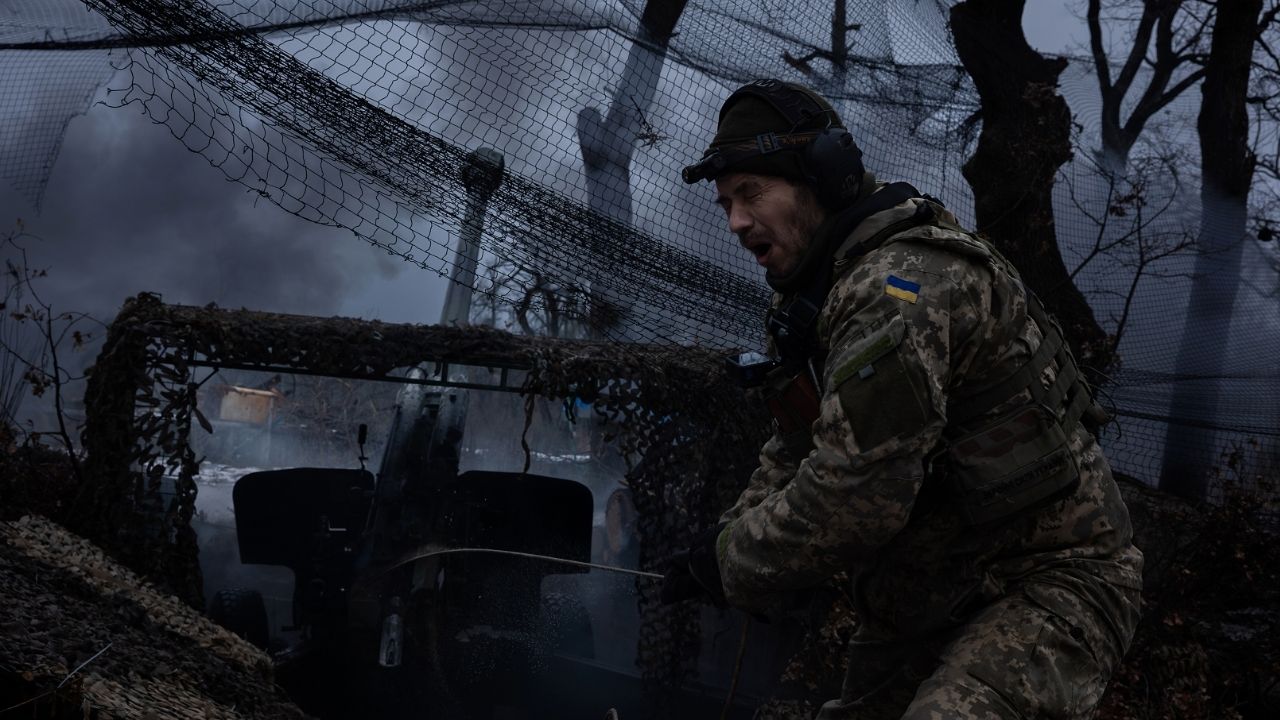
Ushakov said Russia wanted to end the war “through political and diplomatic means” but that until then it would continue to push on the battlefield, “where the Russian Armed Forces hold the strategic initiative.”
During the meeting at the Kremlin, Putin underscored that there was no hope of achieving a long-term settlement if Ukraine was not prepared to resolve “the territorial issue according to the formula agreed upon in Anchorage,” Ushakov said, referring to a meeting in Alaska last year. During that meeting, Putin agreed to cease fighting if Ukraine handed over the remainder of the Donetsk region and also agreed to a range of other nonterritorial demands.
Ukrainian officials have characterized the fighting as at a near stalemate; Zelenskyy said Thursday that both armies were exhausted after four years of war.
The talks come as Ukraine’s capital, Kyiv, is in the grips of one of the most severe heating and electrical power crises of the war. Electricity is provided now for an hour or two per day, and a hot water distribution system for residential heating is periodically failing. Authorities said Friday that 1,940 apartment buildings were unheated, as temperatures dropped to minus 7 Celsius (19 Fahrenheit).
On Thursday, Zelenskyy and Trump met in Davos. After the meeting, Zelenskyy said their talk had been “good.” He said they had discussed obtaining additional Patriot air defense missiles, to shoot down Russian missiles targeting the city’s electrical systems, and that he was expecting a “positive response.” But he provided no details.
“I believe they’re at a point now where they can come together and get a deal done,” Trump said in Davos on Wednesday, referring to the two sides. “And if they don’t, they’re stupid. I don’t want to insult anyone, but you got to get this deal done.”
—
This article originally appeared in The New York Times.
By Andrew E. Kramer and Aurelien Breeden/Tyler Hicks
c. 2026 The New York Times Company