
|
Getting your Trinity Audio player ready...
|
Over the past year, President Donald Trump has pushed NATO with threats and coercion to make divisive changes. Now he is threatening to seize control of Greenland, potentially with military force, which has heightened concerns that he will destroy the trans-Atlantic security alliance.
Leaders in Europe and Canada, which have depended on the United States for nearly 77 years as the alliance’s largest partner, are determined to not let that happen.
Greenland is a semiautonomous territory of Denmark, which is a founding member of NATO. Top diplomats from Greenland and Denmark will defend the territory from Trump’s ambitions at the White House on Wednesday.

Discussions set with Vice President JD Vance and Secretary of State Marco Rubio will provide “a meeting room where we can look each other in the eye and talk about these things,” Danish Foreign Minister Lars Lokke Rasmussen said Tuesday.
Trump has cast himself as NATO’s biggest booster. “I’m the one who SAVED NATO!!!” he wrote on social media Monday.
His threats to withdraw the United States from NATO spurred the alliance in the summer to increase defense spending. He also agreed to continue sending American weapons to Ukraine — after initially pausing them — once NATO allies proposed paying for military aid instead of the United States donating it.
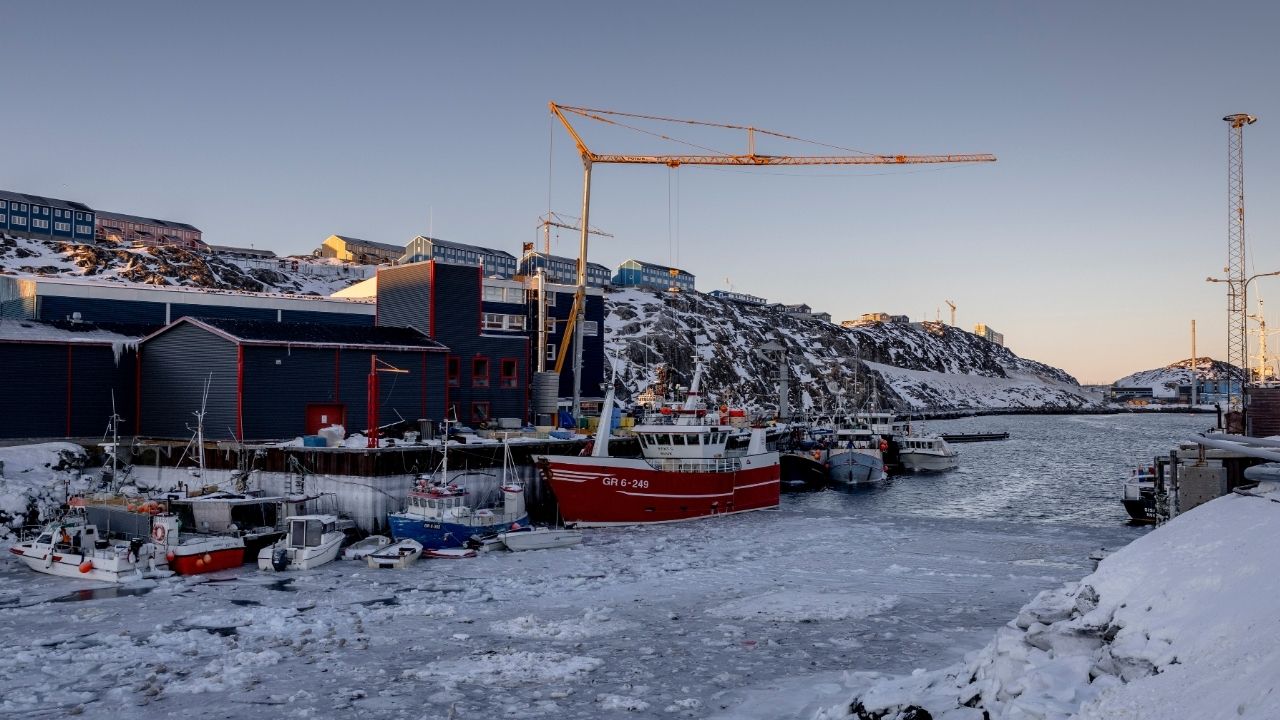
Now NATO allies are devising plans to better secure Greenland’s surrounding waters from adversaries like Russia and China — the reason Trump says U.S. ownership is necessary.
“We all agree in NATO — we all agree — that when it comes to the protection of the Arctic, we have to work together, and that’s exactly what we are doing,” NATO Secretary-General Mark Rutte said Tuesday.
But the flap has raised the prospect that one NATO member might invade the territory of another, throwing the alliance into a tailspin.
“It really is a deal-breaker in the trans-Atlantic relationship,” said Sten Rynning, a NATO analyst and professor at the University of Southern Denmark.
Attacking One Is Attacking All
At issue is Article 5 of NATO’s founding treaty, which holds that an attack on one ally is considered an attack on all. Such an attack triggers an obligation for each NATO member to respond, although not necessarily with armed force.
The treaty does not explicitly contemplate what would happen if one ally strikes another. Article 5 has been invoked only once in NATO history, after al-Qaida’s attacks on the United States on Sept. 11, 2001, so there is no precedent to provide guidance.
Technically, Rynning said, any one NATO ally would have the right to block the alliance from sending its assets to defend an ally under attack. Were the United States to invade Greenland, it would “without question” stop the alliance from intervening, he said, “and NATO would be stuck.”
At that point, Russia might seize on the internal chaos to test NATO by sending its armed forces into alliance territory, Rynning said. “And then, if NATO could not react to that, it would be effectively defunct,” he said.
Rob Bauer, a retired Dutch admiral who stepped down last year as NATO’s most senior military officer, does not think Trump will follow through with his threat to seize Greenland with force, “because it is the end of NATO,” he said in an interview Monday.
He predicted that Trump’s threats amounted to a negotiation tactic to get NATO to commit more resources to the Arctic.
Putting Arctic Security at Center Stage
Bauer said Denmark had for decades discouraged the alliance from frequently operating in Greenland’s surrounding waters because of tensions with the U.S. military. But the current uproar has elevated Arctic security as a NATO priority.
Officials and experts agree that NATO’s presence in the Arctic has grown increasingly necessary as warming seas have opened frozen shipping lanes to Russian and Chinese naval fleets and commercial cargo. That has become more of a concern recently than it was during Trump’s first term, said Kay Bailey Hutchison, who was his ambassador to NATO from 2017 to 2021.
“Now we have more awareness of Chinese and Russian activities,” Hutchison said in an interview Tuesday. “And I think the closeness of Greenland to American waters in the Atlantic has made the issue more important for America from a security standpoint.”
Trump also floated the idea of buying Greenland in 2019, but Hutchison said the matter “kind of faded away” after what she described as “very positive conversations” with Danish officials.
She said it made sense for the United States to take the lead in securing Greenland but that NATO should have a “firm role” and that “most certainly, Denmark has the right to make the foreign policy decisions regarding Greenland.”
Hutchison also doubted that Trump would seize Greenland. “I don’t think military force is a real option,” she said.
‘I Think Congress Will Stop Him’
There is widespread public support in the United States for the alliance, which was created after World War II to deter the Soviet Union. If the president tried to thwart NATO by controlling Greenland, “I think Congress will stop him,” said Sen. Tim Kaine, D-Va.
A bipartisan delegation of senators and House members will travel to Denmark this week to show support for the NATO ally. But others have fallen in line behind Trump, including Rep. Randy Fine, R-Fla., who Monday proposed legislation to allow the president “to take whatever steps necessary to annex or acquire Greenland. ”
The turmoil comes at a delicate time for NATO. Its European members are already grappling with how to continue supporting Ukraine with limited resources, ward off Russian hybrid attacks and bolster security if the United States draws down the number of troops it has stationed on the continent, as expected.
—
This article originally appeared in The New York Times.
By Lara Jakes/Ivor Prickett
c. 2026 The New York Times Company