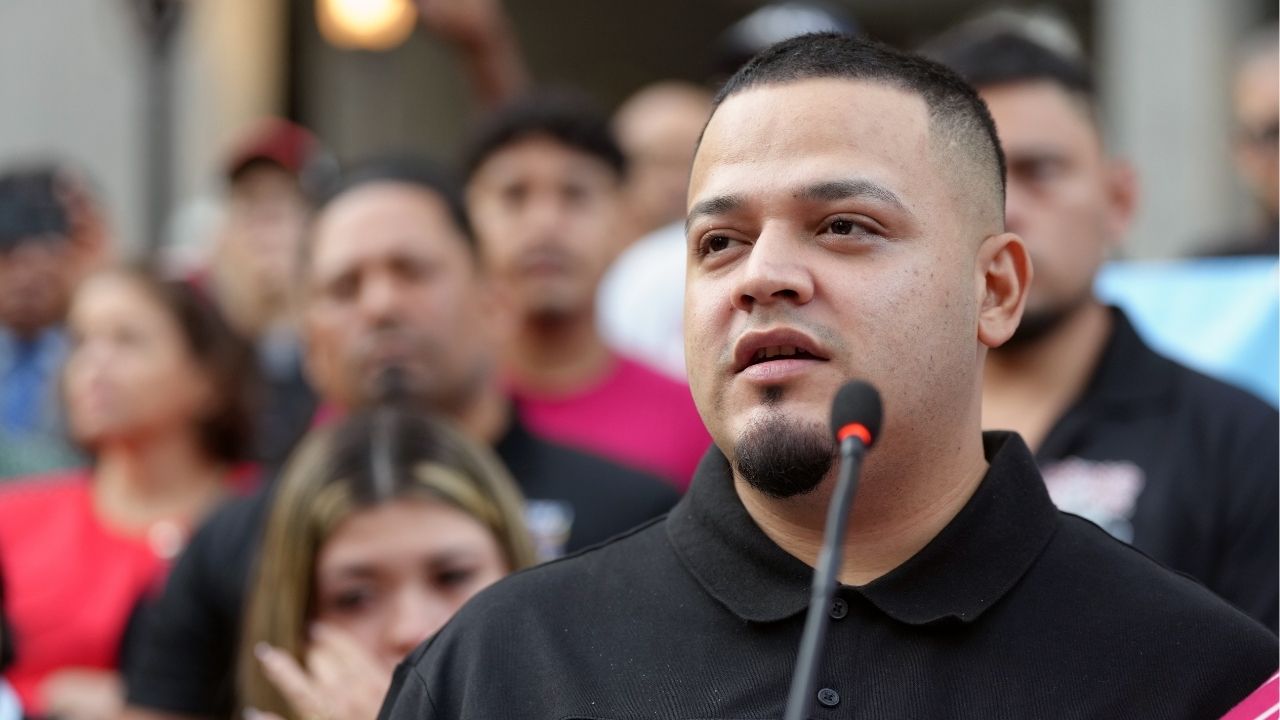
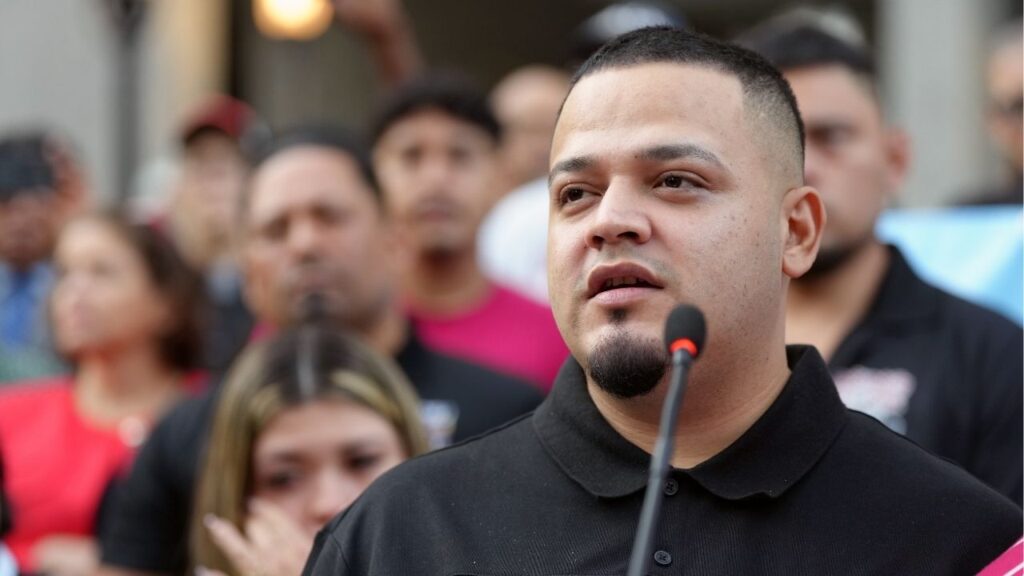
Kilmar Armando Abrego Garcia, the immigrant who was wrongfully deported to El Salvador in March, speaks to supporters as he arrives for his immigration check-in, in Baltimore on Aug. 25, 2025. The release of the emails raised serious questions about whether the Justice Department had misled a judge in telling him that local prosecutors had acted alone in charging Abrego Garcia. (Tierney L. Cross/The New York Times)

Share
|
Getting your Trinity Audio player ready...
|
WASHINGTON — Federal prosecutors in Nashville, Tennessee, have insisted in the past few months that senior Justice Department officials had no involvement in their decision to file charges against Kilmar Abrego Garcia, the immigrant who was wrongfully deported to El Salvador in March and then brought back to the United States to face indictment.
But on Tuesday, excerpts from several emails released by a federal judge overseeing Abrego Garcia’s criminal case appeared to directly contradict those assertions, suggesting that Justice Department leaders — including Todd Blanche, the deputy attorney general — played a greater role in bringing the charges than prosecutors have acknowledged.
The emails, which were made public as part of a newly unsealed judicial order, largely reflected communications about the case that Robert E. McGuire, the acting U.S. attorney in Nashville, had with members of his staff and with Aakash Singh, a top official in Blanche’s office. They raised serious questions about whether the Justice Department had misled Judge Waverly D. Crenshaw Jr., who is overseeing the case, by telling him that local prosecutors had acted alone in charging Abrego Garcia.
“These documents show that McGuire did not act alone and to the extent McGuire had input on the decision to prosecute, he shared it with Singh and others,” Crenshaw wrote in the unsealed order. “Specifically, the government’s documents may contradict its prior representations that the decision to prosecute was made locally and that there were no outside influences.”
One of the emails, dated April 30, was written by Singh to McGuire and another prosecutor, Jacob Warren, as the government was building its criminal case against Abrego Garcia, who at the time was still in custody in El Salvador.
In it, Singh made clear that charging Abrego Garcia was “a top priority” for Blanche’s office. In response, McGuire wrote, “We want the high command looped in.”
A little more than two weeks later, McGuire wrote to his staff that while the ultimate decision about whether to bring charges was his own, he had heard that Blanche and his chief deputy at the time, Emil Bove, were pushing for charges to be filed. In the email, McGuire referred to Blanche as the “DAG” — or deputy attorney general — and to Bove as the “PDAG” — or principal deputy attorney general. He also mentioned the “ODAG” — or the office of the deputy attorney general.
“I have not received specific direction from ODAG other than I have heard anecdotally that the DAG and PDAG would like Garcia charged sooner rather than later,” McGuire wrote.
Crenshaw’s order was only the latest in an ever-growing series of rebukes dealt to the Justice Department as it has pursued parallel efforts to both prosecute Abrego Garcia and expel him from the country again.
Three weeks ago, a federal judge in Maryland released him from immigration custody in a scathing order that accused the Justice Department of egregious conduct that included stonewalling her, disobeying her direct instructions and even “affirmatively” misleading her about its plans to re-deport Abrego Garcia.
Department lawyers are under orders to tell the judge in Maryland, Paula Xinis, by the end of Tuesday whether they will try to take Abrego Garcia back into custody.
Crenshaw’s order containing the excerpted emails was originally issued under seal on Dec. 3, when he instructed prosecutors to hand over the full trove of materials to Abrego Garcia’s lawyers. The lawyers sought the communications in an effort to bolster their claims that the indictment against Abrego Garcia had been brought because the Trump administration was trying to vindictively punish him for contesting his initial deportation.
In October, Crenshaw issued a preliminary ruling finding that there was a “realistic likelihood” that the administration had in fact brought the case vindictively. That decision allowed Abrego Garcia’s legal team to seek internal documents from the government.
In his initial order, the judge singled out Blanche, saying that he had made “remarkable statements” about the criminal case. On the day in June that Abrego Garcia was brought back to face indictment, Blanche went on Fox News and declared that the government had started to investigate the case only after Xinis, in Maryland, had questioned the administration’s decision to deport Abrego Garcia and found that it “had no right.”
The newly released emails only pointed further at Blanche’s involvement in deciding to charge Abrego Garcia.
In one of the emails, written on May 16 as the Justice Department was nearing its decision to bring charges, Warren wrote to Singh, suggesting that Blanche was playing some sort of role in whether to seek an indictment quickly.
“If the DAG does want to move forward with the indictment on Wednesday,” Warren wrote, “we think it would be prudent to loop in the press office ASAP.”
Abrego Garcia’s lawyers have issued subpoenas to Blanche and Singh in an effort to have them testify under oath about their roles in seeking criminal charges. The Justice Department has strenuously objected to the subpoenas in a series of court filings, some written by a top department official, Stanley E. Woodward Jr.
—
This article originally appeared in The New York Times.
By Alan Feuer/Tierney L. Cross
c. 2025 The New York Times Company
RELATED TOPICS:

Justice Dept. Leaders Pushed to Charge Abrego Garcia, Emails Show
Fresno County Firefighters Contain Reedley House Fire