


|
Getting your Trinity Audio player ready...
|
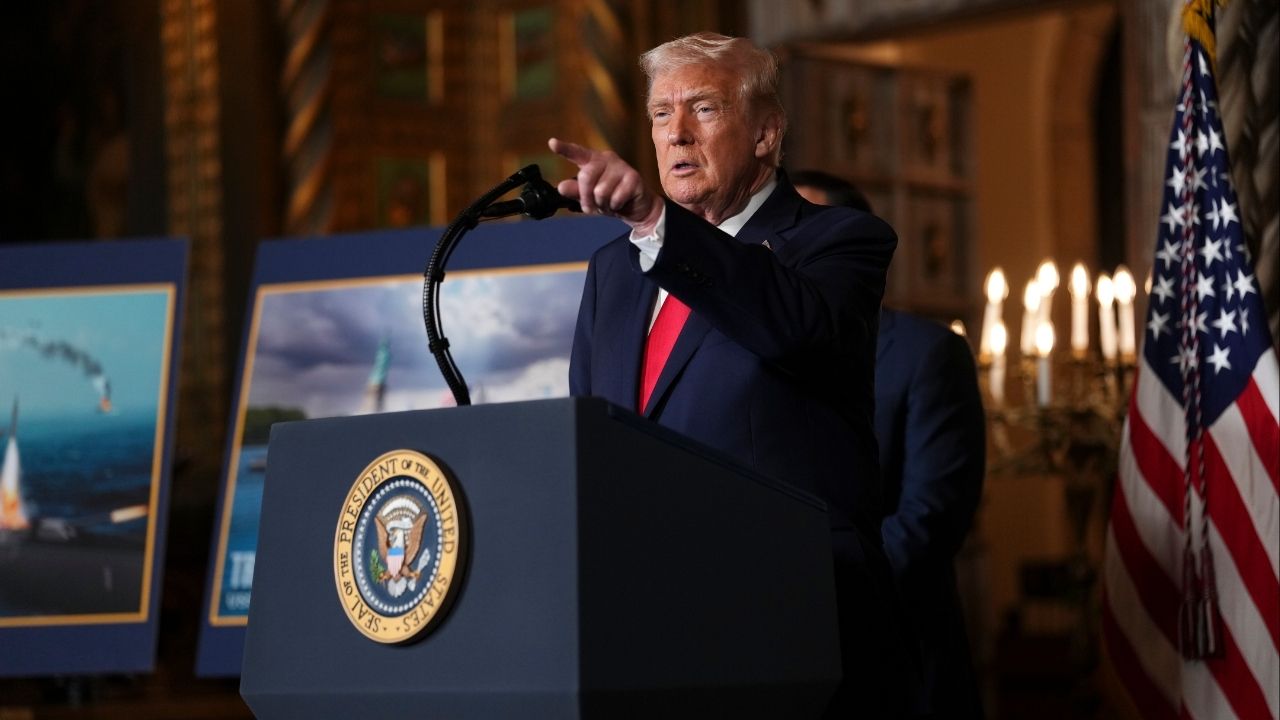
President Donald Trump announced Monday the construction of a new “Trump class” of warships that would anchor what he called a “golden fleet” for the U.S. Navy, fulfilling a long-held goal to give a personal makeover to a fleet of ships he described as “old and tired and obsolete.”
The ships will augment the Navy’s more than five dozen Arleigh Burke-class destroyers — 9,000-ton vessels that are a mainstay of the Navy fleet but that Trump has disparaged as failing to compete with the vessels of foreign fleets, according to a Pentagon official speaking on the condition of anonymity to discuss the plans for the ships.
Navy officials said that the new vessel, which Trump described as “a battleship,” would displace more than 35,000 tons — more than twice the size of the largest surface combatant ships the Navy currently fields — and that it would notionally have the ability to launch hypersonic missiles and nuclear-armed cruise missiles, and carry more munitions overall than current Navy vessels.

“They’ll help maintain American military supremacy, revive the American ship building industry and inspire fear in America’s enemies all over the world,” Trump said alongside renderings of the new ships.
Dating back to his first term, Trump has criticized the look of the Navy’s fleet and called for a return of the World War II-era vessels that were armed with 16-inch guns that were largely phased out for aircraft carriers whose warplanes could strike targets many hundreds of times farther away. In ordering up the construction of battleships, Trump appeared to once again nod back to vessels of old under the umbrella of an agency he calls the “Department of War,” even though Congress has not changed the name of the Department of Defense.
The new warships are also expected to be the centerpiece of the Trump administration’s effort to revamp the Navy to deter global adversaries such as China and revitalize the shipbuilding industry in the United States.
The last new warships the Navy categorized as battleships — the Iowa class of World War II — were, however, something very different from what Trump proposes. The naval service then had just four Iowa-class battleships, each displacing roughly 60,000 tons fully loaded.
According to the U.S. Naval Institute, the Iowa class were nearly 900 feet long, had steel armor belts 16 to 18 inches thick to protect certain parts of the ship, nine 16-inch guns, a dozen 5-inch guns and other weapons. They were decommissioned after World War II and placed back into commission intermittently for service in the Korean and Vietnam Wars. When brought back again as part of President Ronald Reagan’s buildup of the fleet in the 1980s, they were modernized with the addition of anti-ship missiles, Tomahawk cruise missile launchers and antimissile defense guns.
Trump’s design would forgo large-bore guns in favor of just two 5-inch guns and a complement of missiles already fielded across the fleet. His namesake “battleship” would carry two weapons the Navy has spent billions trying and failing to develop prototypes that it can field: hypersonic missiles, which the Navy calls Conventional Prompt Strike, and electromagnetic rail guns, which the service hoped to field on their Zumwalt-class destroyers in the 2000s but ultimately gave up on the idea a decade later when it proved impractical.
The Trump class of warships, as described by the president Monday, would still fail to meet specific congressionally mandated requirements for the Navy to provide fire support to Marines in combat ashore. Thus far, all of the naval service’s efforts to meet those requirements since the last of the Iowa-class ships were decommissioned and stricken from the record in the 1990s have been met with bitter and unheralded failure.
Some critics warned the “battleship” and the Navy’s overarching plans for a “Golden Fleet” — upgraded surface combatant ships joining the Navy’s inventory of aircraft carriers and submarines — fell short of what was needed to deter China and other maritime adversaries.
Mark Montgomery, a retired rear admiral and current senior fellow at the Foundation for Defense of Democracies in Washington, said the ships were behemoths ill-suited to confront China.
Montgomery, a former director of operations at U.S. Pacific Command, said the Navy instead needed a dispersed fleet of minimally manned or unmanned ships with large weapons magazines to combat the Chinese threats at sea.
“These ‘battleships’ will achieve none of these tactical goals,” Montgomery said.
Trump indicated the new vessels would have artificial intelligence capabilities, saying they would be controlled by AI, without providing details.
The Navy has 292 ships in its fleet, mostly destroyers, cruisers, aircraft carriers, amphibious ships and submarines.
Trump said that he expected two of the so-called battleships to be constructed over the next 2 1/2 years and that he anticipated the United States would build as many as 20 of the vessels overall. The ships will anchor what is planned as an upgraded fleet that includes commissioning a new class of frigates, a small escort ship based on the Coast Guard’s new 4,500-ton National Security cutters.
Trump said that he would meet with defense contractors next week in Florida to talk about accelerating production schedules for the warships and that his administration was prepared to penalize companies that moved too slowly.
—
This article originally appeared in The New York Times.
By Zolan Kanno-Youngs, Eric Schmitt and John Ismay/Eric Lee
c. 2025 The New York Times Company