

|
Getting your Trinity Audio player ready...
|
The next fight over Fresno County’s multi-billion dollar transportation tax renewal has brought the Board of Supervisors into the ring.
At their Tuesday meeting, the supervisors — with Nathan Magsig leading the charge — said the Measure C spending proposal doesn’t allocate enough money for regional projects such as the long-planned Highway 180 westward expansion.
This is significant because the board has the power to approve or deny placement of the half-cent tax’s extension on the 2026 ballot.
Meanwhile, the clock is ticking for transportation tax backers to get a rival plan on the ballot by gathering signatures.
Fresno County Clerk/Registrar of Voters James Kus said that ideally a voter initiative campaign should have begun by October.
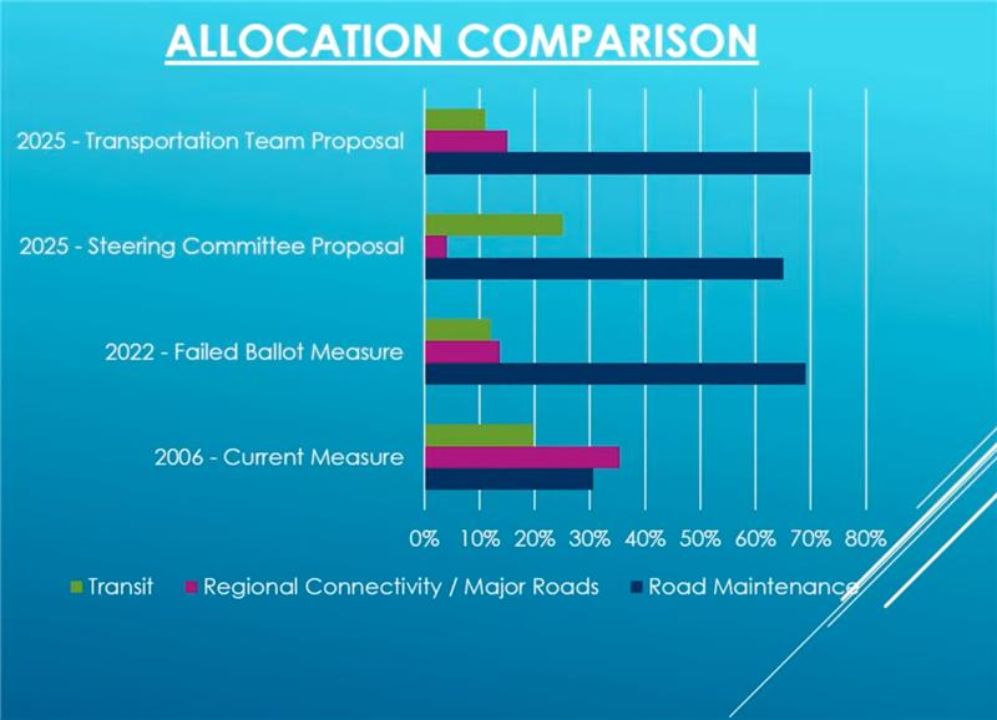
The official Measure C spending proposal created by the 36-member Steering Committee would direct 65% of the potentially $7 billion fund to road repair, 25% to public transit, and 4% to regional roads and projects — a reduction from 36% in the previous Measure C.
Another proposal from an unofficial team of transportation experts familiar with Measure C allocates 70% to road repair, about 15% to regional projects, and a little over 10% to public transit — a spending plan more similar to the 2022 renewal rejected by voters.
Related Story: $7 Billion Fresno Transportation Tax Committee Stalls On Key Issues
Highway 180 Expansion Helps the Entire County: Magsig
Supervisor Magsig said having adequate regional money set aside covers expansion projects that benefit the entire county. He said projects such as connecting Highway 180 to Interstate 5 and widening Millerton Road need funding.
“I recognize that needs have changed, but to pretty much completely eliminate regional projects I think is short sighted, and a lot more money does need to be put into a project that will benefit the whole county and connect our fifteen cities,” he told GV Wire.
Parlier Mayor Alma Beltran and chair of the Fresno Council of Governments, however, said no new regional projects have been proposed. She said the plan put forth by the steering committee prioritizes road repairs and public transit projects the public wants. She said the current proposal favoring city allocations provides what leaders need to fix roadways.
“That is why we decided to take more from the regional because if there’s no projects, that money will sit there for years, possibly 30 years,” Beltran said. “We don’t know what’s to come in the future, but we don’t want to have money sitting there when other communities, especially rural communities, and other projects, can benefit from it.”
Why Hasn’t 180 West Been Completed?
The regional projects are taken on by both the county and CalTrans, typically, said Mohammad Alimi, division manager of the Fresno County Public Works and Planning Department.
In the past, regional projects included bridges, county roads, and perhaps most notably Highways 180 and 41.
The Highway 180 plan, with its $300 million price tag, will have accumulated anywhere between $75 million to $100 million by the end of Measure C in 2027, said Robert Phipps executive director of the Fresno Council of Governments in an email.
With the project lagging its funding goals, about $46 million has been redirected to other projects, including passing lanes on state routes 33, 180, and 198.
Money also went to widening State Route 145 north of Whitesbridge Avenue, Phipps said. The remaining money will cover contingencies on those projects and others in the rural Measure C program, including Highway 41 near Kings County.
Beltran said holding money for major projects keeps it from being used for other projects.
“Mendota could have used it, Kerman, Huron, all that west side that is in dire need for the funding for those roads,” Beltran said.
Magsig, however, said finishing Highway 180 connects west side cities similarly to how Highway 180 East provided better connectivity to Sanger.
“By continuing 180 west, it allows for those west side cities like Firebaugh, Mendota, Kerman to all be able to be connected just like the east side cities,” Magsig said.
Fresno County Needs Future Transportation Options: Bertken
The steering committee’s proposal commits 25% to public transit. Another 4% for “innovation” is limited to transit projects, so the total allocation is closer to 29%, said Mike Leonardo, former Fresno County Transportation Authority Chair.
Kay Bertken, president of the League of Women Voters of Fresno and a member of the steering committee, said the a 30-year tax plan needs to provide transit options into the future.
“We’re talking about 2057. They would like to see a community that is not without options to the individual vehicle. We would like to look like other communities in this state, other large cities that have devoted money, time, resources, planning to having a really robust public transit system,” Bertken said.
Surveys done by Transportation 4 All — a coalition group that received substantial representation on the steering committee — show high demand for public transit.
Bertken said that improving public transit would increase ridership from today’s low numbers. Others have said as the population ages, dependence on public transit will increase.
Responses from Transportation 4 All’s survey show lengthy wait times and limited options as major reasons for not using public transit, which the group identified as “systemic barriers.”
The alternative spending plan created by transportation experts cuts public transit spending from the 2006 measure nearly in half.
Some Steering Committee Proposals Unfeasible: Planners
While the steering committee’s spending proposal was originally supposed to be before supervisors in September, the most recent delay pushed the final decision to Thursday, Dec.11.
Bertken said at the meeting they’re “not even close” to many decisions.
Alimi said the current proposal has unrealistic issues. The plan doesn’t allow any road widening until all roads meet a minimum pavement condition index score of 65, which many planning experts, including Alimi, said was not possible with even the entire Measure C fund.
The plan also requires bike lanes on all major county roads. Another requirement calls for trails in rural areas such as Reedley and Sanger.
“We cannot really afford to put bike lanes on every project that we work on using Measure C,” Alimi said during the meeting. “That is not a reasonable request.”
Transportation Experts Create Alternative Measure C Proposal
Names familiar to Fresno COG and transportation issues make up the group of transportation experts who created the plan alternative:
- Former COG director Tony Boren
- Former Fresno County Transportation Authority director Mike Leonardo
- Former Caltrans District 6 Director Diana Gomez
- President of VRPA Technologies Inc. Georgiena Vivian
- California Transportation Business Group Director Malcolm Dougherty
Boren told GV Wire the group formed after it appeared to them the plan being created by the steering committee was becoming untenable.
“The thought was we need to make sure there’s a viable alternative if this thing goes off the rails,” Boren said.
Signature Petition Measure Has Lower Approval Threshold
A voter initiative for a transportation tax would lower the required threshold from a supermajority of 66.67% to only 50% plus one voter. Public talk from officials has been about maintaining Measure C in its traditional form, but the idea of a voter initiative stepped into the spotlight Tuesday.
The most notable local example of voter initiated ballot measure success is Measure P, the city of Fresno’s parks tax. It passed in 2018 with 52% support.
Illustrating the advantage of voter initiated measures: The 2022 Measure C renewal received 58% support but failed because it didn’t clear the supermajority hurdle.
To get a transportation tax on the November 2026 ballot, the petition has to go before Kus no later than Aug. 7 2026. Supervisors also need to pass a resolution saying the signatures behind the petition are valid, and the last meeting before that August deadline is in July.
Petitions need to be circulated for six months and a notice of intent has to be published, Kus said. It can still be done, but it’s “crunch time,” Kus said.
A petition would need 22,000 signatures but 34,000 would be ideal as it means county staff don’t need to verify every signature, only a random sampling.
Four other propositions on the November ballot mean proposals would be fighting for limited county resources, Kus said.
“It needs to be done pretty quick,” Kus said.