


|
Getting your Trinity Audio player ready...
|
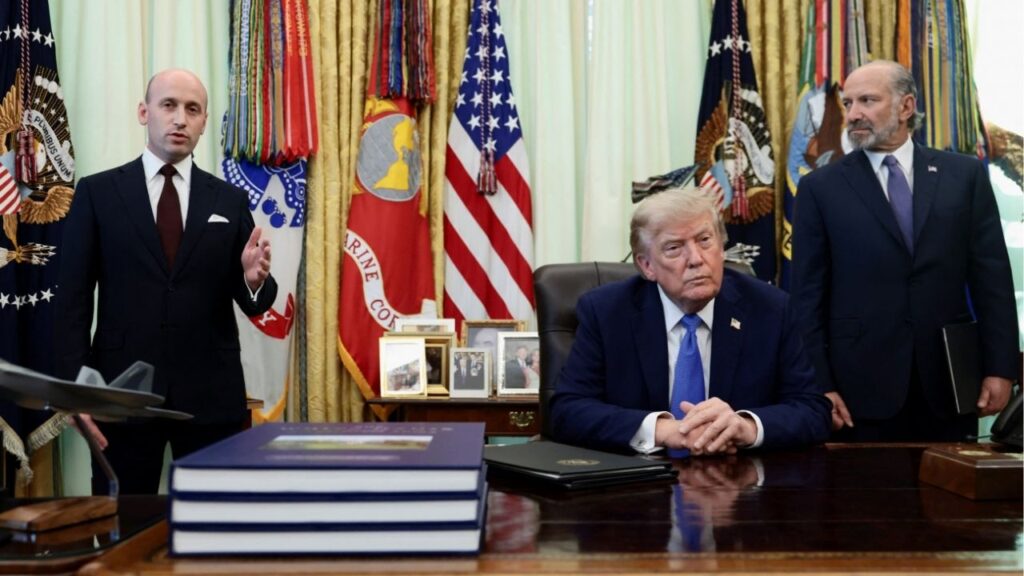
WASHINGTON — When six Democratic lawmakers issued a video last month telling members of the military that they must refuse unlawful orders, President Donald Trump said they had committed “SEDITIOUS BEHAVIOR, punishable by DEATH!”
But Pam Bondi, the attorney general, said the same thing last year in a friend-of-the-court brief in the Supreme Court as a lawyer for the America First Policy Institute, a conservative think tank that represented three former military leaders.
“Military officers are required not to carry out unlawful orders,” she wrote.

She elaborated: “The military would not carry out a patently unlawful order from the president to kill nonmilitary targets. Indeed, service members are required not to do so.”
The brief was filed in support of Trump, who was asking the Supreme Court to grant him immunity from prosecution on charges of trying to subvert the 2020 election. It was, more specifically, an effort to address a statement by one of Trump’s private lawyers, D. John Sauer, now the solicitor general, at an appeals court argument in January 2024.
“Could a president who ordered SEAL team 6 to assassinate a political rival, who was not impeached, would he be subject to criminal prosecution?” Judge Florence Y. Pan asked Sauer.
Sauer said no. That answer seemed to hurt his case, and Bondi tried to limit its blast radius in her brief by saying that the hypothetical was unrealistic because military officers would never comply with such an order.
“A president cannot order an elite military unit to kill a political rival, and the members of the military are required not to carry out such an unlawful order,” she wrote. “It would be a crime to do so.”
Sauer briefly addressed the point in his Supreme Court argument.
The Uniform Code of Military Justice, Sauer said, “prohibits the military from following a plainfully unlawful act.”
Justice Samuel Alito understood the significance of the argument.
“I don’t want to slander SEAL Team 6,” he said, to laughter. “Because they’re — no, seriously, they’re honorable. They’re honorable officers, and they are bound by the Uniform Code of Military Justice not to obey unlawful orders.”
Trump won his case, obtaining substantial immunity. The six Democratic lawmakers have been denounced, investigated and threatened with death.
The FBI has sought to question the lawmakers, all of whom served in the military or the intelligence service. Defense Secretary Pete Hegseth has opened an investigation into whether Sen. Mark Kelly, D-Ariz., committed a military crime by saying in the video what Bondi, Sauer and Alito had said.
The question of whether members of the military must refuse illegal orders is particularly salient these days, of course, in light of the strikes on boats said to be smuggling drugs, which many legal experts say amount to extrajudicial killings.
Two other briefs in the immunity case, these opposing Trump, also addressed unlawful orders.
Military Must Refuse to Obey Them
They agreed that members of the military must refuse to obey them. But they said presidents emboldened by the knowledge that they were immune from prosecution would put grave and dangerous pressure on those they commanded.
A brief from retired admirals and generals, along with former secretaries of the Army, Navy and Air Force, said that “the duty to disobey would be an unacceptably thin fail-safe against a president who was intent on flouting and who was permitted to flout the law without the possibility of criminal prosecution.”
A third brief, from national security and military experts, said presidential immunity coupled with the power to pardon crimes would be a recipe for wholesale lawlessness.
“For example, in the SEAL Team 6 assassination scenario, the team members would not need to fear the consequences of committing murder,” the brief said, “if the order to commit the murder were coupled with the promise of a pardon.”
In a Supreme Court brief in the immunity case, Sauer said the criticism of his exchange about SEAL Team 6 before a three-judge appeals court panel had been untethered from reality.
“The panel fretted about lurid hypotheticals that have never occurred in 234 years of history, almost certainly never will occur and would virtually certainly result in impeachment and Senate conviction (thus authorizing criminal prosecution) if they did occur,” Sauer wrote.
Still, the prospect of ordering the military to conduct unlawful killings has crossed Trump’s mind.
In 2015, early in his first campaign for the presidency, Trump vowed to order the military to kill the relatives of terrorists.
“We’re fighting a very politically correct war,” Trump said, referring to efforts to defeat the Islamic State group. He added, “The other thing with the terrorists, you have to take out their families.”
In an interview at the time, Michael V. Hayden, the retired Air Force general who has directed both the National Security Agency and the CIA, said that such an order would be unlawful and that military personnel would be required to refuse to follow it.
“If he were to order that once in government,” Hayden said, “the American armed forces would refuse to act.”
Bondi’s brief quoted the exchange and said her clients “concur with Gen. Hayden’s assessment.”
Asked about Hayden’s statement at a Republican primary debate in March 2016, Trump said the military would follow his instructions.
“They won’t refuse,” he said. “They’re not going to refuse me. Believe me.”
—
This article originally appeared in The New York Times.
By Adam Liptak/Eric Lee
c. 2025 The New York Times Company