
|
Getting your Trinity Audio player ready...
|
JERUSALEM — Since Israeli forces withdrew from parts of the Gaza Strip in October under a ceasefire agreement, Hamas has moved quickly to fill the void.
Its police forces are out on the streets again. Its fighters have executed opponents. And its officials have levied fees on some costly goods being imported into Gaza, according to local businesspeople.
Over two years of war, top Hamas commanders and thousands of fighters have been killed, and the group’s arsenal has been severely depleted. It now controls less than half of the territory in Gaza, with the rest occupied by Israel.

Yet Hamas has managed to reassert its power in Gaza, according to Israeli security officials and an Arab intelligence official. They spoke on condition of anonymity to discuss internal assessments.
“Hamas was hit hard, but it wasn’t defeated,” said Shalom Ben Hanan, a former senior official in the Shin Bet, Israel’s domestic intelligence agency. “It’s still standing.”
This swift regrouping presents a formidable obstacle to the Trump administration’s plan to reconstruct a Gaza free of Hamas. The plan envisions the enclave’s demilitarization and calls for all military infrastructure, including tunnels and weapons production facilities, to be destroyed.
Hamas emerged from the war with a foundation it can build on.
Ben Hanan, who receives briefings from the Shin Bet leadership, said that even though Hamas’ ranks are thinned, official estimates say that 20,000 fighters remain.
Hamas Replaces Commanders Killed
Hamas has quickly replaced the commanders killed in the war, said Brig. Gen. Erez Winner, who served in a senior role in the Israeli military until March.
The group has many places to hide and store weapons, given that more than half of the underground tunnel network is still intact, the Israeli and Arab officials said.
Hamas still runs the central organs of government in Gaza, including the security services, Ben Hanan said. Its rocket supply has dwindled, but members still have lighter weapons, such as automatic rifles, rocket-propelled grenades and mortars.
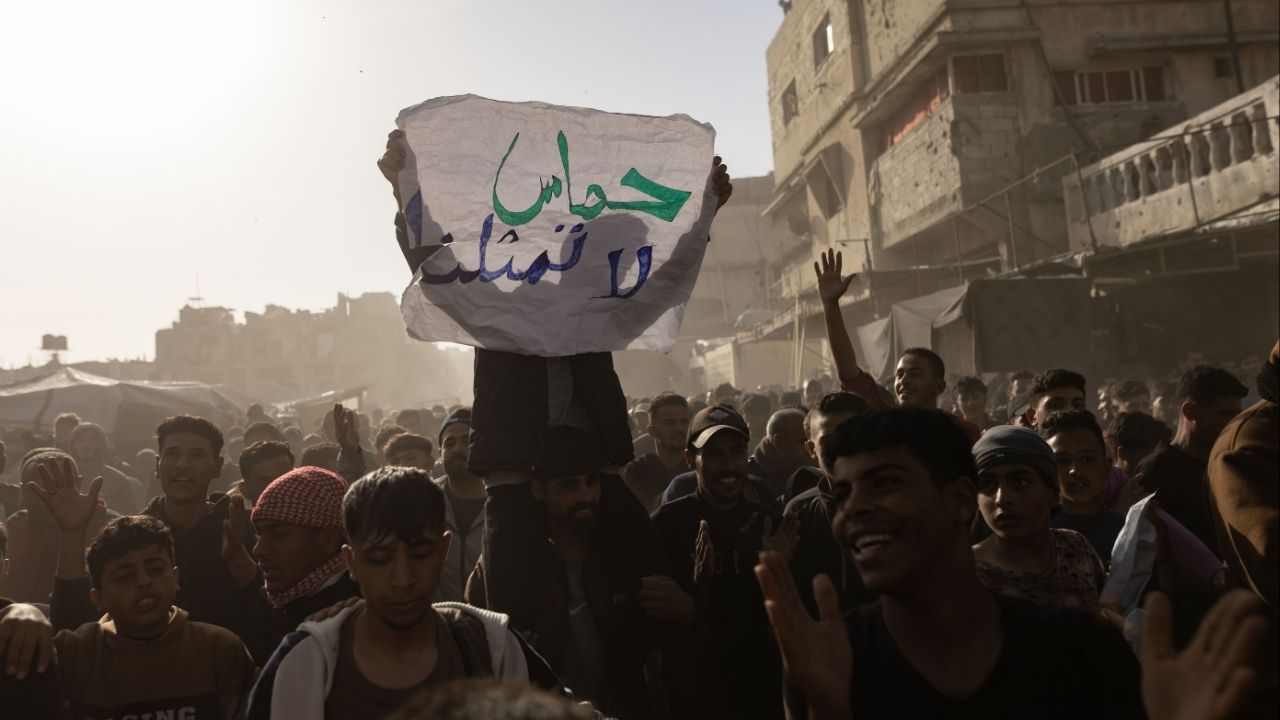
Hamas gunmen are operating checkpoints in parts of Gaza and questioning and detaining people, according to residents. Its police have prevented people from trying to steal from aid trucks and abandoned homes, they said.
“They’re trying to convey to the public that they’re still in charge and they’re providing security,” said Nidal Kuhail, 31, a resident of Gaza City. “You can feel their presence, but they also appear to be weaker than the past.”
Husam Badran, a senior Hamas official, said the group was prepared to allow a committee of Palestinian technocrats to take over the administration of Gaza. Chaos would be the result of leaving behind a power vacuum, he said.
“That would be the most dangerous decision,” he said in an interview. The police, he added, were seeking to “preserve security and stability.”
Raise Money From Ceasefire
As Hamas has tried to establish security, it has also sought to raise money from the ceasefire.
Since the truce took effect, hundreds of trucks carrying humanitarian aid and commercial goods have been entering Gaza daily, a sharp increase from wartime. Hamas has been generating revenue from some of the more costly items flowing in by levying taxes on a small number of commercial goods, such as computers and solar panels, according to four Gaza businesspeople.
Ismail Thawabteh, the director general of the Hamas-controlled government media office in Gaza, denied that the Hamas government was collecting any taxes on imported goods.
Despite its partial comeback, Hamas clearly does not wield the power it did before Oct. 7, 2023, when it was a fully fledged militia and government that controlled Gaza with an iron fist.
The half of Gaza it now presides over was demolished by the war. The Trump administration has refused to consider reconstructing parts of Gaza that remain under Hamas authority. Israeli officials say much of the group’s funding has also been cut off.
Most important, Hamas is facing more pressure than ever from both Israel and the international community to give up whatever arms it still has. The Trump plan for Gaza is predicated on Hamas’ disarmament and a new government taking over the territory’s administration with the support of an international stabilization force.
Badran said Hamas was ready to discuss the issue of the group’s weapons, but only in the context of “serious” talks about a full Israeli withdrawal from Gaza, a total halt to military operations in the territory, and the establishment of a Palestinian state in the West Bank, Gaza and east Jerusalem.
“Without that, talking about these matters would be nonsensical,” he said. “Without value.” He also suggested that Hamas was open to a long-term truce.
Israel Sees Hamas Deepening Control
Israeli political and military officials have complained that with each passing day of the ceasefire, Hamas is deepening its control and reorganizing its forces, making it harder to introduce a viable alternative to replace it.
“It happened very quickly,” Moshe Tur-Paz, a centrist Israeli lawmaker, said of Hamas’ resurgence.
“The moment to bring in the new government was the moment the ceasefire started,” said Tur-Paz, a member of Israel’s parliamentary Foreign Affairs and Defense Committee, which receives classified briefings on security affairs. “Hamas was at its weakest.”
The slow process of setting up a new government for Gaza is playing in Hamas’ favor, he said.
Ben Hanan warned that Hamas could pose a threat again in the future, if Israel becomes complacent about the group.
“Hamas is besieged,” he said. “But if it continues controlling parts of Gaza and wants to rebuild its capacities, it will find a way to rebuild them.”
He added, “The next battle might be in 10 or 20 years, but it could be much worse than Oct. 7.”
—
This article originally appeared in The New York Times.
By Adam Rasgon/Saher Alghorra
c. 2025 The New York Times Company