

|
Getting your Trinity Audio player ready...
|
Farmers in the San Joaquin Valley faced with drastic cuts to the amount of groundwater they can pump are finding some relief with the state’s Multibenefit Land Repurposing Program, or MLRP.

Lisa McEwen
SJV Water
And more money can’t come quickly enough as landowners adjust to requirements of the Sustainable Groundwater Management Act.
The land repurposing program, started in 2022, has already spent $80 million in two rounds of funding for 17 projects throughout the state, the majority of which are in the San Joaquin Valley. Another $32 million was appropriated by the state legislature this year from Proposition 4, also known as the Climate Bond, which was passed by California voters in 2024.

By transitioning irrigated acres into new uses, projects aim to reduce groundwater reliance while creating environmental and economic opportunities, thus the term “multi-benefit.”
Some examples include:
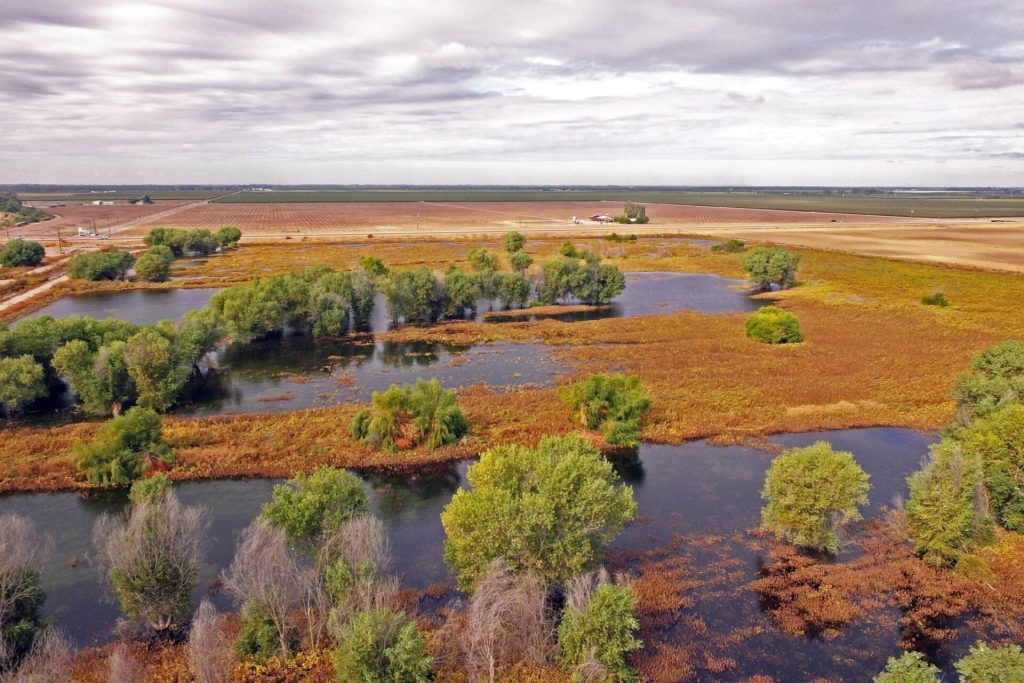
- The Johnson Slough Drainage Project in the Kaweah subbasin repurposes 25 acres of walnuts near the Kaweah Oaks Preserve in Tulare County to a recharge basin with habitat that accommodates waterfowl access. It could provide up to 750 acre feet of recharge during wet years and provides flood management benefits to the nearby town of Farmersville.
- A project in the Madera subbasin will remove 37 acres of pistachios and replace it with 34 acres of drought-resistant agave production coupled with a three-acre reservoir. It will save 83 acre-feet annually, an 83% reduction in groundwater use.
With an estimated 900,000 acres set to be retired in the San Joaquin Valley alone, MLRP projects are becoming an attractive option to take a bit of the sting out of shrinking the farming footprint.
“Whatever you do, don’t ask me to give up more water.” — Farmer Jason Morehead, who has pulled out more than half of his acreage because of groundwater restrictions.
Trading Walnuts for Water Recharge
Tulare County grower Elijah Greidanus is submitting an MLRP proposal in the Tule subbasin, where pumpers need to reduce overdraft by an estimated 115,000 acre-feet. Greidanus’ project would remove 300 acres of walnuts next to the Tule River, and replace them with a recharge basin to capture flood flows from the river and via a turnout on the Friant-Kern Canal.
“If we have another 2023, this basin could recharge up to 22,000 acre-feet,” Greidanus said. “That’s a lot of water for farmers. We might use it, someone else might use it. At the end of day, our goal is that this project is a cost effective way of having more water in the ground to farm with.”
Between removing and chipping the trees, and the earth work required to build berms and levees, the project could reach $2 million.
While Greidanus does not yet know if the project will be selected as part of the Tule subbasin’s portfolio of MLRP projects, it’s important to be poised to pull the trigger.
“Getting our application in with a shovel-ready project is important so we have the opportunity to make it happen when more funding is available,” he said. “California is providing some money to help with those impacts and our project would really help out a lot of farmers.”
Goals Include Habitat Restoration and Flood Control
While MLRP represents a small piece of the significant funding required for compliance with the SGMA, it is identifying projects that, if successful, could be replicated across subbasins to achieve broader goals such as habitat restoration, flood control and community access to recreation, said Allison Tristao, Resource Coordinator for Pixley and Lower Tule River Irrigation districts in the Tule subbasin in southern Tulare County. Pixley ID is administering the Tule subbasin’s $10 million in MLRP funds.
“My advice for anyone interested in participating is to reach out so we can discuss the different project options to determine what best suits their operation,” she said.
The Tule Basin Land and Water Conservation Trust is one of 13 MLRP partners in the Tule subbasin. It is administering $1.7 million of a $10 million MLRP grant and has two flagship projects, the Capinero Creek Restoration, which transitioned a former dairy site into native habitat, and the Tule Trust Fallowing program, which paid farmers to retire less desirable land.
At an October meeting of the Tule Trust ag advisory committee, farmers said they need help as soon as possible. In that basin alone, nearly 70,000 acres are expected to be retired.
Farmer Jason Morehead, who has pulled out more than half of his acreage, said: “Whatever you do, don’t ask me to give up more water.”
Grower Myron Schotanus, whose land is totally dependent on surface water, enrolled a portion in the fallowing program for one year.
In total, the program enrolled 1,100 acres, saving 830 acre-feet, a drop in the bucket compared to the estimated 115,000 acre-feet of water that needs to stop being pumped.
The program expired and Schotanus said he needs more options as soon as possible.
“I need to get the bank off my back,” he said.
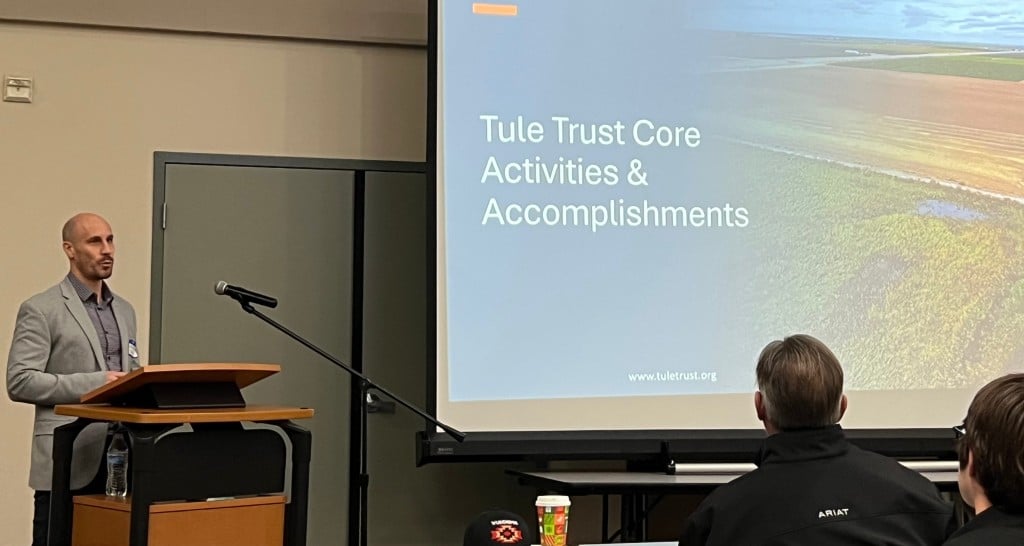
Land without a purpose is something to be avoided, said Tule trust executive director Nick Reed-Krase at the Nov. 20 “State of the Basin” conference in Tulare.
“We don’t want idled lands not being managed in any way,” Reed-Krase said.
The same sentiment rings true in the Madera subbasin, where money can’t flow quickly enough, said Jeannie Habben, Deputy Director of Water and Natural Resources for Madera County. Madera is one of eight statewide block grantees. Interest from landowners was swift, with 72 pre-applications, followed by 28 completed project applications during Madera’s submission period this summer.
“Landowners are really looking for something to assist them in this new time of SGMA,” Habben said. “We had 28 complete an in-depth application that was like writing a grant. You just don’t get that kind of response. This is not like other state programs where you’re pulling teeth to get participation.”
Six Projects Chosen in Madera County
In Madera County, the six projects selected will transition about 238 acres from mostly almonds and citrus to a wide variety of new uses, from a multi-benefit stormwater management project with public access and recreational opportunities to a tribal/cultural space for Indigenous community needs. Another will create a buffer zone between agricultural operations and residential areas while providing groundwater recharge. Together, an estimated 600 acre-feet of water will remain in the aquifer.
Habben said MLRP is still a relatively new program and requires patience.
“The only challenge is that it is new,” she said. “We’re all walking through it at the same time. We kick things back and forth, it’s like creating something as you go.”
Each block grant recipient has a regional team that helps develop and implement projects.
“One of the biggest challenges is managing the diverse group of partners involved,” Tristao said. “Keeping everyone aligned and moving in the same direction can be quite demanding.”
Tristao said she anticipates more funding will become available, especially for additional projects in the Tule subbasin.
“The extent of MLRP’s impact and its ability to make a significant difference will largely depend on future funding,” she said.
Habben said she tells growers to “stay tuned.”
Department of Conservation spokesperson Janice Mackey said she anticipates a new grant solicitation in mid-2026.
About the Reporter
SJV Water Reporter Lisa McEwen grew up in Tulare County. She has reported on agriculture and other issues for a wide variety of publications, including, Ag Alert, Visalia Times-Delta, the Fresno Bee and the Tulare and Kings counties farm bureau publications.
About SJV Water
SJV Water is an independent, nonprofit news site covering water in the San Joaquin Valley, www.sjvwater.org. Email us at sjvwater@sjvwater.org