
|
Getting your Trinity Audio player ready...
|
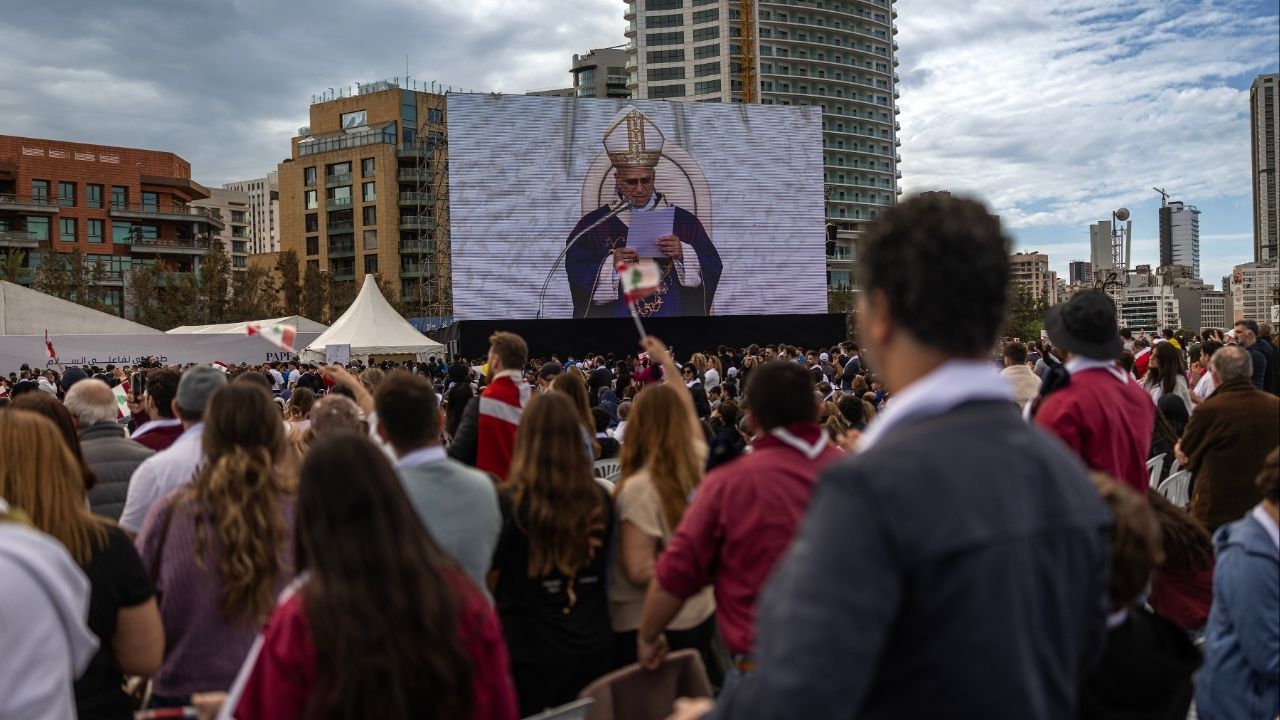
BEIRUT — Thousands of people gathered Tuesday near Beirut’s destroyed port where Pope Leo XIV celebrated a waterfront Mass. It was an extraordinary end to his first international trip as head of the Roman Catholic Church, which he used to deliver a message of peace to a tumultuous region.
From the outset, the day was laden with symbolism.
The pope began with a visit to patients and staff at a psychiatric hospital on the outskirts of Beirut, the Lebanese capital. He then offered a silent prayer near the site of the Beirut port explosion of 2020, where hundreds were killed and thousands injured when some 2,750 tons of military-grade ammonium nitrate combusted.

The pope also met with families of those killed in the explosion, many of them still waiting for officials to be held accountable.
Leo then presided over a Mass at the waterfront, where the Mediterranean stretches before the city and mountains rise behind it. Thousands of people — families with children, government officials from various religions, and U.N. peacekeepers — began arriving as early as dawn, many on foot because roads to the area had been closed.
The Mass capped the pope’s six-day visit, which began in Turkey and ended in Lebanon, the nation with the largest proportion of Christians in the Middle East. When it was over, his plane headed back to Rome.
Throughout the trip, Leo spoke of peace, urged support for youth and promoted interfaith dialogue. His appeals resonated deeply in a country and region with profound political, social and economic upheaval.
Many Lebanese said his presence offered a rare moment of unity and reassurance in their fractured and war-scarred nation, where Israeli strikes frequently interrupt a fragile truce that ended a war between Israel and the Iran-backed militant group Hezbollah a year ago. The Lebanese are haunted by constant fears of a renewed war.
“From the minute he got off the plane, I felt deeply that the savior is here,” said Joelle Korom, 42, who walked by the explosion site at the port to attend Mass with her three children. “With this visit, we hope that peace will prevail, that we will all be united and that there will be better days ahead.”
The pope arrived in a Lebanon very different from the one that greeted the last pope who visited, in 2012.
An economic collapse began in 2019 and was worsened by pandemic lockdowns. It has gutted the currency, shuttered businesses and wiped out savings. Public fury over corruption followed, leading to huge anti-government protests.
Then came the 2020 port explosion.
The blast erupted from a large quantity of unsecured ammonium nitrate that had been stored at the port since 2013. No one has been held accountable for the accident, which, for many Lebanese, laid bare what they saw as decades of official negligence and corruption.
“With the visit of Pope Leo, now we know that the Vatican sees us and he feels our pain,” said Tatiana Hasrouty, who lost her father in the blast. He worked at the port.
Beginning in late 2023, a war between Israel and Hezbollah flattened markets and villages in south Lebanon, crippling infrastructure and displacing more than 1 million civilians, according to the Lebanese government.
Hezbollah was severely weakened as its leaders were assassinated and its ally in neighboring Syria, the dictator Bashar Assad, was ousted.
Lebanon’s new president and prime minister, chosen in January, face the task of rebuilding and restoring basic services even as the country comes under near-daily Israeli strikes.
The pope arrived amid all of this turmoil, seeking to show support for the Lebanese people.
For three days, he was greeted with ululations, whistles and chants of his name. Across Beirut and neighboring towns, spectators waved Lebanese and Vatican flags and gathered beneath billboards bearing his image alongside the message “Blessed are the peacemakers.” He spoke in English, French and some Arabic and listened to messages from young people, political leaders and figures from religions and sects representing Lebanon’s diverse mix.
“This visit is important because the Vatican historically has been one of the leading protectors of Lebanese national unity,” said Karim Émile Bitar, a professor of international relations at Saint Joseph University of Beirut who attended the Mass. “This visit is symbolic because it takes place at a time when the existential angst of most Lebanese is at an all-time high.”
The visit drew criticism from some Lebanese, but it was mostly aimed at their own officials. They questioned how roads could be so rapidly repaved and security so swiftly tightened for his arrival when similar efforts are rarely made for ordinary citizens.
“We have been suffering and demanding this for years,” said Miguel Wakim, 32, a trader in Beirut. “But unfortunately, we have grown used to this from our government.”
Others hoped his visit would offer a balm to a nation battered by cycles of violence and hardship.
“The world has forgotten us,” said Paula Chedid, 45, who attended the Mass with her husband, son and his friend. “But hopefully this trip can bring peace and change.”
—
This article originally appeared in The New York Times.
By Abdi Latif Dahir/Diego Ibarra Sanchez
c. 2025 The New York Times Company