

|
Getting your Trinity Audio player ready...
|
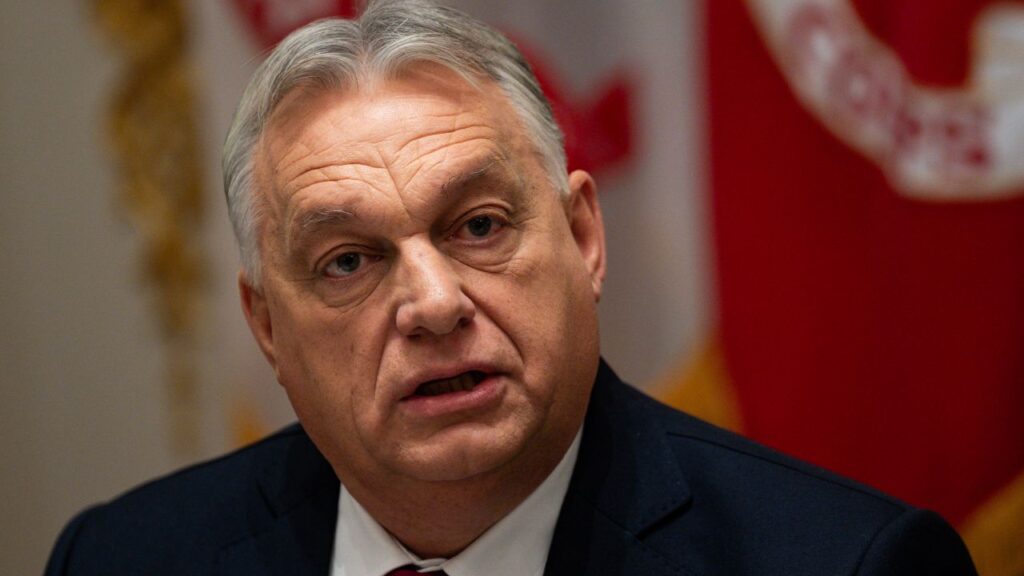
BUDAPEST, Hungary — When Vice President JD Vance visited Hungary this past week, he spoke at and praised Mathias Corvinus Collegium, an educational institution set up to create a new conservative elite in step with the Russia-friendly and MAGA-aligned views of Prime Minister Viktor Orban.
Vance’s laudatory remarks on Wednesday about the 10-year-old college, known as MCC, as a bastion of free thinking and common sense, however, stuck in the craw of Zalan Alkonyi, one of its researchers focused on Russia.
The college, Alkonyi said in an interview at his book-filled home in Budapest, has many serious scholars, but it puts pressure on them to speak and publish in support of the government’s line.

The chair of the college’s board of trustees is Balazs Orban, who is not related to the prime minister but does serve as his political director.
“For years I had to practice severe self-censorship on Russia and the Russian policy of the Hungarian government,” said Alkonyi, 28.
He recounted feeling pressure to support, or at least not contradict, Orban’s view that Ukraine, not Russia, was the main threat to European security and that the European Union had been foolish in helping Kyiv resist Russian attack.
Orban Has Been in Power for 16 Years
With Hungary about to hold a general election that could end Orban’s 16 years in power — an outcome that neither Washington nor Moscow wants — Alkonyi is among a growing list of defectors from institutions that the governing Fidesz party for years counted as loyal allies.
The latest of these was Viktor Norman Virag, a former senior member of the National Bureau of Investigation, who on Wednesday told Partizan, an opposition media outlet, that 80% of his work involved “meeting political expectations,” which in one case meant dropping a case against a Russian suspected of being a cybercriminal.
Others who have broken ranks with the government include Szilveszter Palinkas, a captain in the military who was featured on recruiting posters and attended a military academy in Britain at the same time as Orban’s son, Gaspar.
Another defector was Zombor Berezvai, who recently quit as chief economist at the Hungarian Competition Authority, a state institution under the control of the government. Explaining his departure, he told Partizan that he had been prevented from investigating businesses tied to Fidesz.
Their decisions to abandon ship came as Fidesz slumped in the polls behind Tisza, an upstart opposition party led by Peter Magyar, himself a former Orban loyalist who split with the governing party in 2024.
Are the Polls Right?
The polls could well be wrong, as they were in the United States in 2016, but the mere prospect of change has loosened bonds that were based less on ideological affinity with Orban than on dependence on Fidesz-controlled institutions for steady work and career advancement.
Alkonyi, who joined MCC in 2022 after a stint working for Hungary’s Foreign Ministry, said the college has only a “tiny minority of true believers” but many who, after four thumping Fidesz election victories in a row, believed that Orban was here to stay so kept quiet.
“I considered myself a right-winger, too, but I’m not sure anymore,” he said. “I have a crisis of identity like the whole country.”
“I decided to speak up about Russian interference,” he added, “because this is not a distant issue happening in Moldova or Georgia but in my own country.”
Deciding that Fidesz’s rule might not be eternal after all, he put a Tisza banner on the balcony of his apartment overlooking a busy Budapest avenue last month. Shortly after that, he posted a message on Facebook denouncing “Russian intervention in the Hungarian elections” that he said was “unprecedented in the European Union in its methods and sophistication.”
That directly contradicted the government’s line — reinforced by Vance in public statements during his visit to Hungary — that the only significant interference in the election has come from “bureaucrats” at the headquarters of the European Union in Brussels, and from President Volodymyr Zelenskyy of Ukraine.
Alkonyi then posted a video contending that MCC employees were pressured to distribute government propaganda.
He took vacation time before making the posts and is not due back at work at MCC until after the election. He said he expected to be reprimanded or fired, but had so far heard nothing from his superiors at MCC.
Colleagues, he added, had contacted him to voice private support.
As part of its election program, the opposition Tisza party has promised to claw back assets — primarily shares in a big state oil company — given to MCC by the Fidesz government. The party says it will “end the practice of using public funds to build political networks.”
MCC did not reply to requests for comment.
Defection Carries a Heavy Price
Defection often carries a heavy price, said Gabor Ivanyi, 74, a Methodist pastor who christened the two eldest children of Orban and counted him as an ally in the struggle against Hungary’s communist government in the 1980s, when both shared a commitment to a liberal, European future for their country.
Since parting ways two decades ago with Orban, who was angered by the pastor’s open criticism of Fidesz’s nationalist turn in the 2000s, Ivanyi has been targeted in a series of media smear campaigns. His church has been hit with tax investigations and police raids against a homeless shelter and a school for special-needs children that it runs in Budapest.
A February article published in Hungarian and English on a website registered just a few days earlier accused the pastor of abusing five children who attended schools run by his church. But that article, according to disinformation experts, was the work of Russian dirty tricks, not Fidesz. It was later deleted.
The article also falsely claimed that the opposition leader, Magyar, had called Ivanyi his “spiritual leader,” and that three former students attempted suicide.
“I don’t think the Russians care about me or even know who I am, but behind Fidesz are lots of dirty Russian games,” he said. “I’m not even running in this election, but they have a big problem with me because I say they are criminals.”
This article originally appeared in The New York Times.
By Andrew Higgins and Lili Rutai/Tierney L. Cross
c.2026 The New York Times Company