

|
Getting your Trinity Audio player ready...
|
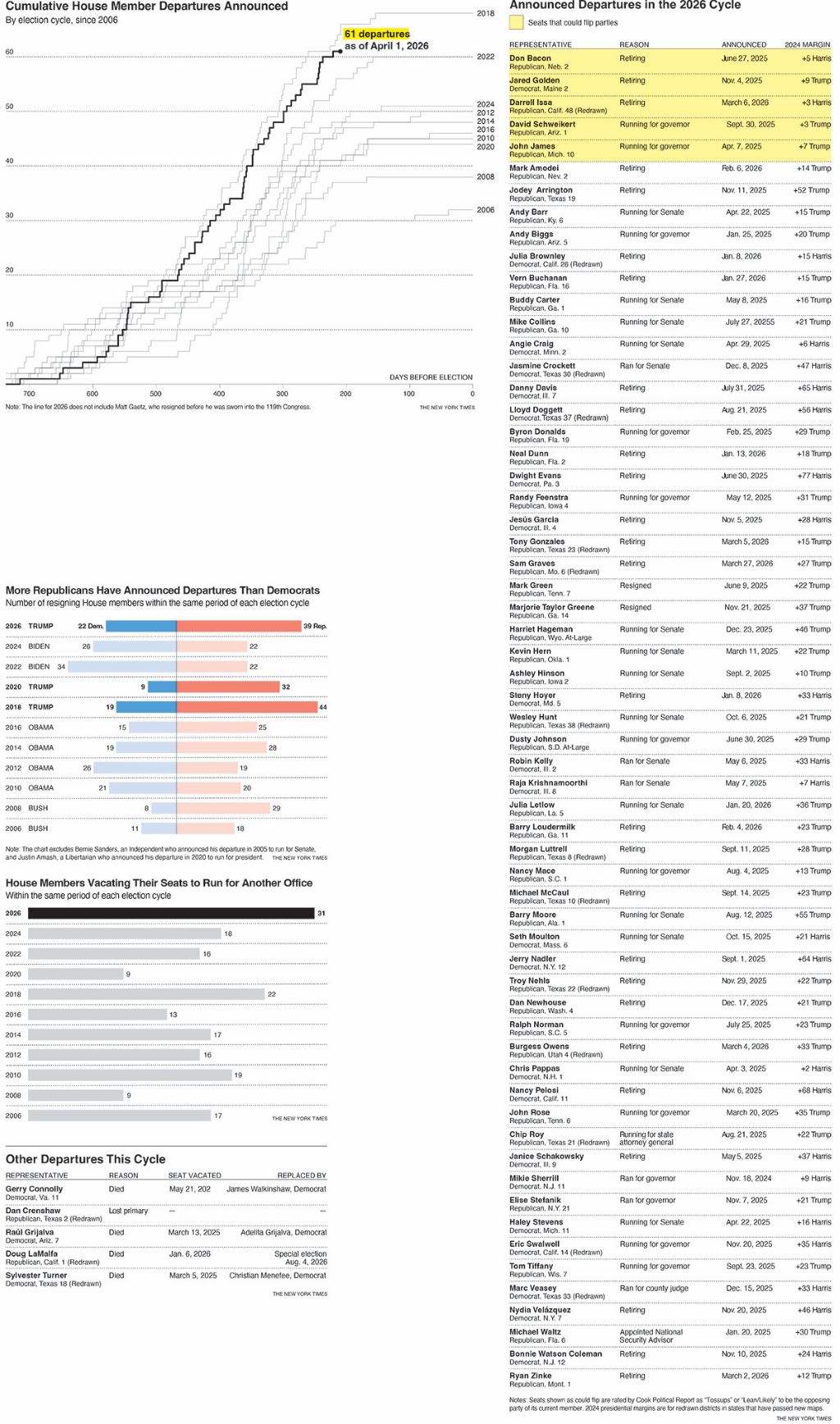
As the midterm election cycle gets underway, lawmakers are departing the House of Representatives in droves — propelled by age, political calculations, and sheer frustration with the dysfunction and paralysis of the institution.
The number of Republicans departing the House this cycle is one of the highest since 1930, according to Brookings Vital Statistics on Congress. This cycle’s Republican departures are surpassed only by 2018, the midterm election year during President Donald Trump’s first term when his party was also bracing for big losses. (The GOP lost 40 House seats, and the majority, that year.)
Such a high rate of turnover in the majority party typically reflects incumbents preferring to leave Congress rather than risk serving in the minority. More than 30 Democrats departed the House during the 2022 midterm election cycle, in which Republicans won the majority.

Over the last year, GOP resignations have reflected the challenge of remaining unified amid intraparty fissures and constant pressure from Trump to fall in line on every issue. When she announced her abrupt resignation in the middle of her term in December, Rep. Majorie Taylor Greene likened serving in Congress to being a “battered wife” and said Americans were right not to trust their government.
Several members from both parties are seeking Senate or governor’s seats that offer longer terms and an escape from the burdens of governing from one of the slimmest majorities in modern congressional history.
Departures Not Expected to Affect the Balance of Power
While November’s midterm elections may be some of the tightest in several cycles, few departures so far are expected to significantly alter the balance of power in the House.
Each party has so far gained just one opportunity to flip a seat in a district won by the other party’s presidential candidate. Republicans have a strong chance of picking up the seat being vacated by Rep. Jared Golden, D-Maine, who repeatedly managed to win in a Trump-friendly district. And Democrats have an opportunity to flip the seat being vacated by Rep. Don Bacon, R-Neb., who represents an Omaha-centered district that has increasingly trended toward Democrats.
An aggressive redistricting arms race instigated by Republicans and matched by Democrats has also reshaped the political map. In Texas, Rep. Lloyd Doggett, a Democrat, opted for retirement after his district was combined with that of a fellow Democrat, Rep. Greg Casar. In California, Rep. Darrell Issa, a Republican, is ending his 12-term career rather than run in a newly drawn district likely to favor a Democrat.
Generation Changes Pave Way for New Leadership
The turnover lays the groundwork for generational change that some Democrats have resisted for years. Former Speaker Nancy Pelosi, D-Calif., and her longtime No. 2 in leadership, Rep. Steny H. Hoyer, D-Md., both octogenarians, each announced their retirements after decades in the House.
Republicans are also poised to lose a wave of senior lawmakers who lead key panels, including Reps. Jodey Arrington of Texas, the Budget Committee chair; Sam Graves of Missouri, the chair of the Transportation and Infrastructure Committee; and Mark Amodei, who heads the subcommittee that oversees Homeland Security spending. Their exits mean a loss of institutional knowledge but will also open the door for younger members to ascend.
(Irineo Cabreros contributed reporting.)
This article originally appeared in The New York Times.
By Ashley Wu and Robert Jimison/Kenny Holston
c.2026 The New York Times Company