
|
Getting your Trinity Audio player ready...
|
As Americans pumped gas into their cars Monday, pennies were getting pumped right out of their pockets. A lot of pennies.
As the Iran conflict entered its fifth week, gas prices had increased about 35% since Feb. 28, with the national average hitting $4.02 per gallon Tuesday. It was the largest increase in decades. The conflict has threatened oil shipments through the Strait of Hormuz, which previously carried a quarter of the world’s seaborne oil.
Motorists in every corner of the country are watching the numbers tick up and — rarely — down. On Monday, New York Times reporters followed along as they made their calculations.

Brooklyn, New York
At a Mobil station on Atlantic Avenue along a popular route to Kennedy International Airport in New York City’s Brooklyn borough, Mohammed Razzak, an Uber driver, paid $70 Monday to top up his Chevrolet Suburban, a purchase that would have cost about $53 earlier this year.
“This is too much,” Razzak, 48, said. “Since the beginning of the war, it’s gone up almost $1 a gallon” — to $3.69, from $2.79.
Uber has offered drivers increased discounts on gas, but Razzak, who has been driving for 14 years, said his bottom line has gotten steadily worse.
“Every week, I’m spending $100 extra,” he said. “It’s not like my fare is going up every day. We are suffering, all the drivers, all the people — not the government. There’s nothing I can do. No choice.”
Orlando, Florida
Many mornings, Penelope Cepeda drives her mother to work and in the afternoon picks up her sister from school. And she commutes to her own job or to college classes.
She drives a relatively fuel-efficient Kia K4, but the skyrocketing gas prices caused by the Iran war — more than a $1 hike per gallon in Florida over the past month — have cut into an already tight budget. Before the increases, Cepeda paid about $35 for a tank of gas. That price is now more than $45. For Cepeda, who earns $12 an hour as in-home caregiver, every penny counts.
“If you’re counting on the dollars that you’re earning by the hour, it’s like, ‘Damn, 80 cents?’” said Cepeda, a student at Valencia College who fills her tank two or three times a month. “That’s money that I’m losing for my car bill. That’s money that I’m losing for my water bill or my phone bill.”
Cepeda, 20, gave up on plans to travel for spring break, but hopes gas prices will stabilize by the summer so she can take a vacation.
“Maybe a cruise. Maybe something cheap. If cruises go up, then maybe we’re just going to stay here.”
Portland, Oregon
Russell Dupuis of Minneapolis had a mountain of luggage and a two-day trip home ahead of him Monday morning. Still, he was smiling at the decision his family of four had made to take Amtrak to a gymnastics meet for his son, Mitchell, 14.
“Flying was just too expensive,” he said. “And driving? Nobody wanted to do that.”
Dupuis and his wife, Mary Dupuis, do enough driving at home between their own lives and their children’s activities — school, gymnastics, hockey, soccer, and time with friends. Gas prices are straining their budget, but Russell Dupuis sees no other choice.
Taking the train to Portland cost the family a little under $950. They also used Uber rather than renting a car in Oregon, a decision that felt especially wise when they saw the price of gas in Portland. In Minnesota, a gallon costs around $3.50. In Oregon, they saw some stations at more than $5 a gallon.
“Can people really afford that here?” Mary Dupuis said.
She’s got more sticker shock ahead. Mitchell Dupuis’ team did well enough to qualify for another tournament later this spring in Texas. Mary Dupuis is planning to drive. How much will that cost in gas?
“My parents are coming, and my dad’s booked everything, so I’m just not going to ask him,” Mary Dupuis said. “I’m scared to know.”
Mission, Texas
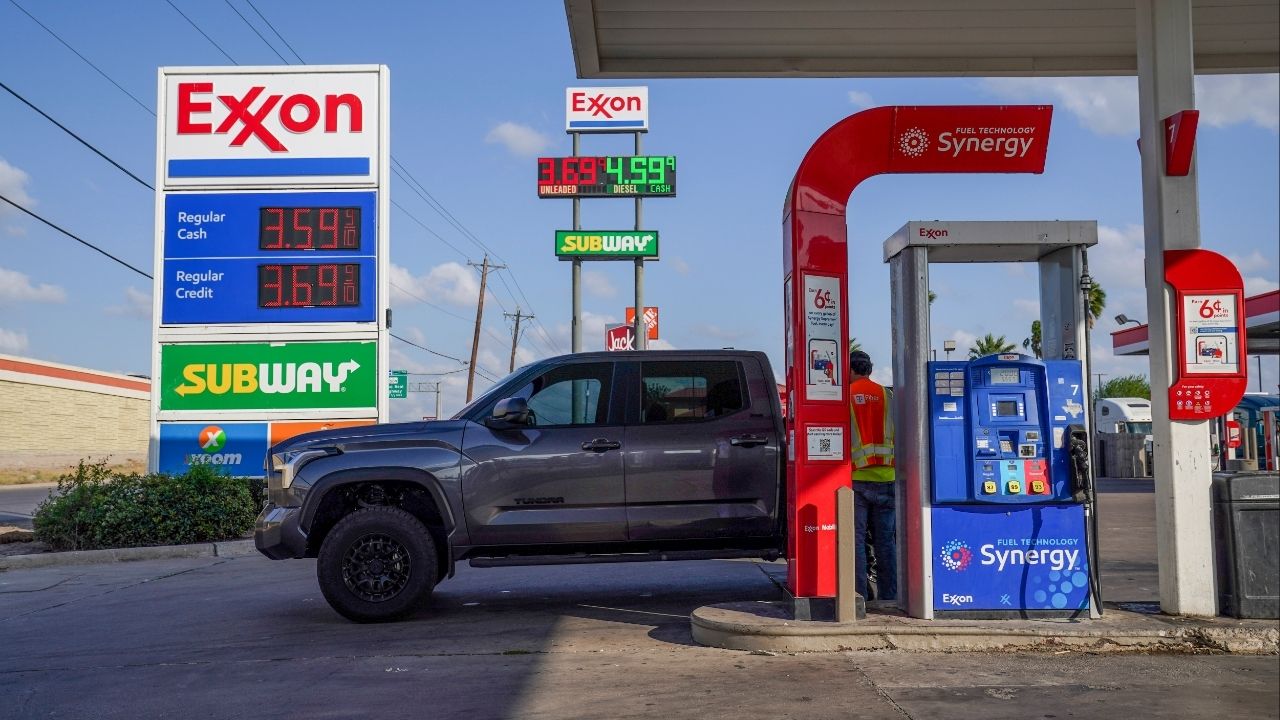
Lucas Agüilera stopped at a gas station in Mission, a border city, and winced as he saw the price at the pump go up, and up, and up.
“It used to take me about $70 to fill my tank and now it takes me about $90,” Agüilera said. A gas-powered generator in his truck bed would have to go unfilled for now. “I don’t know how long we can keep up paying these prices,” he said.
A few feet away, José Hector Martinez took a second peek at the price — $3.35 for unleaded.
“That’s a lot more than I’m used to,” Martinez said in Spanish. He filled the tank for his 1998 Dodge truck for $24 and prayed that it would last all week.
“I would drive and shop for cheaper prices, but I don’t want to waste the gas,” he said.
—
This article originally appeared in The New York Times.
By Audra D. S. Burch, Andy Newman, Edgar Sandoval, Anna Griffin and Pooja Salhotra/Gabriel V. Cárdenas
c. 2026 The New York Times Company