

|
Getting your Trinity Audio player ready...
|
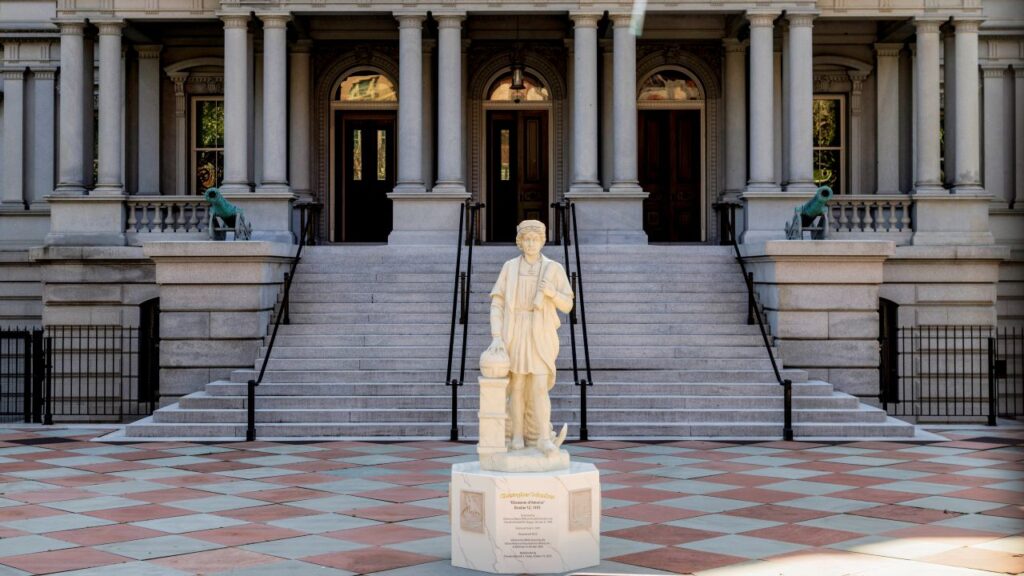
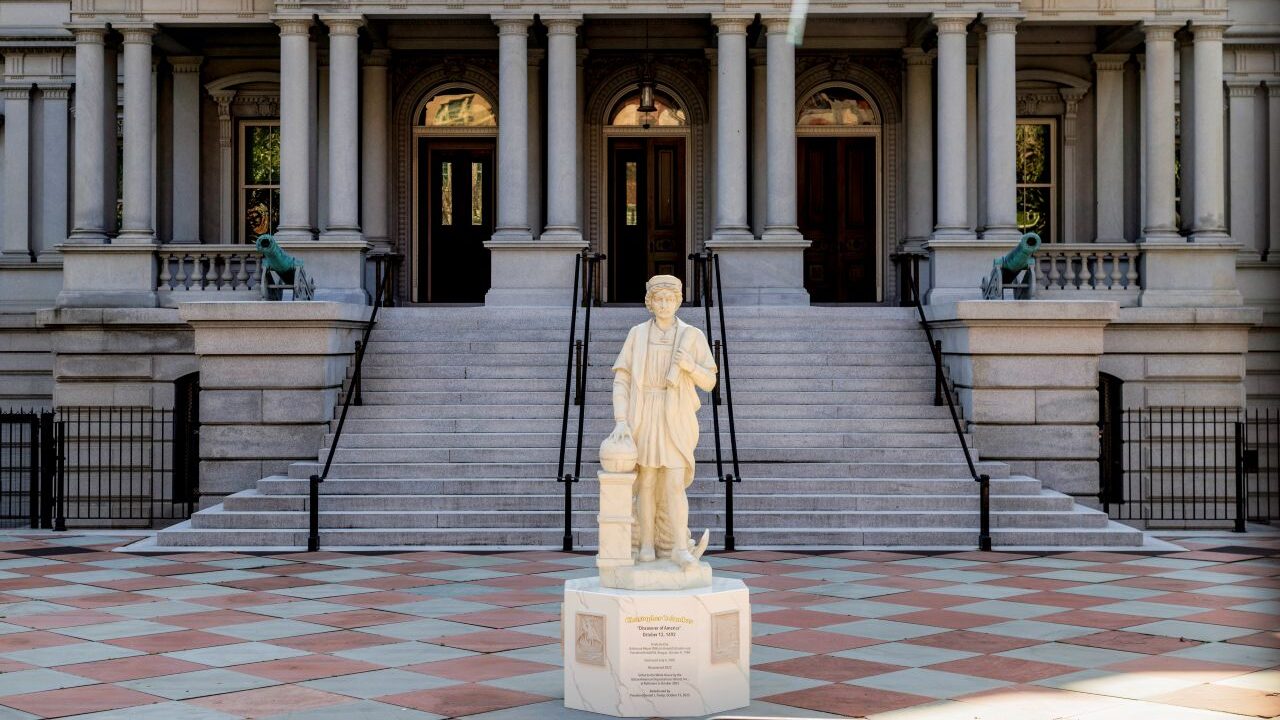
A statue of Christopher Columbus was installed on the grounds of the White House early Sunday, as part of President Donald Trump’s effort to position the explorer as a hero after monuments to him were removed across the country.
The statue is a replica of one that protesters in Baltimore tore down and dumped into the city’s Inner Harbor in the summer of 2020. The statue’s marble pieces were retrieved from the harbor, and a Maryland artist used them to guide the creation of the replica.
The new statue was erected sometime overnight on the north side of the Eisenhower Executive Office Building, facing Pennsylvania Avenue in Washington, which houses offices for White House staff and is next to the West Wing. The statue is behind fencing.

“In this White House, Christopher Columbus is a hero, and President Trump will ensure he’s honored as such for generations to come,” said Davis Ingle, a White House spokesperson, in a statement.
Original Statue Toppled After George Floyd Murder
The toppling of the original statue stemmed from the racial justice protests that erupted after the murder of George Floyd in May 2020. More than 30 statues were dismantled in the span of four months, either torn down by protesters or ordered removed by officials.
Those who have opposed the lionization of Columbus have focused on his role as a slave trader of Indigenous Taíno people; on the brutal campaign of subjugation waged by Spanish colonists; and on the decimation of the Indigenous population, through violence and disease, in the century and a half after his voyages.
The effort to demote Columbus from a place of honor in public spaces has been vigorously opposed by many Italian American groups, who see statues of the Genoese explorer as a symbol of ethnic pride, commemorating a time when their immigrant relatives faced discrimination and persecution.
Many of the monuments celebrating the explorer, including the one that was once in Baltimore, were donated by Italian American groups in the 19th and 20th centuries. President Ronald Reagan spoke at the dedication ceremony for Baltimore’s statue in 1984.
On Independence Day in 2020, protesters pulled down that statue with ropes and threw it into the harbor. Upset by the statue’s destruction, Tilghman Hemsley, a local painter, sculptor and fisherman, assembled a team of divers to retrieve it. His son, Will Hemsley, then used scans of the salvaged pieces to create a replica — a project that received $30,000 from the National Endowment for the Humanities during Trump’s first term.
New Homes for Some Columbus Statues
Since 2020, some of the statues that were dismantled nationwide have found new homes, including in churches, museums and Italian American social clubs. John Pica, a former Maryland state senator who helped oversee the project, said it was difficult to find a new location in Baltimore for the statue because of a fear that the controversy over Columbus’ historical legacy would be reignited. The replica statue — and a second one created as a backup — sat in Tilghman Hemsley’s studio for years.
The potential to add the statue to federal property arose during discussions within the Trump administration about the celebrations for this year’s 250th anniversary of U.S. independence. In a proclamation last year, Trump called Columbus “the original American hero, a giant of Western civilization, and one of the most gallant and visionary men to ever walk the face of the earth.”
“This is Columbus making his comeback from the darkest days that existed five to six years ago,” said Basil Russo, the leader of the Conference of Presidents of Major Italian American Organizations, who brokered the transfer of the statue to the federal government.
Edward Lengel, a former chief historian of the White House Historical Association, said the addition of the statue was part of Trump’s “radical reshaping” of the White House grounds — represented most dramatically by plans to construct a ballroom over the demolished East Wing.
“What this administration is doing,” Lengel said, “is turning it into a partisan battleground.”
This article originally appeared in The New York Times.
By Julia Jacobs/Jason Andrew
c.2026 The New York Times Company