

|
Getting your Trinity Audio player ready...
|
With two proposals to fund road repair in Fresno County cleared to begin collecting signatures, voters will soon see petitions to put the competing half-cent sales tax measures on the November ballot.
In a presentation before the Fresno County Board of Supervisors on Tuesday, former Fresno County Transportation Authority executive director Mike Leonardo said his group has begun printing petitions for the Fix Our Roads initiative.
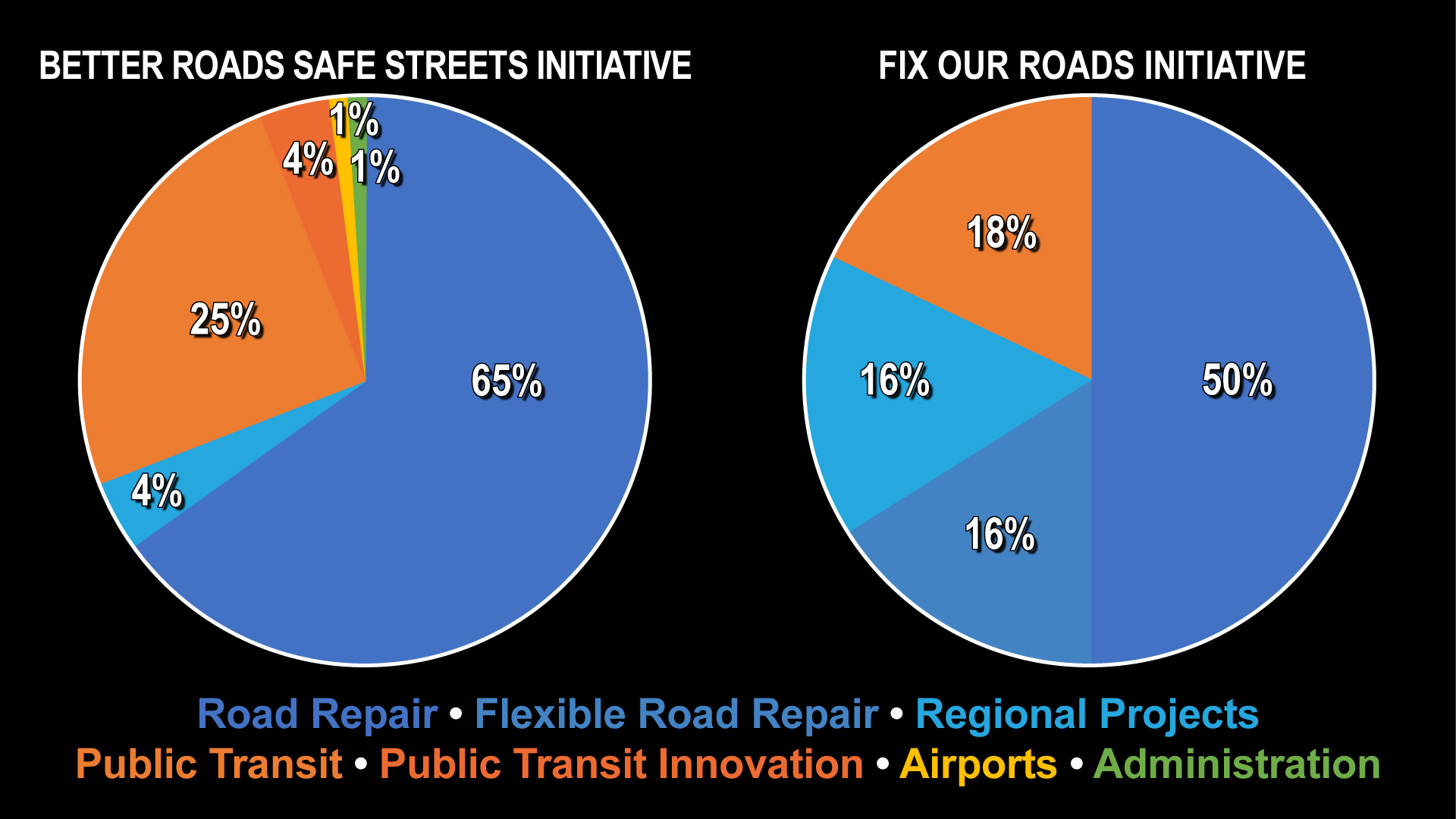
In January, coalition group Moving Fresno Forward was cleared to begin collecting signatures for their 30-year Better Roads, Safer Streets, which allocates 65% of funds to road repair, 29% to public transit, 4% to regional projects, 1% to the airports, and 1% to administration.

Leonardo said his group’s 20-year plan dedicates more tax money to road repair (82%) while allowing for congestion relief, something that the coalition plan restricts. He also said his group’s plan doesn’t increase spending on public transit (18%), which has not increased ridership despite millions of dollars more being dedicated to the service.
He said three public opinion polls indicate that Fresno County residents want their roads fixed more than they want public transit.
“The results of those polls were very consistent — basically, ‘fix roads, fix roads, fix roads.’ And when you’re done with that, reduce congestion, eliminate bottlenecks, improve safety,” Leonardo said. “And as you get down the list, it started to talk about transit with the primary focus on keeping transit fares low for seniors.”
The Challenges of Reaching the Ballot, Winning Approval
Fresno County Clerk/Registrar of Voters James Kus said both measures will realistically need to meet the larger, 33,000-signature minimum as the time needed to do a total review has passed. The deadline for approval by the Board of Supervisors is Aug. 7, making the efforts a “challenge,” Kus said.
“You cannot qualify if I have to do a full count,” Kus told the Clovis City Council on Monday.
Qualifying a proposal for the ballot via signature petitions will be expensive, somewhere between $600,000 and $660,000. Multiple people involved in signature gathering tell GV Wire that the current price is $18 to $20 per signature.
That price reflects the fact that as many as a dozen state initiatives could be on the November ballot.
Passage of a transportation tax requires 50%-plus-one approval by voters. If both proposals qualify for the ballot, the one with the highest percentage above the voter-approval threshold would go into effect.
Cities Making Their Choices on Which Plan They Prefer
As the Moving Fresno Forward coalition plan makes its rounds with voters, it has at the same time gone through various city councils. Mendota, Parlier, and Huron city councils approved resolutions backing the measure earlier in March.
“The Fresno County Transportation Improvement Act will help bring critical investment to repair local streets and improve safety for children and pedestrians in our community,” said Mendota Mayor Victor Martinez. “That’s why the city of Mendota and our city council are proud to support this effort — because our residents deserve safer streets and a stronger transportation future.”
A week later, Fresno Unified trustees similarly backed the plan, saying requirements for safe routes to schools and public transit help students access education.
On Monday, the Clovis City Council chose the coalition plan over Leonardo’s plan.
Clovis Mayor Vong Mouanoutoua said the coalition plan went before thousands of people and allows cities to build complete streets, with sidewalks and bike lanes if they choose. He also said the coalition plan doesn’t require a funding match to build new trails.
Of the 82% for road repair in Leonardo’s plan, 50% can only be used on roads. Money for sidewalks has to come out of a 16% “flexible” fund.
“Clovis likes complete streets. We like our trails, we don’t want to be restricted by that,” Mouanoutoua said.
Fresno County Supervisor Garry Bredefeld said Moving Fresno Forward has an open invite to present before supervisors.
In response to the invite, a spokesperson with the coalition told GV Wire they look forward to presenting “to ensure they have an accurate and factual understanding of the Better Roads, Safe Streets plan.”
Restrictions Versus Flexibility
Leonardo took a different tone, saying his group’s plan gives cities more local control through flexible funding that doesn’t require bike lanes or trails when they want to do major fixes or widening.
The coalition plan requires bike lanes or sidewalks to be added when certain road repairs occur. The coalition plan also requires jurisdictions to add trails and safe routes to schools, placing minimums on Fresno, Clovis, and the county, along with smaller jurisdictions.
“Sixty-five percent is not just for fixing roads. It has requirements for bikes and trails,” Leonardo said.
It authorizes the Fresno Council of Governments to stop funding to cities that don’t comply, Fresno County Supervisor Buddy Mendes said.
Leonardo’s plan also provides money for regional projects such as a long-desired improved overpass at Shaw Avenue and Highway 99, something the city of Fresno has put on the back burner considering its high cost.
Of the 82%, a 16% pool goes to regional projects such as the overpass, widening of Jensen Avenue, improved access to Interstate 5, and a list of other projects that span multiple jurisdictions.
But those at the coalition have said the measure shouldn’t pay for those kinds of regional projects. Funding for those projects in the coalition plan is capped at 4%.
The 20-year Fix Our Roads plan raises $3.9 billion versus Moving Fresno Forward’s 30-year $7.3 billion.
Given the fast technological development in the transportation sector, Leonardo said funding needs to change rapidly.
“Projecting out 20 years is hard enough, let alone 30 years,” he said.
Clovis Council, Supervisors Take Different Tones on Transit
Clovis councilmembers Matthew Basgall and Drew Bessinger said at the Monday meeting they favor the increased transit money from the coalition plan. For Clovis, the increase would result in about $4 million annually compared to just under $2 million annually with Leonardo’s plan — which nearly meets the current funding level, said Andy Haussler, Clovis city manager.
Leonardo’s plan calls for consolidation of the three agencies — Clovis Roundup, Fresno Area Express, and the Fresno County Rural Transit Agency — something Bessinger and Mouanoutoua opposed.
Leonardo said at the county meeting that consolidation would reduce redundant spending and improve coordination.
Public transit comprises about 2% of all Fresno County trips, and advocates of Leonardo’s plan point out that increasing transit funding hasn’t resulted in more ridership.
Clovis Mayor Pro Tem Diane Pearce, the lone Clovis councilmember backing Leonardo’s plan, said the flexible 16% allocation allows the city to bridge funding gaps.
“The flexible pot of local money … would enable the city of Clovis to make up any shortfall to our transit, but it also doesn’t force the entire county to be subsidizing other public transit that hasn’t seen the rebounding in ridership,” Pearce said.