
|
Getting your Trinity Audio player ready...
|
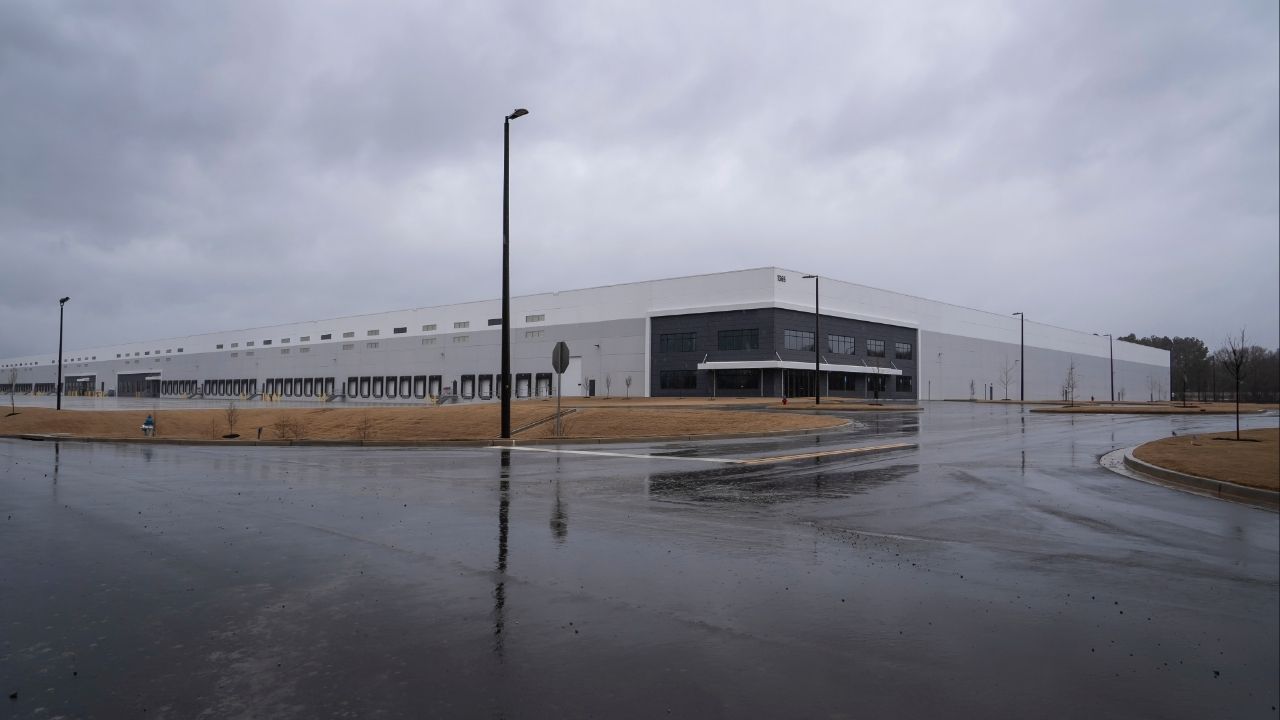
The Department of Homeland Security wants to turn an industrial warehouse in Social Circle, Georgia, into an ICE detention “mega center.”
At more than 1 million square feet, it would be larger than any single jail or prison building in America. Twelve football fields could fit inside.
A test floor plan of the site that DHS provided to local officials is unlikely to be the final design, but it shows how the warehouse could be turned into an Immigration and Customs Enforcement detention facility.

Retrofitting a Structure Made for Another Purpose
DHS is scrambling to add detention space to support President Donald Trump’s mass deportation agenda. A spokesperson said the Social Circle facility was vetted to assess community impact and that the conversion would meet ICE detention standards.
But experts in architecture, prison design and detention say it will be difficult to retrofit a warehouse as a place where 8,500 people can live safely and humanely.
The floor plan shows that most of the space will be used to house detainees, with about a third used for administrative purposes. That includes intake, offices, medical rooms and cafeterias. ICE policy requires that detainees be allowed to meet privately with their lawyers, but there is no dedicated space for this in the plan.
The layout shows only a first floor, which could hold about 5,000 people across 80 pods. Small recreation areas could provide detainees access for at least one hour each day, as required.
Experts consulted by The New York Times were particularly concerned about safety and sanitation in such a large space.
“This volume of people needs a huge amount of ventilation,” said Raphael Sperry, an architect who has researched ethical design in prisons for decades. He added that warehouses are not designed for high occupancy.
To prevent the spread of disease, at least some interior walls should be solid, experts said. DHS used chain-link fences as walls inside some recently built tent facilities where outbreaks of measles and COVID have occurred.
The floor plan shows only a single path for the 8,500 detainees and hundreds of staff to evacuate in an emergency such as a fire. While the warehouse has at least 30 more doors that the floor plan does not appear to account for, even those may not be enough for egress.
The documents DHS gave to the city offer little information about the implementation of ventilation, plumbing or electrical systems.
DHS did not respond to detailed questions from the Times. The agency told local officials that construction would take 60 to 75 days and that detainees could be housed in Social Circle as early as mid-May.
A City’s Population Would More Than Double
Local officials and residents have voiced concerns about the detention center’s proximity to an elementary school and to many people’s homes. The area voted overwhelmingly for Trump in 2024, but many residents oppose the facility. It would more than double the local population.
Eric Taylor, the city manager, has repeatedly said that Social Circle does not have the water or sewer infrastructure to support the facility.
“The federal government is pushing this through without any input from local government and with seemingly little regard for what it means for our community,” Taylor said.
—
SOURCES: ICE 2025 National Detention Standards; Bryan C. Lee Jr., a fellow of the American Institute of Architects and the president of the National Association of Minority Architects; Michelle Brané, a former immigration detention ombudsman for DHS in the Biden administration; and Claire Trickler-McNulty, a former deputy assistant editor for the Office of Detention Policy and Planning at ICE.
—
This article originally appeared in The New York Times.
By Allison McCann, Helmuth Rosales and Eric Rabinowitz/Nicole Craine
c. 2026 The New York Times Company