
|
Getting your Trinity Audio player ready...
|
The Democratic National Committee sued the Trump administration Tuesday to try to compel the government to say whether it was planning to put armed federal agents or military personnel at polling places or election offices this year.
The lawsuit, filed in federal court in Washington, D.C., says that 11 separate Freedom of Information Act requests filed in October to the Department of Justice, the Department of Homeland Security and the Department of Defense have prompted no meaningful response, a violation of the law.
“To ensure that the American people obtain timely knowledge of potential threats to free and fair elections and to enable the DNC to take appropriate action to ensure voting rights are protected, the DNC now seeks this Court’s aid to enforce” Freedom of Information Act requirements, the lawsuit states.

It is possible that no such records exist within the Trump administration; the lawsuit is simply accusing the agencies of failing to respond to the information requests.
There are no current reported plans for the administration to use armed agents or troops in the upcoming elections. U.S. federal law bans military personnel or other “armed” agents from being “at any place where a general or special election is held.”
But fears that the Trump administration might disregard that law have percolated for months among Democrats and voting rights groups, who point to the president’s publicly stated desires to “nationalize” elections and his stated regret over not having seized voting machines in the 2020 election. Other actions taken by the administration, including a raid in late January by the FBI at a local election warehouse in Fulton County, Georgia, have only heightened those concerns.
Democrats Focus on ICE Tactics
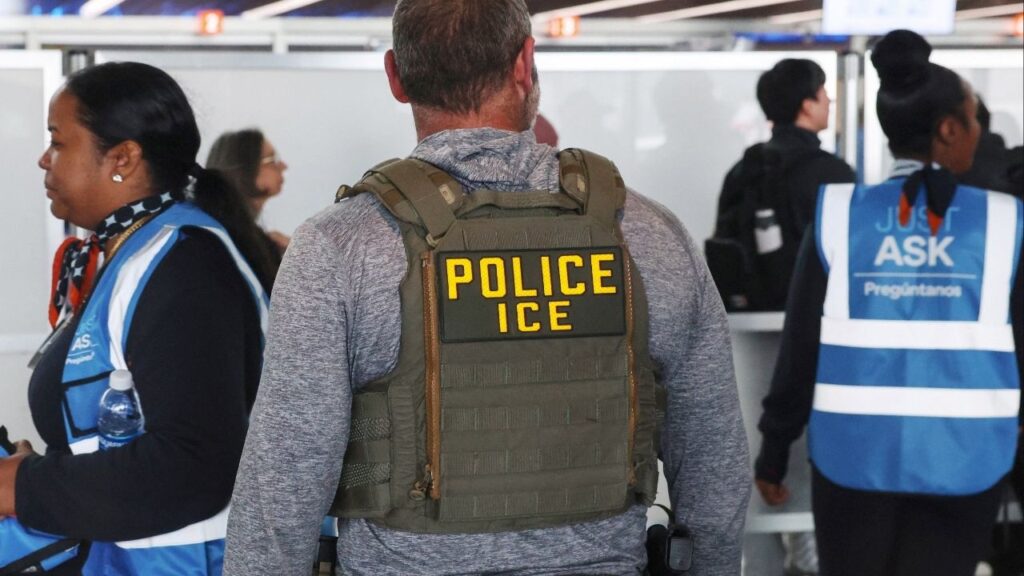
Democrats are also still seething over the heavy-handed tactics of Immigrations and Customs Enforcement agents in Democrat-controlled cities, including Minneapolis, where federal agents killed two U.S. citizens in separate shootings in January.
Representatives for the three agencies did not immediately respond to requests for comment.
Previous public statements from the Trump administration on whether to use armed agents at the polls, while largely dismissive of the possibility, have left enough ambiguity for Democrats to remain on high alert.
“I can’t guarantee that an ICE agent won’t be around a polling location in November; that’s frankly a very silly hypothetical question,” Karoline Leavitt, the White House press secretary, said during a briefing with reporters last month. “But what I can tell you is I haven’t heard the president discuss any formal plans to put ICE outside of polling locations.”
Similarly, during a hearing with senators last week, Kristi Noem, the former secretary of homeland security, said that “there are no plans to have ICE officers at our polling locations.” But she also refused to “rule out” the possibility that armed agents could be involved in elections.
Private conversations between election officials and the administration have been slightly more definitive. “There will be no ICE presence at polling locations for this election,” Heather Honey, the deputy assistant secretary for election integrity at the Department of Homeland Security, told election officials during a virtual meeting late last month, according to three people who were on the call and were granted anonymity to discuss a private meeting.
The Democrats’ lawsuit suggests they are not convinced — and won’t be until they receive more concrete confirmation that no plans or discussions are underway.
—
This article originally appeared in The New York Times.
By Nick Corasaniti/Travis Dove
c. 2026 The New York Times Company