

|
Getting your Trinity Audio player ready...
|
Growing numbers of school districts in the Valley and around California are spending less on classroom teachers than state law requires.
Education Code 41372 requires unified school districts — pre-K through 12 — to devote at least 55% of their budgets to classroom teachers. For high school districts, the requirement is at least 50%; for elementary school districts, at least 60%.
For some districts, the gap between what state law requires them to spend on classrooms and the percentage they spend has continued to widen in recent years.

Districts contend that the law is outdated and does not reflect changes in school finance and staffing since it was first enacted in the 1970s, forcing them to apply for waivers when they fail to hit the threshold.
Perhaps not surprisingly, the head of the state teachers union says districts should be doubling down on classroom spending instead of seeking waivers to reduce it.
“When you invest in educators and you keep them in your schools so they don’t leave for other districts where they’re paying more, you are investing in the students of your community,” said David Goldberg, president of the California Teachers Association.
Union Seeks State Probe
The CTA fired a warning shot in January when it sent a letter to Tony Thurmond, the state superintendent of public instruction; Attorney General Rob Bonta, and State Controller Malia Cohen asking for an “immediate” investigation and fiscal audit of the Sacramento County Office of Education for its “systematic approval of unjustified classroom spending waivers.”
The letter highlights the Twin Rivers Unified School District, which according to the CTA has an unrestricted reserve fund of more than $79.6 million, a special reserve fund of $93.5 million, and — unlike many California school districts — is gaining enrollment.
Sacramento County is only one of many counties that routinely signs off on classroom spending waivers, Goldberg said, calling it a “dereliction of duty.”
Districts are opting to funnel money into administrative salaries and building up overly deep reserves instead of channeling resources to classroom workers as required by state law, Goldberg said.
“Oftentimes it’s mismanagement. Oftentimes, frankly, it’s bloated bureaucratic structures, and it’s huge reserves,” he said. “If you show me the data is saying it’s because they’ve got all these new therapists and nurses and counselors, that’s the story. But the research I’ve seen and the data I’ve seen does not point to that at all being the case.”
More Waivers, Bigger Gaps
According to a March 27, 2025 fiscal report by School Services of California, Inc., nearly 60% of California elementary school districts and nearly 30% of unified school districts did not meet their spending thresholds in 2023-24.
“The intent of the law, ensuring strong investment in classroom instruction, remains important. However, the way the law measures that investment does not fully reflect how schools operate today.” — Dr. Michele Cantwell-Copher, Fresno County Superintendent of Schools
The statistics cited in the 2025 report show a steady increase among elementary, high school, and unified districts not meeting the minimum classroom spending percentage over the decade. The report contends that some costs of education are excluded from the formula that determines the percentage of spending on classroom teachers.
“The numerator ignores all the other costs necessary to educate children, including the costs of counseling and support services, intervention materials, textbooks, and keeping the lights on,” said the report. School Services of California is a business, financial, management, and advocacy resource for the state’s educational agencies.
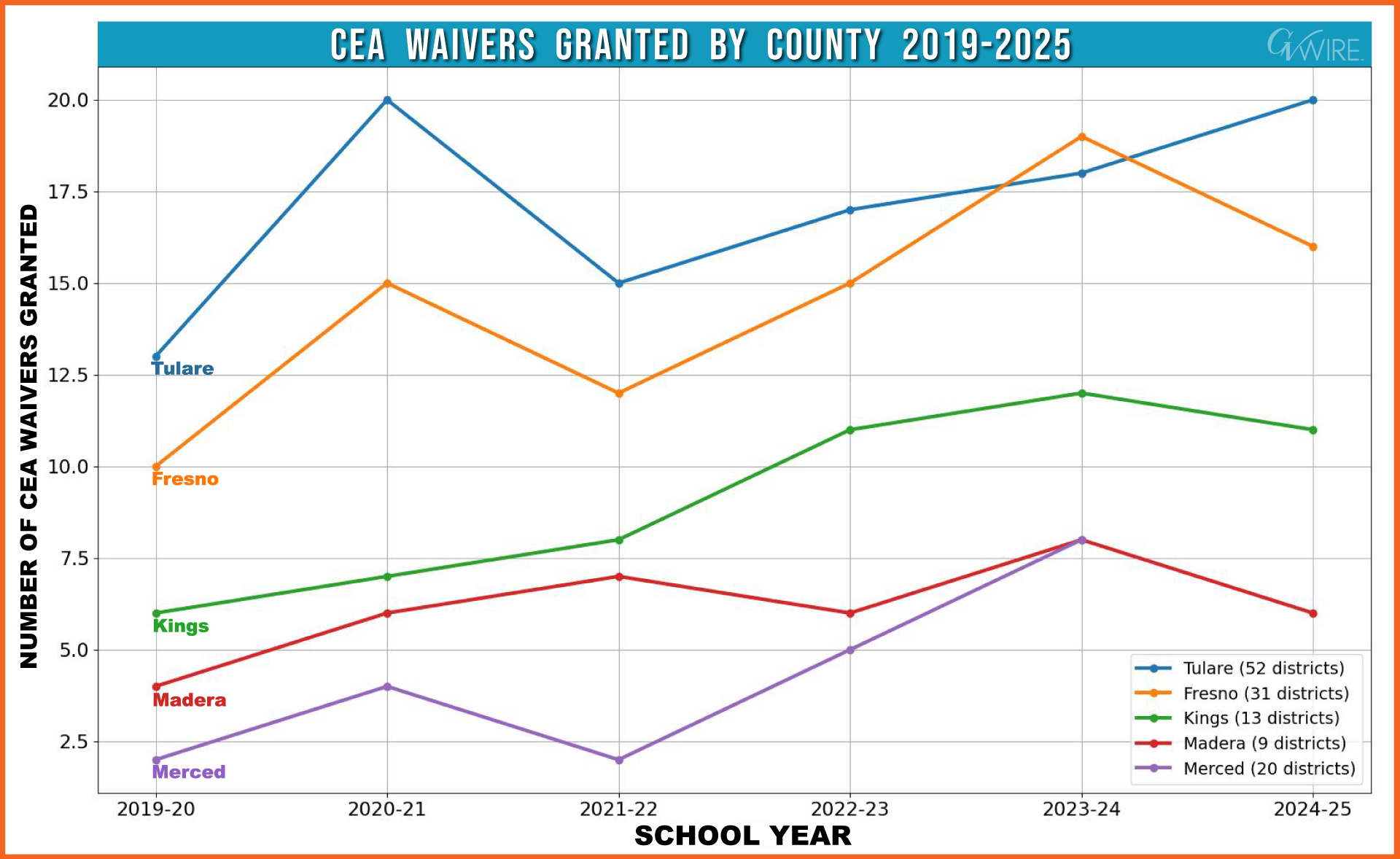
Over the past six years, the number of waivers granted to Valley school districts has continued to climb. In Kings County, for example, all 13 school districts have been granted at least one waiver over that period, and some districts like Hanford, Lakeside, and Lemoore elementary districts have gotten waivers six years in a row.
Reef Sunset Unified also has gotten waivers for the past six years, including in 2023-24 and 24-25 when the Avenal-based district missed its 55% classroom spending minimum by 14 percentage points.
In Tulare County, 31 of the county’s 52 school districts have gotten waivers in at least one of the past six years. Five districts got waivers all six years.
In Fresno County, 20 of the county’s 31 school districts have gotten at least one waiver over the past six years. Orange Center Elementary District’s gap widened from year to year. The tiny district, located on South Cherry Avenue south of Fresno, is supposed to devote 60% of its budget to classroom teachers. But according to its waiver applications, it budgeted 55% in 2019-20, 51% in 20-21, 55% in 21-22, 43% in 22-23, 38% in 23-24, and 41% in 24-25.
In Madera County, eight of the nine districts got waivers at least once over the past six years, and three got waivers all six years.
Reasons for Waivers
Districts can seek exemptions to the minimum classroom spending ratio for several reasons: overly high salaries, financial hardship, and small class sizes. The majority of waivers in the Valley went to districts that claimed their classroom teacher salaries were in excess of comparable districts.
If districts do not seek and receive waivers, the amount that they underspend on classroom teachers is supposed to be added to the following year’s budget in the classroom teachers category.
Goldberg said it’s incomprehensible to him that districts, when compared against each other, can all claim the same thing — excessive teacher salaries.
“What was that show on NPR?” he said, referring to the mythical Lake Wobegon where all the children were said to be above average. ”It’s just crazy. That’s just like a race to the bottom, is what that is.”
County schools superintendents in the Valley told GV Wire that they are following the law when granting the waivers but say that it’s past time for legislators to take a look at updating the law.
“The intent of the law, ensuring strong investment in classroom instruction, remains important,” Fresno County Superintendent of Schools Dr. Michele Cantwell-Copher told GV Wire in an email. “However, the way the law measures that investment does not fully reflect how schools operate today. Education has evolved significantly since the law was adopted in the 1970s, and there is an opportunity for thoughtful updates so the policy aligns with current funding structures and student support models.”
When asked if it was a “red flag” for her office when district spending on classroom teachers is significantly lower than the state-required threshold, Cantwell-Copher said her office is responsible for ensuring compliance with the law and reviewing waiver requests. The responsibility for how money is spent is up to the school districts, she said, adding that the need for a waiver can “result from a range of factors, including enrollment changes, one-time costs, or expanded student services.”
Tricia Protzman, Madera County schools superintendent, said in an email that school finance has undergone many changes since the law was first enacted in 1978 and updated in 2002, “including the implementation of local control funding formula (LCFF) and Local Control Accountability Plan (LCAP) which significantly changed the funding structure for LEAs” such as school districts.
Three of the nine Madera County districts sought waivers based on hardship, not comparable teacher pay, and all three had the biggest gap in missing the spending threshold. For example, Bass Lake Elementary spent 49.7% in 2023-24 instead of the 60% required by law.
That year the district wrote in its waiver application, “Small elementary school districts are at great disadvantage in meeting the requirements of EC 41372. Not only are the expenditure percentage requirements higher for an elementary district (60%), but with the advent of the Local Control Accountability Plan (LCAP) and the mandated state priorities that are required to be addressed in the document, the meaning of EC 41372 has become even more problematic. Not all of the priorities established by the state are based on classroom instruction, thus many of the services and priorities required to be included in the LCAP do not count toward meeting this education code requirement, which does not move the district closer to meeting EC 41372.”
Districts with Small Enrollments Exempt
Eight of Merced County’s 20 districts sought waivers for the 2023-24 school year, including Delhi Unified, which missed its 55% threshold by nearly 10 percentage points that year and got a waiver based on the teacher salary comparison. Two even smaller districts, El Nido and Merced River elementary school districts, got waivers because their class sizes dipped under 28.
Delhi would have qualified for a waiver based on small class sizes, Superintendent Dr. Steve M. Tietjen said in an email. “This kind of dynamic comes into play many times as a district deals with enrollment decline and the greater impact on the school district. Many times, it is a multiple year process to re-orient a district‘s financial well-being when enrollments fall.”
Tietjen said he agrees that it’s time for legislators to take another look at the law.
“Our current system of comparing districts of like size and fiscal makeup seems to be an exercise in 20th century thinking. In answer to your question, yes, the state should take another look at this regulation and bring it into the 21st century.”
But Goldberg. the state teachers’ union chief, said watering down the law won’t incentivize districts to rein in administrative salaries and reserves allocations.
“I don’t think that that would make sense to move away from this (minimum spending law) … In essence we’d be green-lighting districts to further disinvest in students and in educators.”
GV Wire reached out to the current and former chairs of the Assembly Education Committee and Thurmond, the state superintendent of public instruction, seeking comment but did not receive responses.