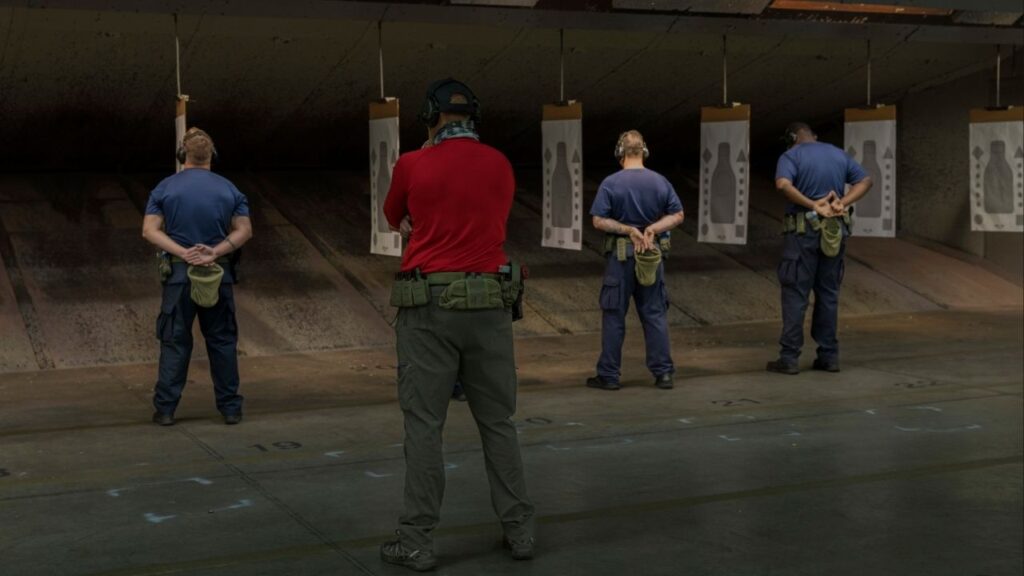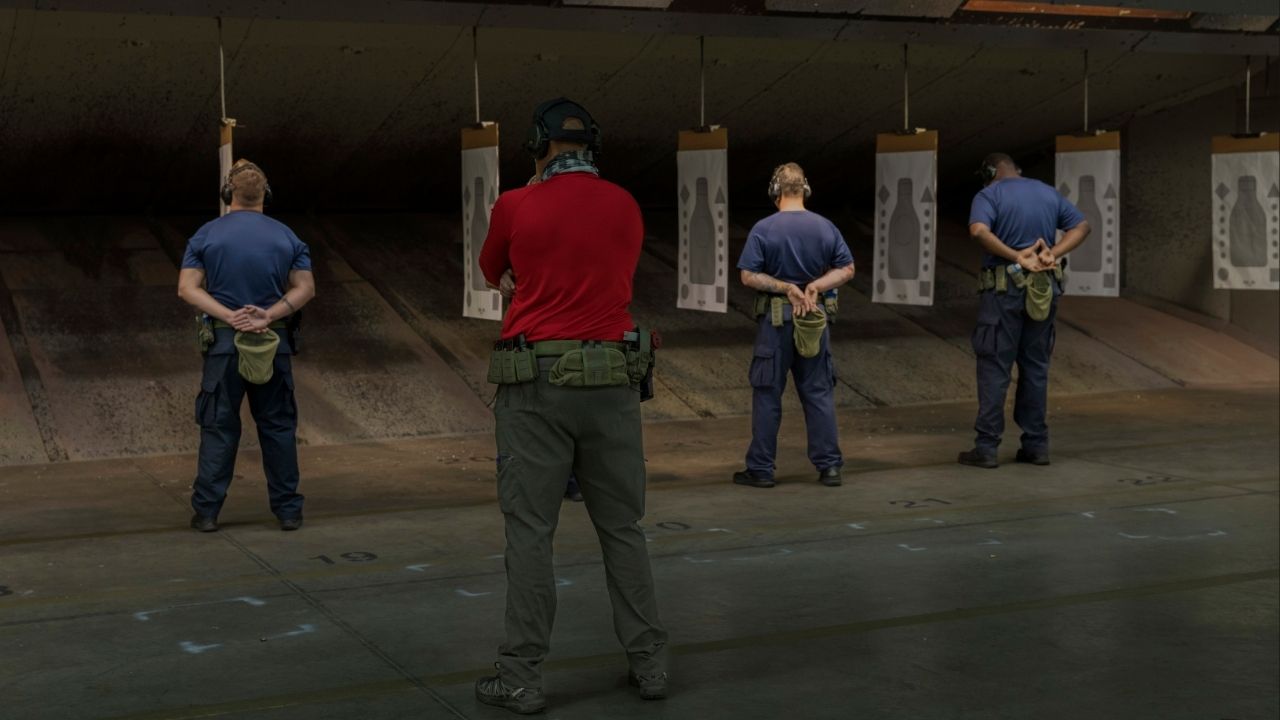
Immigration and Customs Enforcement recruits train with firearms at a training center at the Federal Law Enforcement Training Center in Glynco, Ga., Aug. 21, 2025. An Immigration and Customs Enforcement official who resigned this month from his job instructing new recruits plans to speak out on Monday, Feb. 23, as a whistle-blower, describing what he says is a “deficient, defective and broken” training program with a pared-back curriculum as the Trump administration races to expand the agency. (Audra Melton/The New York Times)

Share
|
Getting your Trinity Audio player ready...
|
WASHINGTON — An Immigration and Customs Enforcement official who resigned this month from his job instructing new recruits plans to speak out Monday as a whistleblower, describing what he says is a “deficient, defective and broken” training program with a pared-back curriculum as the Trump administration races to expand the agency.
The account by Ryan Schwank, a former ICE lawyer who worked at the federal government’s law enforcement training academy, coincides with Senate Democrats’ releasing several dozen pages of internal ICE records that they say demonstrate how the Trump administration has curtailed the agency’s basic training.
Some of the previously unreported documents indicate that ICE officers are now training for significantly fewer hours than they did before President Donald Trump’s hiring surge. Others suggest that several training classes appear to have been cut from the required syllabus, including one titled “Use of Force Simulation Training” and others on immigration law and ICE’s legal authorities.
Together, the new disclosures underscore concerns about the conduct and preparedness of Homeland Security Department agents, who have shot and killed at least three American citizens over the past year. Trump’s decision to order immigration officers into major American cities has led to a rise in violent encounters with members of the public, leading to fears that poor training for new agents will produce more chaos.
“Without reform, ICE will graduate thousands of new officers who do not know their constitutional duty, do not know the limits of their authority and do not have the training to recognize an unlawful order,” Schwank said in prepared remarks that he plans to deliver Monday alongside congressional Democrats in Washington.
Lauren Bis, a spokesperson for the department, said in a statement that training hours had not been reduced, adding, “Our officers receive extensive firearm training, are taught de-escalation tactics, and receive Fourth and Fifth Amendment comprehensive instruction.”
Schwank was hired as an ICE lawyer in 2021 and became an instructor last year at the federal government’s law enforcement training academy in Georgia, where he taught courses on the law. He resigned Feb. 13 after he and another publicly unidentified person submitted a confidential whistleblower complaint on a separate matter: a new ICE policy allowing deportation officers to enter homes and arrest people without a judicial warrant that has raised constitutional questions.
His account comes at a time when funding for the Homeland Security Department has lapsed as Democrats push for a range of new restrictions on immigration agents.
After a planned infusion of $75 billion over four years from Trump’s signature domestic policy bill, ICE has embarked on a massive hiring spree. So far, the agency said it has hired over 12,000 new officers and agents, more than double the existing number. Between October and late January, more than 800 ICE recruits graduated from the academy, according to the documents, which were released by Democrats on the Senate Committee on Homeland Security and Governmental Affairs. Another 3,204 recruits are projected to graduate by the end of September.
But the surge of recruits threatened to overwhelm the Federal Law Enforcement Training Centers, which train most federal agents. In response, ICE officials scaled back the agency’s training regimen, a shift reflected in the newly disclosed documents.
The disclosures include syllabuses containing required courses and daily schedules for ICE basic training. A July 2025 syllabus shows recruits at that time received 584 hours of training over 72 days. A syllabus from this month, however, shows training reduced to eight hours per day over 42 days, which amounts to about 336 hours. That would be a roughly 40% decrease in training hours.
Todd Lyons, ICE’s acting director, told Congress this month that ICE recruits were now training for “six days a week, 12 hours a day.” He also said agents were receiving new training both before they reported to the training academy and once they showed up for their jobs.
“The meat of the training was never removed,” Lyons added after being pressed about whether ICE was lowering its standards.
In a fact sheet, the Homeland Security Department said that it had received an additional $750 million in funding for the training academy and that it had “streamlined training to cut redundancy and incorporate technology advancements, without sacrificing basic subject matter content.” The department also noted that many new ICE recruits are “experienced law enforcement officers who have already successfully completed a law enforcement academy.”
Administration officials had previously said the reduction in training time came largely from the elimination of Spanish-language classes. However, the documents show that a number of other classes listed as being required last year no longer appear in the February syllabus. They include courses on handling the property of detainees, filling out paperwork that alleges someone is in the United States without authorization, taking a “victim-centered approach” and “integrity awareness training.”
In a statement, Sen. Richard Blumenthal, D-Conn., encouraged other whistleblowers to speak out.
“To anyone else who is repulsed by what you’re seeing or what authorities are asking you to do, please know that you can make a real difference by coming forward,” Blumenthal said.
—
This article originally appeared in The New York Times.
By Nicholas Nehamas and Hamed Aleaziz/Audra Melton
c. 2026 The New York Times Company
RELATED TOPICS:
Categories



Dollar Weakens as US Tariffs Struck Down, Iran Tensions Rise

The European Union Hits Pause on Its US Trade Deal