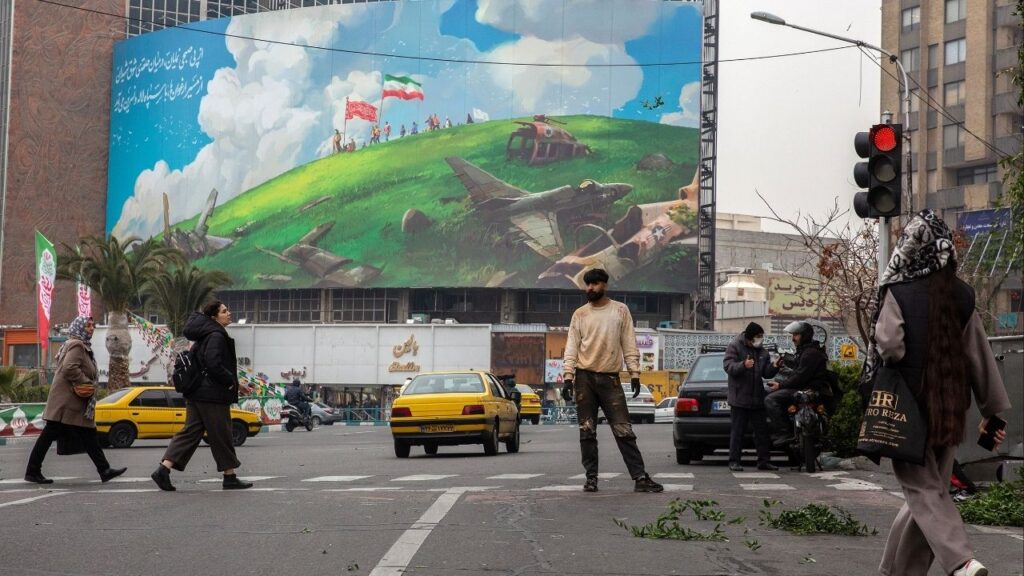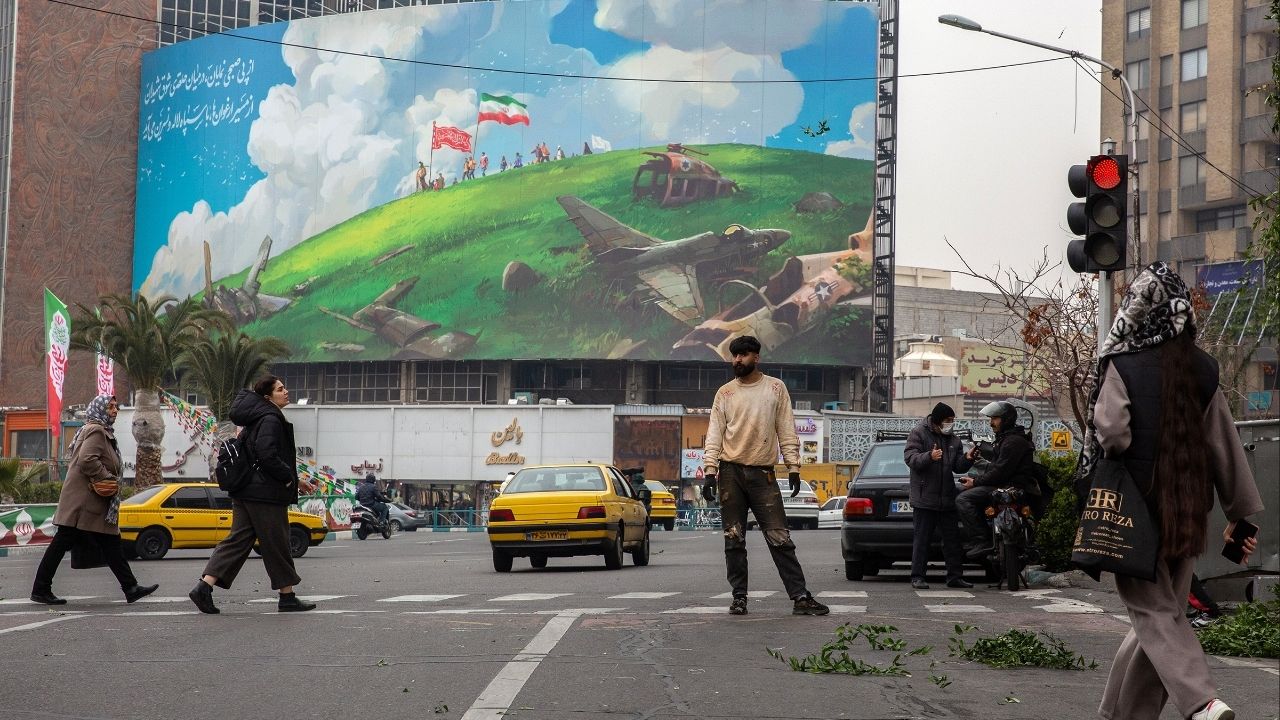
People cross the Valiasr Square, where there’s a new billboard showing American fighter jets being destroyed, in Tehran, Iran, on Feb. 7, 2026. Security officials are monitoring increasingly worrisome signs as President Trump considers another military campaign against Iran. (Arash Khamooshi/The New York Times)

Share
|
Getting your Trinity Audio player ready...
|
WASHINGTON — U.S. and other Western security officials say they are monitoring increasingly worrisome signs that Iran could direct proxies to conduct retaliatory terrorist attacks against American targets in Europe and the Middle East if President Donald Trump orders large-scale strikes against Iran.
The officials, speaking on the condition of anonymity to discuss confidential intelligence assessments, say they have not yet detected any specific plots in the works. But they say heightened “chatter” — spy jargon for electronic intercepts of terrorists’ communications — indicates some level of attack planning and coordination.
Threats abound. There is concern among intelligence and counterterrorism officials that Tehran could enlist the Houthis in Yemen to resume attacks on Western shipping in the Red Sea. There is also concern in Europe that Hezbollah sleeper cells or even al-Qaida or its affiliates could be ordered to attack American bases or embassies. One senior U.S. official said that government analysts were tracking “a lot” of activity and planning but that it was unclear what could trigger an attack.
“Iran can work through proxies to conduct terrorist attacks that will raise costs for any U.S. military campaign,” said Colin P. Clarke, the executive director of the Soufan Center, an intelligence and consulting firm in New York.
Uncertainty Complicates War Planning
The uncertainty further complicates the Trump administration’s war planning. The ambiguity around Trump’s as yet unstated goals — options ranging from limited strikes against military targets to toppling Iran’s supreme leader, Ayatollah Ali Khamenei — may lead Iran’s government to see an American-led offensive as an existential threat.
As a result, Iran could escalate the conflict against the United States and Israel in ways it did not during their attacks in June, or after the U.S. military assassinated Gen. Qassem Soleimani, the head of Iran’s Revolutionary Guard, in 2020.
As part of a military buildup in the Middle East in recent weeks, the Pentagon has rushed additional Patriot batteries and other missile defenses to help protect the 30,000 to 40,000 American troops stationed in the region. But a terrorist attack would probably target less well-defended targets.
“If the U.S. military campaign against Iran is existential for the supreme leader and the most senior members of the IRGC, I would fully expect Tehran to order terror attacks abroad, including in Europe,” Clarke said.
A senior Western official said that the United States and its allies in Europe and the Middle East were well aware of the threat of potential “hybrid responses” — including terrorist attacks — and that Western governments were “continuously reviewing” intelligence reports on those threats.
Top Democrat Warns of Risks of Attacking Iran
On Friday, the top Democrat on the Senate Armed Services Committee warned the Trump administration about the risks of attacking Iran in the coming days.
“Military strikes on Iran would risk igniting a wider regional war, endangering American forces across the Middle East and destabilizing global markets in ways that would harm everyday Americans,” Sen. Jack Reed, D-R.I., said in a statement.
“Before any military action is considered, President Trump must come before the American people, explain why any conflict would be necessary, be honest about the risks and costs and present a clear strategy with a defined endgame,” said Reed, a West Point graduate and former officer in the 82nd Airborne Division.
Security specialists also warn that an attack on Iran would be significantly more complex than the military’s operation in Venezuela in January to capture President Nicolás Maduro, and could potentially draw the United States into a protracted conflict.
Although Iran’s proxies in the region — Hamas, Hezbollah, the Houthis and the government of President Bashar Assad in Syria — have been battered or ousted in the past year, what remains still poses a significant potential threat to Americans and American interests, particularly in the Middle East, U.S. and Western officials say.
The heightened risks from Iran and its proxies come at a time when U.S. and Western military and counterterrorism officials are already on edge over rumblings in the past several months about the possibility of a mass-casualty attack carried out by al-Qaida in Europe.
Al-Qaida is looking to stage an attack to remain relevant and attract followers, according to Western intelligence analysts. “Al-Qaida’s ambition for external operations remained high and may be increasing,” a United Nations Security Council counterterrorism assessment concluded this month.
—
This article originally appeared in The New York Times.
By Eric Schmitt/Arash Khamooshi
c. 2026 The New York Times Company
RELATED TOPICS:
Categories


Canada Presses OpenAI for Answers on Mass Shooter’s Chatbot Use