
|
Getting your Trinity Audio player ready...
|
NEW YORK — Zohran Mamdani, the 34-year-old mayor of New York City, fueled his rise with a simple message about affordability and the moral imperative of properly taxing the rich.
But Tuesday, Mamdani sent out a conflicting message, floating a property tax increase that would affect middle-class New Yorkers and that threatens to disrupt his alliance with Gov. Kathy Hochul and embolden his detractors in the City Council.
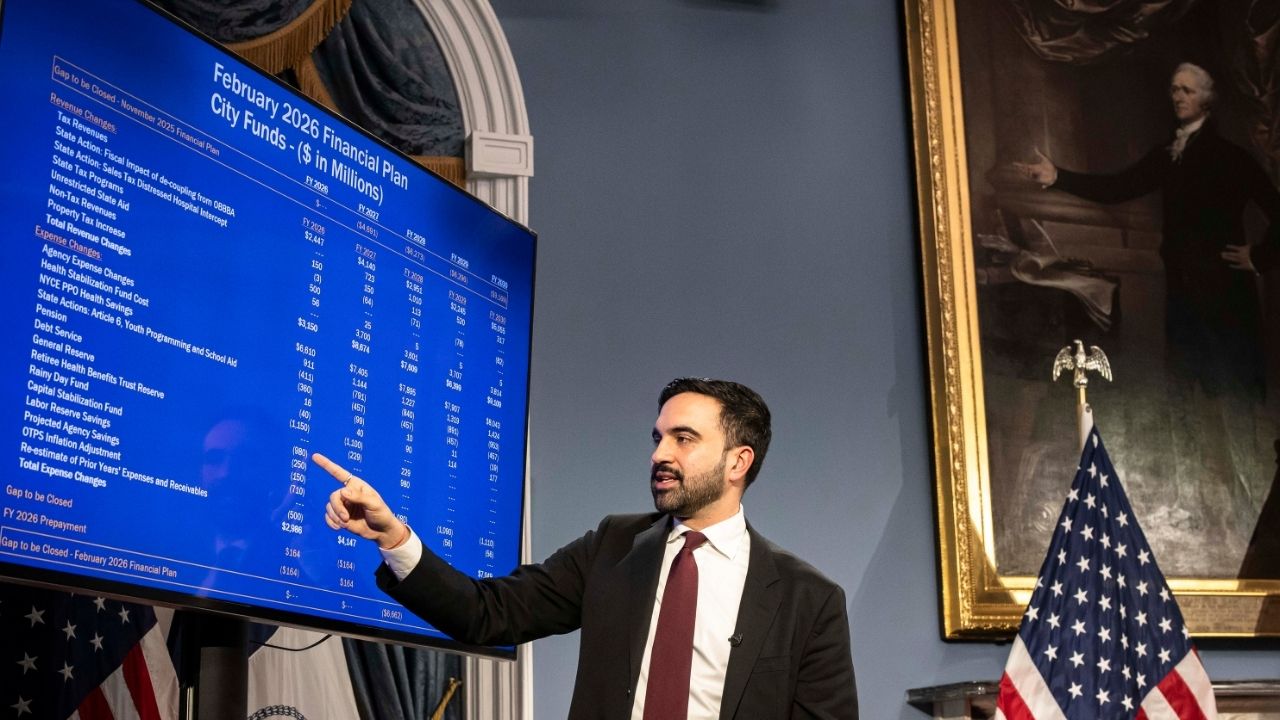
In his $127 billion executive budget proposal, Mamdani had to confront a $5.4 billion budget gap over two years — far smaller than the $12 billion deficit that he announced three weeks ago, but still sizable.

While there are many ways for the city, working with the state, to raise revenue, Mamdani asserted that only two are available to him: raising the city’s property taxes or persuading Hochul to increase taxes on the wealthy.
He made it clear Wednesday that his preference was to increase taxes on the wealthiest New Yorkers and the most profitable corporations, “such that a fiscal crisis is not resolved on the backs of working- and middle-class New Yorkers.”
But neither option seems politically feasible. Hochul has steadfastly refused to raise income taxes, and her resolve is not likely to weaken in a year when she faces reelection. Mamdani also lost leverage when he endorsed her reelection bid this month. And City Council Speaker Julie Menin, who would have to go along with a property tax hike, has indicated she won’t.
So what is the mayor up to? He says he is simply being transparent. But even if he cannot persuade the governor to raise taxes on high earners, he may be able to coax her to embrace a more politically palatable revenue raiser, or to dedicate more state funding to city coffers.
What Is Mamdani Proposing?
Mamdani has warned that if the governor and state Legislature do not institute tax hikes on the wealthy to bring in roughly $4 billion a year, he would have no choice but to lean on one of the few revenue mechanisms the city does control: property taxes.
The mayor is proposing to raise the average citywide property tax rate by 9.5%, to 13.45%, from the current 12.28%. That would amount to higher taxes for more than 3 million homes and more than 100,000 commercial buildings. Utilities such as Con Edison would be hit with higher taxes, too.
The suggested rate increase would amount to a property tax hike of about $700 a year for a typical owner of a one-, two- or three-family home, according to the Citizens Budget Commission, a nonprofit think tank.
Raising property taxes is politically risky for Mamdani and would perpetuate a Byzantine, opaque system that Democrats and Republicans (and Mamdani) have long agreed disproportionately affects middle- and working-class homeowners and indirectly affects renters, since property taxes influence rents. Mamdani characterized the move as a “last resort.”
Property taxes are a significant source of revenue for New York City, providing $35.3 billion this fiscal year and a projected $36.6 billion for the upcoming year. Mamdani projected raising an additional $14.8 billion over four years from his proposed increase.
He made it clear that he would prefer the state to impose a tax hike on individuals earning more than $1 million a year and on major corporations.
Who would pay for a property tax increase?
A property tax increase would be felt across all types of real estate in New York City. These broad-based taxes are considered regressive because of a cap on how much property tax assessments can increase on an annual basis, and a law governing how much each of the four classes of property pays into the total levy.
As a result, tax hikes are often felt more strongly by those whose properties are in middle-income neighborhoods that do not appreciate as quickly in value, compared with homeowners in wealthier neighborhoods.
Who Would Pay for a Millionaires’ Tax Increase?
The mayor’s proposal would affect the top 1% of people in New York state who earn $1 million a year or more.
Mamdani has not made it clear whether the increase would apply to only earnings in excess of $1 million, or the entire income amount.
But for high earners, the increase could be substantial. The mayor has consistently framed his proposal as a 2-percentage-point increase in income taxes on those wealthy New Yorkers, to 5.88% from 3.88%, but that percentage point increase translates to a tax rise of just over 51%.
If the higher tax rate was to apply to the entire income total, someone earning $1 million would be responsible for $58,000 in city taxes instead of $38,000. The mayor acknowledged this when he recently said that “someone earning a million dollars a year can afford to contribute $20,000 more.”
Mamdani has argued that the very wealthy can afford such an increase because they will be paying less in federal taxes, thanks to changes contained in President Donald Trump’s signature tax bill last year, which the mayor projected would save high earners $12 billion collectively.
Why Is the Mayor Doing This?
The executive budget proposal calls for $5 billion in new spending, much of it tied to forces beyond the mayor’s control, including a state class-size mandate and the cost of rental vouchers, which are the subject of litigation. The mayor has also inherited a budget gap now projected at $5.4 billion over the next two years.
He remains committed to trying to make the city more affordable and still believes the best way of doing so is to raise taxes on the wealthy — a goal sacrosanct for his democratic socialist base. He is also disinclined to propose a so-called austerity budget that cuts popular programs, even as he projected $1.7 billion in savings Tuesday.
At the same time, Mamdani appears unwilling to more overtly challenge Hochul. He endorsed her for reelection despite her opposition to his tax proposal; signaled he would skip a rally planned for next week in Albany to persuade her to tax the rich; and thanked her for her budget allocations to New York City during his remarks Tuesday.
Governors are far more powerful than mayors and control large portions of their budgets and legislative agendas. Mamdani’s solid relationship with Hochul helped yield a $1.4 billion, two-year state allocation for child care expansion and another $1.5 billion in aid announced Monday.
Potentially antagonizing a meaningful ally is not the mayor’s only political risk: He is setting himself up for a tough budget negotiation with the City Council, whose members have already begun grousing about the idea of raising property taxes.
Do Either of These Have Any Chance of Actually Happening?
Probably not. Even if the mayor can get Democratic state lawmakers to support a millionaires’ tax, Hochul would have to sign it into law — something she has said repeatedly she has no interest in doing.
Democrats’ ambitions to retake the House in the November midterms also make it a politically challenging time to push new taxes, even those with the support of a majority of New Yorkers.
And while Mamdani has more control over the process of raising property taxes, Mamdani’s governing counterparts in the City Council seem less than enthusiastic about the prospect.
—
This article originally appeared in The New York Times.
By Sally Goldenberg, Dana Rubinstein and Grace Ashford/Dave Sanders
c. 2026 The New York Times Company